Subcommittee advances Senate Bill 32 creating tax credit for donations to pregnancy resource organizations
March 24, 2026 | 2026 Legislative Meetings, South Carolina
This article was created by AI summarizing key points discussed. AI makes mistakes, so for full details and context, please refer to the video of the full meeting. Please report any errors so we can fix them. Report an error »
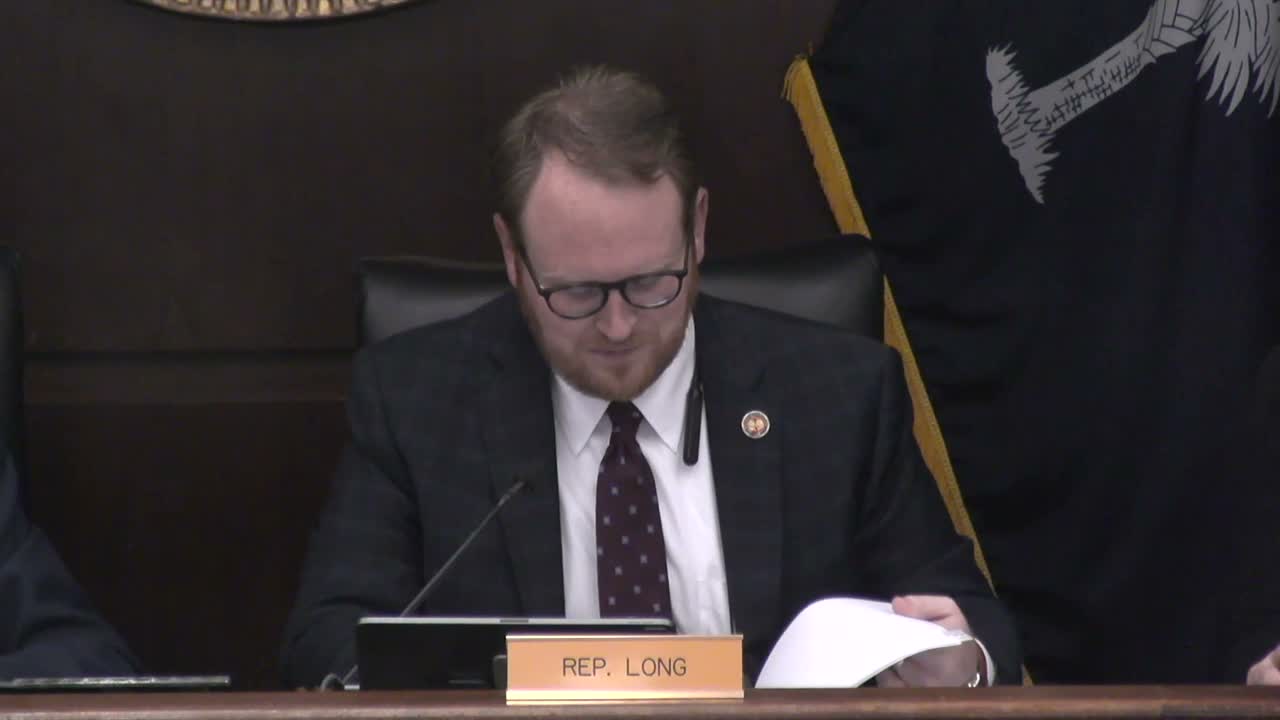
A legislative subcommittee advanced Senate Bill 32, the Pregnancy Resource Act, to the full committee after hearing testimony from nonprofit leaders and a certified public accountant who urged technical clarifications to eligibility and audit requirements.
Staff summarized S 32 as enacting the Pregnancy Resource Act and creating a nonrefundable income tax credit equal to up to 50% of a taxpayer’s total state income tax liability for cash contributions to qualifying pregnancy resource centers, crisis pregnancy centers, maternity homes, or residential programs for human‑trafficking victims, with unused credit carried forward for five years and a limit that administrative expenses paid from program contributions not exceed 20%.
Kathy Leek, state director of Lifeline Children’s Services, said Lifeline provides pregnancy counseling, foster‑care services, adoption assistance and residential programs and urged the subcommittee to clarify eligibility language so the Department of Revenue can implement the credit as intended. "S 32 appropriately recognizes the essential role of pregnancy resource centers who are serving women and children in our state," Leek said, and she asked the committee to strengthen sections 2(a)(i) and 2(a)(ii) to ensure clear, unambiguous criteria.
John Mark Porter, board chair of A Moment of Hope and a CPA, expressed support for the bill but raised technical concerns about the bill’s audit and review language. Porter recommended clarifying whether a financial‑statement audit, a review, or a compliance audit satisfies the bill’s reporting requirements; he also suggested allowing an initial‑year substitution (for example, permitting a Form 990 in year one) for small ministries that may lack the resources to obtain an audit immediately. Porter warned audits can be expensive for organizations with under $250,000 in annual revenue and recommended monitoring implementation to ensure smaller organizations can benefit.
Committee members thanked witnesses for detailed, technical feedback and said staff will consider amendment language. The subcommittee voted by roll call to give S 32 a favorable report to the full committee (four ayes); members indicated they expect technical amendments at the full‑committee stage to address the implementation concerns raised without changing the bill’s substantive purpose.
The bill now moves to the full committee where sponsors said they intend to offer amendment language to clarify eligibility and audit requirements before final action.
Staff summarized S 32 as enacting the Pregnancy Resource Act and creating a nonrefundable income tax credit equal to up to 50% of a taxpayer’s total state income tax liability for cash contributions to qualifying pregnancy resource centers, crisis pregnancy centers, maternity homes, or residential programs for human‑trafficking victims, with unused credit carried forward for five years and a limit that administrative expenses paid from program contributions not exceed 20%.
Kathy Leek, state director of Lifeline Children’s Services, said Lifeline provides pregnancy counseling, foster‑care services, adoption assistance and residential programs and urged the subcommittee to clarify eligibility language so the Department of Revenue can implement the credit as intended. "S 32 appropriately recognizes the essential role of pregnancy resource centers who are serving women and children in our state," Leek said, and she asked the committee to strengthen sections 2(a)(i) and 2(a)(ii) to ensure clear, unambiguous criteria.
John Mark Porter, board chair of A Moment of Hope and a CPA, expressed support for the bill but raised technical concerns about the bill’s audit and review language. Porter recommended clarifying whether a financial‑statement audit, a review, or a compliance audit satisfies the bill’s reporting requirements; he also suggested allowing an initial‑year substitution (for example, permitting a Form 990 in year one) for small ministries that may lack the resources to obtain an audit immediately. Porter warned audits can be expensive for organizations with under $250,000 in annual revenue and recommended monitoring implementation to ensure smaller organizations can benefit.
Committee members thanked witnesses for detailed, technical feedback and said staff will consider amendment language. The subcommittee voted by roll call to give S 32 a favorable report to the full committee (four ayes); members indicated they expect technical amendments at the full‑committee stage to address the implementation concerns raised without changing the bill’s substantive purpose.
The bill now moves to the full committee where sponsors said they intend to offer amendment language to clarify eligibility and audit requirements before final action.
Don't Miss a Word: See the Full Meeting!
Go beyond summaries. Unlock every video, transcript, and key insight with a Founder Membership.
✓
Get instant access to full meeting videos
✓
Search and clip any phrase from complete transcripts
✓
Receive AI-powered summaries & custom alerts
✓
Enjoy lifetime, unrestricted access to government data
30-day money-back guarantee
