Agriculture committee hears hours of opposition to broad rewrite of Nebraska brand law amendment AM2503 to LB1187
March 19, 2026 | 2026 Legislature NE, Nebraska
This article was created by AI summarizing key points discussed. AI makes mistakes, so for full details and context, please refer to the video of the full meeting. Please report any errors so we can fix them. Report an error »
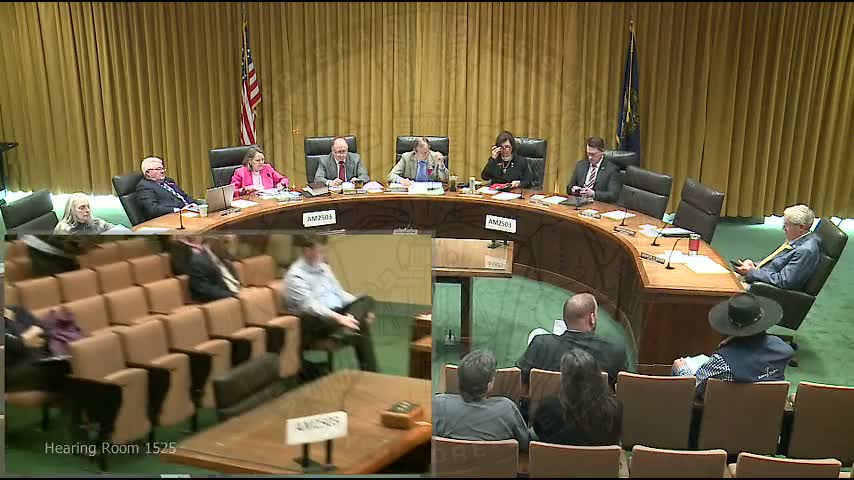
LINCOLN, Neb. — The Nebraska Legislature’s Agriculture Committee on March 21 heard hours of testimony on AM2503 to LB1187, a wide-ranging amendment that would change how Nebraska’s Livestock Brand Act is administered, raise some fee caps and alter inspections and brand-committee membership.
Chair Senator Barry DeKay opened the hearing by outlining the amendment’s principal elements — increased per-head and electronic inspection caps, a raised brand-renewal cap, new exemptions for dairies and certain backgrounding facilities, limits on routine audits absent probable cause, and expansion and restructuring of the brand committee. He said the amendment was meant to provide “minimal revenue authority” so the brand committee can remain viable while broader reform discussions continue.
Why it matters: Brand inspection is the primary system Nebraska producers use to verify ownership and deter livestock theft. Testimony showed deep concern that AM2503 would shift costs, weaken inspection safeguards and change who sits on the brand committee — a mix that opponents said risks traceability and imposes new burdens on small ranchers.
Edward Dunn, who testified in opposition, framed the debate around ownership protection: “A brand is not some ceremonial holdover from the past. It's evidence of ownership,” Dunn said, arguing the amendment would make the system “more expensive, more bureaucratic, and more porous.” He criticized proposed exemptions and the expansion of fee authority while noting the stress many producers now face from drought and wildfire recovery.
Duane Gangwish, representing the Nebraska Brand Committee, told the panel AM2503 contains several provisions that require clarification or revision before implementation. He recommended narrowing the definition of a "backgrounding lot" so it applies only to in-state facilities, limiting changes that would permit non-cattle participants to serve on the committee, and avoiding audit standards framed as "probable cause," which he said is a criminal-law term ill-suited to administrative enforcement.
On finances, Gangwish said the committee projects a modest reserve but has lost revenue from a packing plant and seen rising costs, and that the amendment’s fee caps (including a brand renewal cap proposed at $400) would provide more latitude to sustain operations. He said the committee ceased an earlier $20 surcharge when it realized it had been charged improperly and would be willing to consider refunds if a statutory mechanism existed.
Several producers and stakeholder groups urged the committee to slow down. Elizabeth Hurst of the Nebraska Farm Bureau said her organization supports modernization but urged holding AM2503 to gather more member feedback. Craig Uden of Nebraska Cattlemen testified neutral but warned that some recently added amendment elements had not been adopted into association policy.
Many witnesses representing western ranching areas pressed timing concerns given recent, large wildfires. Paula Brown of Banner County and Savanna Hebert, a fourth-generation producer from Cherry County, said ranchers are dealing with immediate losses and could not meaningfully participate in a rewritten amendment adopted on a compressed timeline.
Other recurring concerns: opponents warned that the amendment’s proposed district map and committee makeup would under-represent brand-area producers and shift costs from large registered feedlots onto smaller producers who rely on the brand system; some testifiers also alleged political influence from feedlot donations, a claim committee members and appropriations representatives pushed back on or asked to substantiate.
The hearing record: Chair DeKay closed the record after a long series of speakers and reported 239 online comments: 236 opposed, one proponent and two neutral. No committee vote was taken at the hearing.
What’s next: The committee held AM2503 on the record for additional consideration; members signaled further questions on implementation details, geographic representation on the brand committee, audit standards and financial mechanisms for refunds or surcharges.
The hearing included extensive exchanges between the brand committee’s representative and senators on precise drafting, financial impacts and what changes would be necessary to preserve ownership verification and enforcement.
Contact: The Agriculture Committee’s record remains open online through the published comment period noted in the hearing materials. The committee did not take final action that day.
Chair Senator Barry DeKay opened the hearing by outlining the amendment’s principal elements — increased per-head and electronic inspection caps, a raised brand-renewal cap, new exemptions for dairies and certain backgrounding facilities, limits on routine audits absent probable cause, and expansion and restructuring of the brand committee. He said the amendment was meant to provide “minimal revenue authority” so the brand committee can remain viable while broader reform discussions continue.
Why it matters: Brand inspection is the primary system Nebraska producers use to verify ownership and deter livestock theft. Testimony showed deep concern that AM2503 would shift costs, weaken inspection safeguards and change who sits on the brand committee — a mix that opponents said risks traceability and imposes new burdens on small ranchers.
Edward Dunn, who testified in opposition, framed the debate around ownership protection: “A brand is not some ceremonial holdover from the past. It's evidence of ownership,” Dunn said, arguing the amendment would make the system “more expensive, more bureaucratic, and more porous.” He criticized proposed exemptions and the expansion of fee authority while noting the stress many producers now face from drought and wildfire recovery.
Duane Gangwish, representing the Nebraska Brand Committee, told the panel AM2503 contains several provisions that require clarification or revision before implementation. He recommended narrowing the definition of a "backgrounding lot" so it applies only to in-state facilities, limiting changes that would permit non-cattle participants to serve on the committee, and avoiding audit standards framed as "probable cause," which he said is a criminal-law term ill-suited to administrative enforcement.
On finances, Gangwish said the committee projects a modest reserve but has lost revenue from a packing plant and seen rising costs, and that the amendment’s fee caps (including a brand renewal cap proposed at $400) would provide more latitude to sustain operations. He said the committee ceased an earlier $20 surcharge when it realized it had been charged improperly and would be willing to consider refunds if a statutory mechanism existed.
Several producers and stakeholder groups urged the committee to slow down. Elizabeth Hurst of the Nebraska Farm Bureau said her organization supports modernization but urged holding AM2503 to gather more member feedback. Craig Uden of Nebraska Cattlemen testified neutral but warned that some recently added amendment elements had not been adopted into association policy.
Many witnesses representing western ranching areas pressed timing concerns given recent, large wildfires. Paula Brown of Banner County and Savanna Hebert, a fourth-generation producer from Cherry County, said ranchers are dealing with immediate losses and could not meaningfully participate in a rewritten amendment adopted on a compressed timeline.
Other recurring concerns: opponents warned that the amendment’s proposed district map and committee makeup would under-represent brand-area producers and shift costs from large registered feedlots onto smaller producers who rely on the brand system; some testifiers also alleged political influence from feedlot donations, a claim committee members and appropriations representatives pushed back on or asked to substantiate.
The hearing record: Chair DeKay closed the record after a long series of speakers and reported 239 online comments: 236 opposed, one proponent and two neutral. No committee vote was taken at the hearing.
What’s next: The committee held AM2503 on the record for additional consideration; members signaled further questions on implementation details, geographic representation on the brand committee, audit standards and financial mechanisms for refunds or surcharges.
The hearing included extensive exchanges between the brand committee’s representative and senators on precise drafting, financial impacts and what changes would be necessary to preserve ownership verification and enforcement.
Contact: The Agriculture Committee’s record remains open online through the published comment period noted in the hearing materials. The committee did not take final action that day.
Don't Miss a Word: See the Full Meeting!
Go beyond summaries. Unlock every video, transcript, and key insight with a Founder Membership.
✓
Get instant access to full meeting videos
✓
Search and clip any phrase from complete transcripts
✓
Receive AI-powered summaries & custom alerts
✓
Enjoy lifetime, unrestricted access to government data
30-day money-back guarantee
