Committee backs SF 3704 after expert and user testimony on kratom safety and product standards
March 24, 2026 | 2026 Legislature MN, Minnesota
This article was created by AI summarizing key points discussed. AI makes mistakes, so for full details and context, please refer to the video of the full meeting. Please report any errors so we can fix them. Report an error »
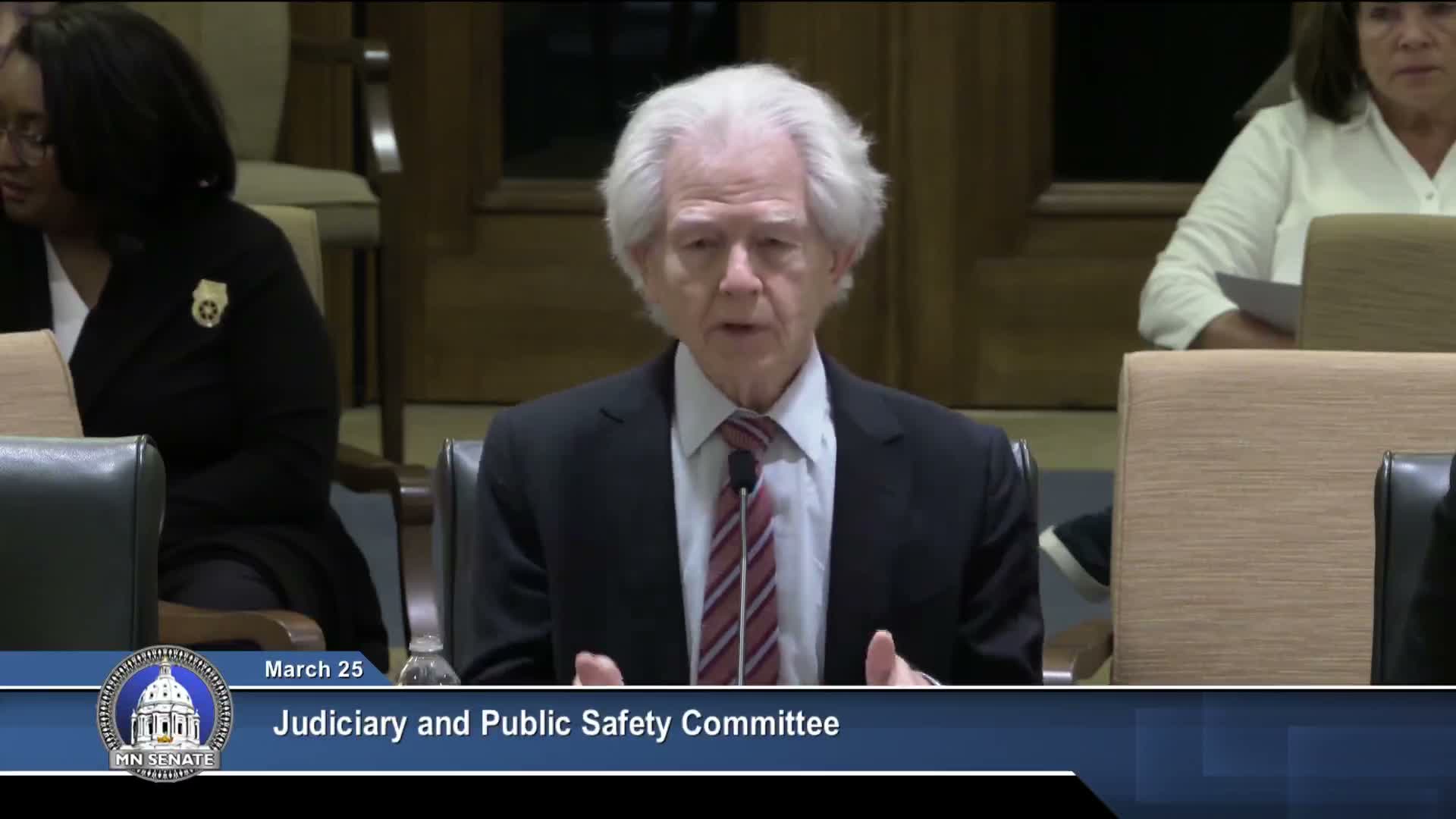
Dr. Jack Henningfield, a researcher who has worked with NIDA and WHO, told the Senate Judiciary Committee that whole‑leaf kratom — a plant in the coffee family — is distinct from products that have been chemically manipulated or concentrated. "If it's adulterated with . . . boosted alkaloids or all these crazy things, it shouldn't be allowed in my opinion," Henningfield said, offering his research library and expertise to the committee.
Henningfield described mitragynine as the primary alkaloid in traditional kratom and said the compound 7‑hydroxymitragynine (described in testimony as "7 hydroxy") is found at very low levels in natural leaf but appears at high levels in some adulterated or synthetically boosted products. He said early international data show few documented deaths from natural kratom exposures and that many serious adverse reports in the United States involve polypharmacy or adulterated products.
The committee also heard a personal account from Ryan Haugen, a professional narrator who said whole‑leaf kratom helped him manage CPTSD and panic attacks. "Whole Leaf Kratom helped me build the life I have now," Haugen said, asking lawmakers to preserve access to traditional products while targeting dangerous, concentrated formulations.
Senators questioned several policy choices, including a proposal in SF 3704 to raise the minimum purchase age from 18 to 21. Henningfield said surveys indicate most U.S. users are older than 21 and likened the age‑limit approach to past tobacco policy, arguing that three additional years of age can reduce youth initiation. Other members urged more emphasis on labeling and product‑standard rules; proponents said separate labeling work is underway but that a 21‑year minimum could be combined with stronger labeling in future sessions.
Senator Westlund moved to recommend SF 3704 be passed and sent to the senate floor; the motion carried by voice vote. The committee record shows members intend to continue work on product labeling and limits on adulterants in subsequent sessions.
Henningfield described mitragynine as the primary alkaloid in traditional kratom and said the compound 7‑hydroxymitragynine (described in testimony as "7 hydroxy") is found at very low levels in natural leaf but appears at high levels in some adulterated or synthetically boosted products. He said early international data show few documented deaths from natural kratom exposures and that many serious adverse reports in the United States involve polypharmacy or adulterated products.
The committee also heard a personal account from Ryan Haugen, a professional narrator who said whole‑leaf kratom helped him manage CPTSD and panic attacks. "Whole Leaf Kratom helped me build the life I have now," Haugen said, asking lawmakers to preserve access to traditional products while targeting dangerous, concentrated formulations.
Senators questioned several policy choices, including a proposal in SF 3704 to raise the minimum purchase age from 18 to 21. Henningfield said surveys indicate most U.S. users are older than 21 and likened the age‑limit approach to past tobacco policy, arguing that three additional years of age can reduce youth initiation. Other members urged more emphasis on labeling and product‑standard rules; proponents said separate labeling work is underway but that a 21‑year minimum could be combined with stronger labeling in future sessions.
Senator Westlund moved to recommend SF 3704 be passed and sent to the senate floor; the motion carried by voice vote. The committee record shows members intend to continue work on product labeling and limits on adulterants in subsequent sessions.
Don't Miss a Word: See the Full Meeting!
Go beyond summaries. Unlock every video, transcript, and key insight with a Founder Membership.
✓
Get instant access to full meeting videos
✓
Search and clip any phrase from complete transcripts
✓
Receive AI-powered summaries & custom alerts
✓
Enjoy lifetime, unrestricted access to government data
30-day money-back guarantee
