Panel approves smoke‑detector bill to require 10‑year sealed batteries on replacement
March 24, 2026 | 2026 Legislature MN, Minnesota
This article was created by AI summarizing key points discussed. AI makes mistakes, so for full details and context, please refer to the video of the full meeting. Please report any errors so we can fix them. Report an error »
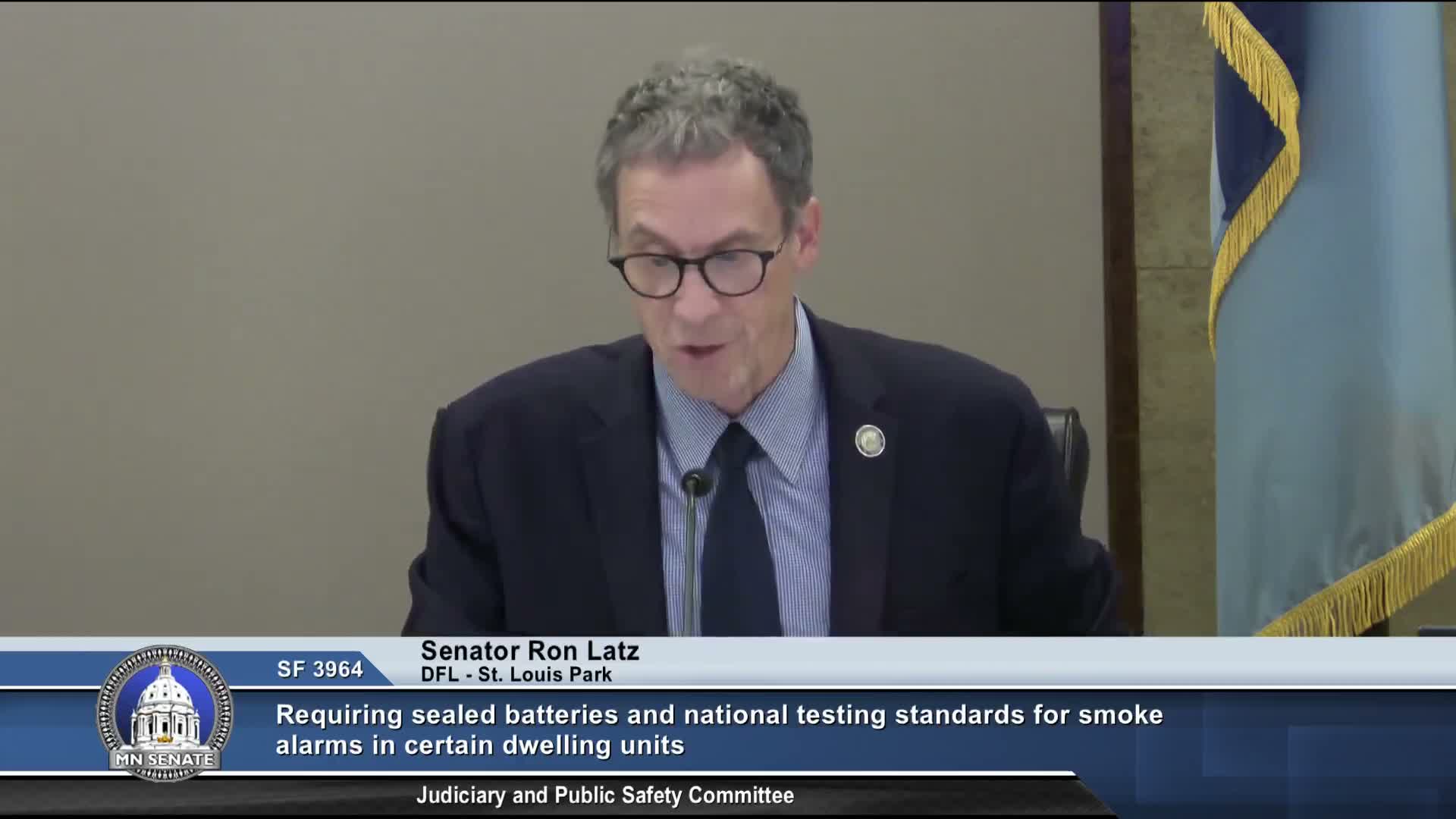
Senator Matt Howe introduced SF 3964 to require that when a battery‑powered smoke alarm is replaced, the replacement alarm be equipped with a sealed 10‑year battery. "All it does is require you, if you're gonna replace one, you replace it with a smoke detector with a 10‑year battery," Howe said, framing the change as a public‑safety step that does not increase the number of alarms or alter their placement.
Joe Sellwood, testifying for Kidde, said the measure closes a reliability gap: the Minnesota state fire code already requires battery‑powered alarms be replaced at 10 years, but sealed‑battery units ensure the replacement can provide reliable power for that service life. "Battery failure . . . is the leading reason a smoke alarm is silent when it matters most," Sellwood said, citing National Fire Protection Association statistics on home fires and deaths.
Committee members discussed whether the legislature should mandate a product standard or let the Department of Public Safety and the state fire marshal amend the code. Senator Limmer offered an amendment that directs the fire marshal to consider a code change and implements the requirement in the next code revision; the committee adopted the amendment and then recommended the bill to pass and be sent to the senate floor by voice vote.
Members raised cost and equity questions but heard industry testimony that the upfront price difference for units with sealed 10‑year batteries averages about $10, with lifetime cost roughly comparable to annual battery replacement in standard units. The committee recommended SF 3964 to the full Senate.
Joe Sellwood, testifying for Kidde, said the measure closes a reliability gap: the Minnesota state fire code already requires battery‑powered alarms be replaced at 10 years, but sealed‑battery units ensure the replacement can provide reliable power for that service life. "Battery failure . . . is the leading reason a smoke alarm is silent when it matters most," Sellwood said, citing National Fire Protection Association statistics on home fires and deaths.
Committee members discussed whether the legislature should mandate a product standard or let the Department of Public Safety and the state fire marshal amend the code. Senator Limmer offered an amendment that directs the fire marshal to consider a code change and implements the requirement in the next code revision; the committee adopted the amendment and then recommended the bill to pass and be sent to the senate floor by voice vote.
Members raised cost and equity questions but heard industry testimony that the upfront price difference for units with sealed 10‑year batteries averages about $10, with lifetime cost roughly comparable to annual battery replacement in standard units. The committee recommended SF 3964 to the full Senate.
View the Full Meeting & All Its Details
This article offers just a summary. Unlock complete video, transcripts, and insights as a Founder Member.
✓
Watch full, unedited meeting videos
✓
Search every word spoken in unlimited transcripts
✓
AI summaries & real-time alerts (all government levels)
✓
Permanent access to expanding government content
30-day money-back guarantee
