Committee hears bill to make part‑time and paid‑on‑call firefighters eligible for state line‑of‑duty benefit; bill laid over
March 25, 2026 | 2026 Legislature MN, Minnesota
This article was created by AI summarizing key points discussed. AI makes mistakes, so for full details and context, please refer to the video of the full meeting. Please report any errors so we can fix them. Report an error »
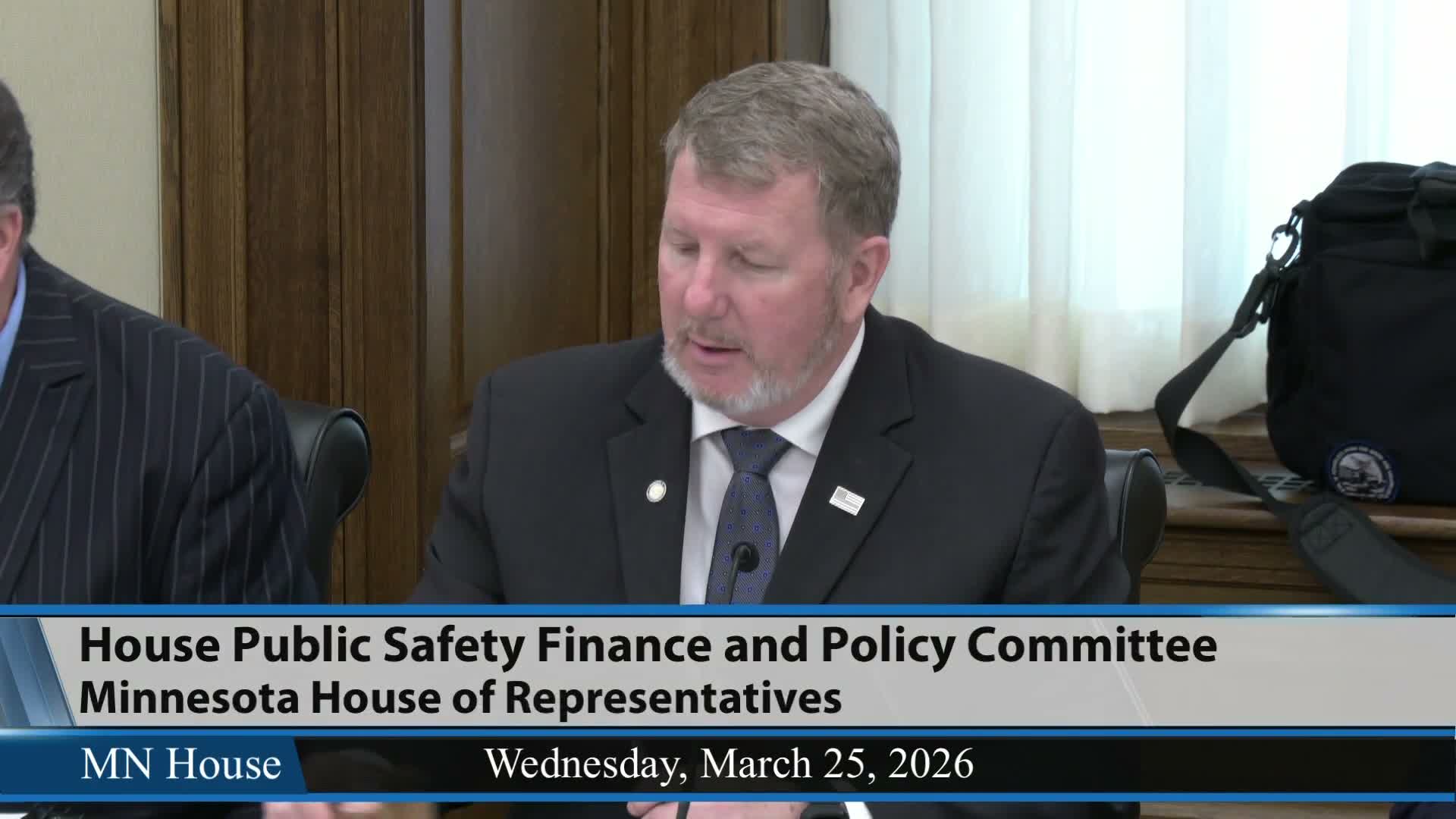
Representative Lizette Knudson introduced House File 2817 to clarify that the state’s one‑time benefit for line‑of‑duty firefighter deaths applies to full‑time, part‑time, paid‑on‑call and volunteer firefighters alike. Testifying on behalf of a statewide coalition, Hopkins Fire Chief Mike Wenshaw told the committee the change is needed to avoid ‘‘tragic’’ technical denials and to ensure families are supported.
Wenshaw, representing the Minnesota Fire Association Coalition, said that in Greater Minnesota most departments rely on paid‑on‑call staff: ‘‘Out of the 471 different departments in our state, 365 are paid on call,’’ and he estimated about ‘‘15,000 firefighters in the state of Minnesota that are paid on call’’ who would be affected by the clarification. He described the 2022 death of assistant chief James Scanlon and said, because of current statutory language, ‘‘His family is not receiving the state benefit’’ and federal benefits are withheld until the state declares a line‑of‑duty death.
The bill’s A1 amendment excludes clerical, administrative and non‑manual employees from the definition of firefighter to reduce cost impacts; the committee adopted that amendment by voice vote. Representative Knudson emphasized the bill’s aim was statutory clarity so that families ‘‘know that the state of Minnesota has their backs.’’
Because House fiscal reported a cost in the fiscal note, the committee chose to lay the bill over for further review rather than re‑refer it; committee members said they support the policy but want to resolve the budget impact before advancing the measure.
The committee took no final vote on the underlying policy merits; the bill’s next procedural step is pending fiscal review.
Wenshaw, representing the Minnesota Fire Association Coalition, said that in Greater Minnesota most departments rely on paid‑on‑call staff: ‘‘Out of the 471 different departments in our state, 365 are paid on call,’’ and he estimated about ‘‘15,000 firefighters in the state of Minnesota that are paid on call’’ who would be affected by the clarification. He described the 2022 death of assistant chief James Scanlon and said, because of current statutory language, ‘‘His family is not receiving the state benefit’’ and federal benefits are withheld until the state declares a line‑of‑duty death.
The bill’s A1 amendment excludes clerical, administrative and non‑manual employees from the definition of firefighter to reduce cost impacts; the committee adopted that amendment by voice vote. Representative Knudson emphasized the bill’s aim was statutory clarity so that families ‘‘know that the state of Minnesota has their backs.’’
Because House fiscal reported a cost in the fiscal note, the committee chose to lay the bill over for further review rather than re‑refer it; committee members said they support the policy but want to resolve the budget impact before advancing the measure.
The committee took no final vote on the underlying policy merits; the bill’s next procedural step is pending fiscal review.
View the Full Meeting & All Its Details
This article offers just a summary. Unlock complete video, transcripts, and insights as a Founder Member.
✓
Watch full, unedited meeting videos
✓
Search every word spoken in unlimited transcripts
✓
AI summaries & real-time alerts (all government levels)
✓
Permanent access to expanding government content
30-day money-back guarantee
