Senate advances bill allowing third-party large generators for big industrial users after heavy debate
March 18, 2026 | 2026 Legislature NE, Nebraska
This article was created by AI summarizing key points discussed. AI makes mistakes, so for full details and context, please refer to the video of the full meeting. Please report any errors so we can fix them. Report an error »
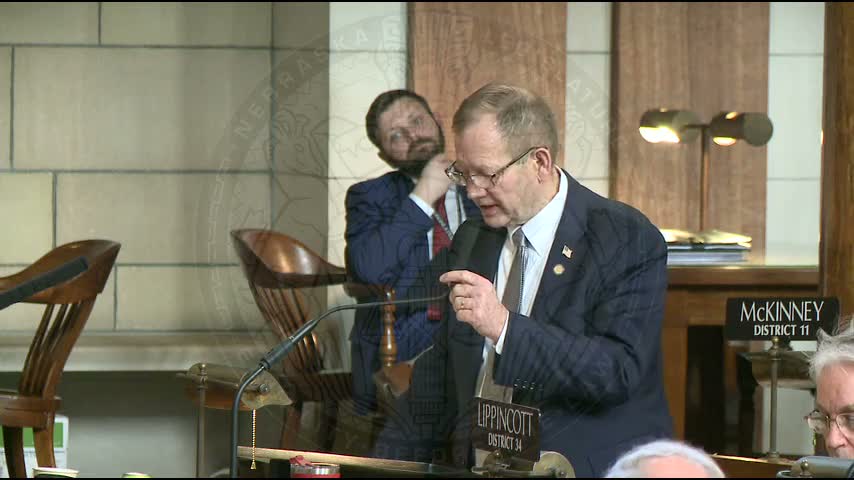
The Senate spent an extended portion of the session debating LB1261, a bill that would permit large industrial customers (projects of roughly 1,000 megawatts) to bring their own generation and interconnect with Nebraska public-power entities under buy–sell power-purchase agreements.
Sponsor Senator Barry DeKay said the approach lets private developers carry the capital cost of generation and prevents ratepayers from underwriting expensive plants that serve a single large customer. Supporters said the model could attract large investments — data centers, sustainable-fuel manufacturers or other intensive users — while reducing direct financing burdens on public-power districts.
Opponents warned of several potential harms: threats to public-power governance if management could waive key approvals, the possibility of stranded assets, heavy water demands for cooling in agricultural regions, and public-transparency shortfalls where projects are negotiated under nondisclosure agreements. Senators raised concerns about how new private generation would count toward system reserve margins and how outages or decommissioning would be handled.
Lawmakers negotiated and approved committee and floor changes to narrow ambiguous language (the committee struck a problematic word in AM2086) and added requirements that boards of consumer-owned utilities must approve contracts and any contractual waivers affecting rights or eminent-domain-related issues. Sponsors described those amendments as preserving local control while allowing a framework to recruit large energy users.
The committee amendment was adopted on a recorded voice tally and LB1261 advanced to the engrossing stage. Supporters said the bill is a tool to keep Nebraska competitive for large projects while protecting ratepayers; critics said more work is required on water, decommissioning and community engagement.
Sponsor Senator Barry DeKay said the approach lets private developers carry the capital cost of generation and prevents ratepayers from underwriting expensive plants that serve a single large customer. Supporters said the model could attract large investments — data centers, sustainable-fuel manufacturers or other intensive users — while reducing direct financing burdens on public-power districts.
Opponents warned of several potential harms: threats to public-power governance if management could waive key approvals, the possibility of stranded assets, heavy water demands for cooling in agricultural regions, and public-transparency shortfalls where projects are negotiated under nondisclosure agreements. Senators raised concerns about how new private generation would count toward system reserve margins and how outages or decommissioning would be handled.
Lawmakers negotiated and approved committee and floor changes to narrow ambiguous language (the committee struck a problematic word in AM2086) and added requirements that boards of consumer-owned utilities must approve contracts and any contractual waivers affecting rights or eminent-domain-related issues. Sponsors described those amendments as preserving local control while allowing a framework to recruit large energy users.
The committee amendment was adopted on a recorded voice tally and LB1261 advanced to the engrossing stage. Supporters said the bill is a tool to keep Nebraska competitive for large projects while protecting ratepayers; critics said more work is required on water, decommissioning and community engagement.
Don't Miss a Word: See the Full Meeting!
Go beyond summaries. Unlock every video, transcript, and key insight with a Founder Membership.
✓
Get instant access to full meeting videos
✓
Search and clip any phrase from complete transcripts
✓
Receive AI-powered summaries & custom alerts
✓
Enjoy lifetime, unrestricted access to government data
30-day money-back guarantee
