Senate committee hears bill to let pharmacists start buprenorphine to expand OUD treatment
March 25, 2026 | 2026 Legislature MN, Minnesota
This article was created by AI summarizing key points discussed. AI makes mistakes, so for full details and context, please refer to the video of the full meeting. Please report any errors so we can fix them. Report an error »
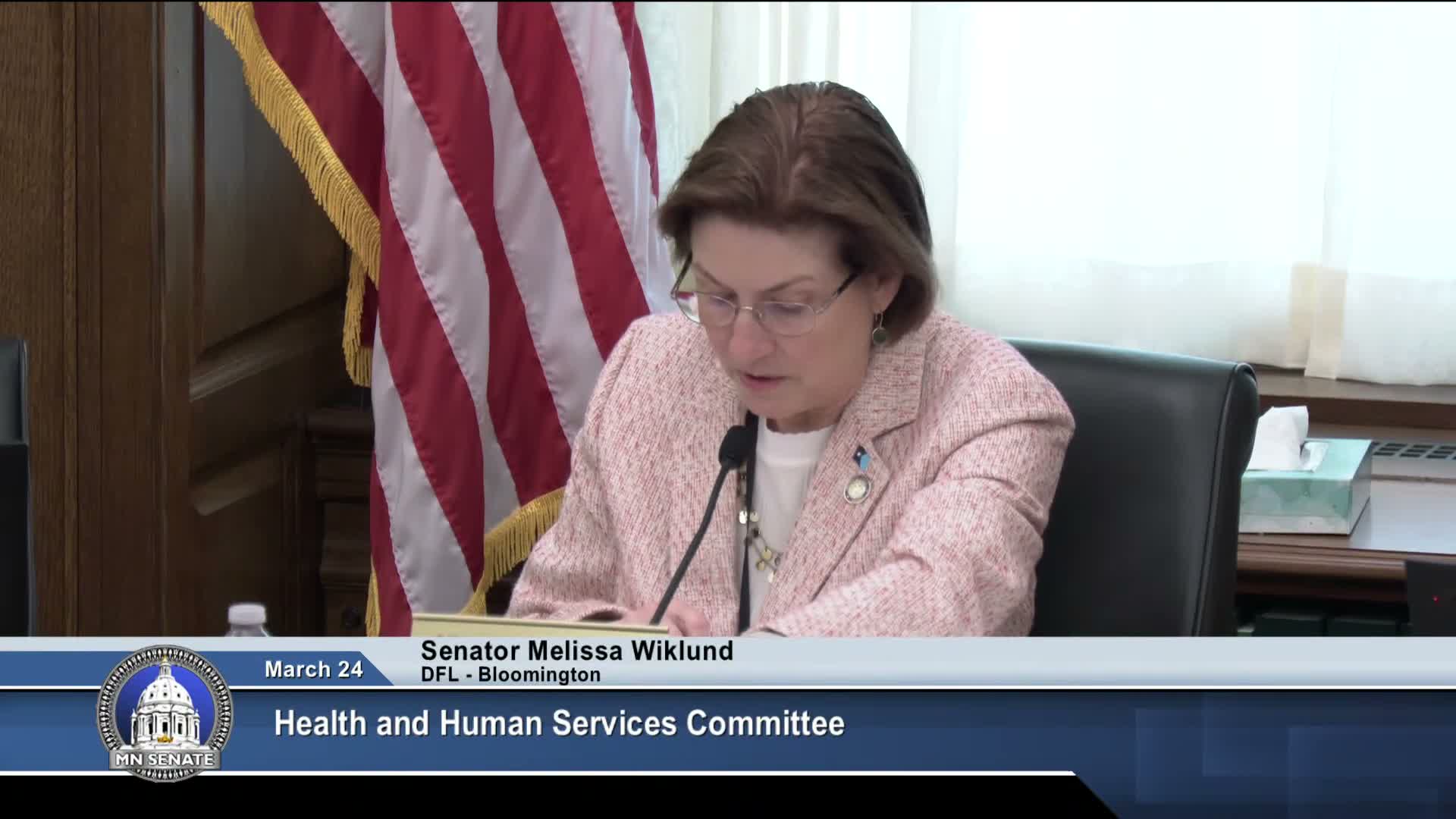
Senate File 4486, introduced by Senator Hoffman in the Health and Human Services Finance and Policy Committee, would authorize pharmacists to initiate, prescribe, administer and dispense buprenorphine to treat opioid use disorder. Hoffman told the committee the bill is aimed at reducing delays in care that contribute to overdose deaths; he cited an estimated 1,000 overdose deaths in Minnesota in 2023 and significant Medicaid costs tied to opioid-related care.
Several pharmacists and addiction specialists testified in support. "This bill will allow pharmacists to start or continue buprenorphine for patients who need it, whether that be in a retail pharmacy in a small rural community, emergency room, jail, hospital, or clinic," said Jordan Bannister, a CentraCare clinical pharmacist and board member of the Minnesota Pharmacists Association. Bannister described pharmacists as accessible medication experts and said an eight‑hour DEA training would be required for those providing this care.
Holly Dron, an emergency medicine pharmacist, said emergency departments already provide thousands of buprenorphine prescriptions when outpatient access is limited and that expanding pharmacist authority would increase timely access to treatment: "When treatment is available immediately, patients are far more likely to engage in recovery processes." Dr. Robert Cole Perringer, an addiction medicine specialist, told the committee that buprenorphine and methadone are the medications that save lives and that expanding access is a "game changer," especially in rural Minnesota.
Some physicians raised questions about implementation and diagnostics. Cammie LaValle and Dr. Todd Hess expressed concern about how a diagnosis of opioid use disorder (OUD) would be determined and whether pharmacists could, intentionally or not, disrupt existing physician treatment plans for patients who legitimately require opioid analgesics for conditions such as cancer. "My concern is who has made the diagnosis of OUD," said Dr. Hess, a pain management specialist, asking whether a pharmacist would make that determination on the spot.
Supporters said the bill is written to limit pharmacists' authority to treating OUD and to operate via patient request and collaboration with other clinicians. Bannister noted safeguards such as required training and collaboration pathways to refer patients to physicians after initiation.
The committee did not vote on the bill; Senator Hoffman asked that the measure be laid over for further consideration. The record shows committee members and clinical witnesses agree on the potential to expand access but want clearer language on diagnostic thresholds and care coordination prior to final action.
Several pharmacists and addiction specialists testified in support. "This bill will allow pharmacists to start or continue buprenorphine for patients who need it, whether that be in a retail pharmacy in a small rural community, emergency room, jail, hospital, or clinic," said Jordan Bannister, a CentraCare clinical pharmacist and board member of the Minnesota Pharmacists Association. Bannister described pharmacists as accessible medication experts and said an eight‑hour DEA training would be required for those providing this care.
Holly Dron, an emergency medicine pharmacist, said emergency departments already provide thousands of buprenorphine prescriptions when outpatient access is limited and that expanding pharmacist authority would increase timely access to treatment: "When treatment is available immediately, patients are far more likely to engage in recovery processes." Dr. Robert Cole Perringer, an addiction medicine specialist, told the committee that buprenorphine and methadone are the medications that save lives and that expanding access is a "game changer," especially in rural Minnesota.
Some physicians raised questions about implementation and diagnostics. Cammie LaValle and Dr. Todd Hess expressed concern about how a diagnosis of opioid use disorder (OUD) would be determined and whether pharmacists could, intentionally or not, disrupt existing physician treatment plans for patients who legitimately require opioid analgesics for conditions such as cancer. "My concern is who has made the diagnosis of OUD," said Dr. Hess, a pain management specialist, asking whether a pharmacist would make that determination on the spot.
Supporters said the bill is written to limit pharmacists' authority to treating OUD and to operate via patient request and collaboration with other clinicians. Bannister noted safeguards such as required training and collaboration pathways to refer patients to physicians after initiation.
The committee did not vote on the bill; Senator Hoffman asked that the measure be laid over for further consideration. The record shows committee members and clinical witnesses agree on the potential to expand access but want clearer language on diagnostic thresholds and care coordination prior to final action.
View the Full Meeting & All Its Details
This article offers just a summary. Unlock complete video, transcripts, and insights as a Founder Member.
✓
Watch full, unedited meeting videos
✓
Search every word spoken in unlimited transcripts
✓
AI summaries & real-time alerts (all government levels)
✓
Permanent access to expanding government content
30-day money-back guarantee
