Nebraska Senate advances bill to shield doctors who recommend medical cannabis amid debate over patient safeguards
March 20, 2026 | 2026 Legislature NE, Nebraska
This article was created by AI summarizing key points discussed. AI makes mistakes, so for full details and context, please refer to the video of the full meeting. Please report any errors so we can fix them. Report an error »
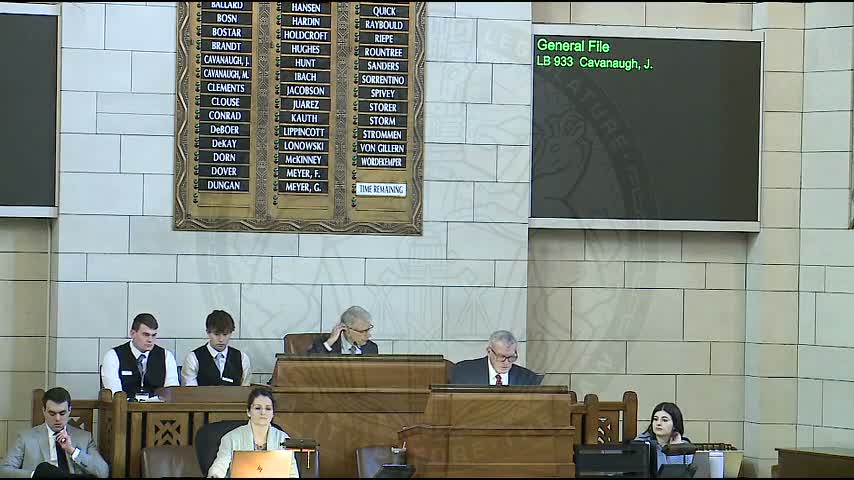
Lincoln — The Nebraska Legislature on Friday advanced LB 933, a bill by Sen. John Kavanaugh intended to protect health care practitioners from penalties "solely for providing a written recommendation" that, in the practitioner’s professional judgment, the benefits of cannabis outweigh the risks.
Kavanaugh, the bill’s sponsor, told colleagues the measure is narrowly drafted to mirror language approved by voters in the Medical Cannabis Patient Protection Act and to address a practical problem: "There are no medical practitioners in the state of Nebraska who are issuing recommendations or feel they can issue a recommendation because they are afraid that their license will be affected," he said. He added the bill is not a blanket immunity: "They can still be sanctioned if they are recommending and it is not the standard of care." (Sen. John Kavanaugh)
The debate centered on two questions: whether the bill properly implements the ballot‑initiative language and whether state statute should require a separate scientific‑evidence standard for recommendations. Sen. Steve Storm offered an amendment that would have required recommendations be made "based upon a preponderance of current scientific evidence." Storm said the change is a modest patient‑safety guardrail that would require practitioners to rely on peer‑reviewed studies and recently published evidence when recommending cannabis.
Supporters of Storm’s amendment argued it would protect patients by ensuring recommendations rest on current science. Opponents, including Kavanaugh and multiple senators who supported the underlying bill, said the amendment would insert new statutory requirements that conflict with the language voters adopted and could create legal uncertainty about when a practitioner is protected. "That is problematic because then it disaligns or makes this bill not align with the ballot language," Kavanaugh said.
Several senators pressed practical questions about implementation. Speaker Arch asked whether a written recommendation will be required for possession and how dispensaries will verify recommendations; Kavanaugh and others explained that the Medical Cannabis Commission’s regulations will determine what dispensaries require, including a registry and what must be transmitted to a dispensary. Sen. Hansen said the commission’s proposed rules already specify recommendation contents — form, dosage, frequency — and limits on amounts dispensed.
Senators also discussed malpractice exposure and how a standard of care would be applied. Kavanaugh and others cited existing Nebraska malpractice law (statute 44‑28‑10) and said malpractice remains the avenue for sanctioning negligent practitioners. "If they are doing it inappropriately and not following standard of care, following procedures, that’s the thing we’re trying to get to here," Kavanaugh said.
On the floor, proponents emphasized constituent stories of patients — including children with severe epilepsy — who have had to seek out‑of‑state recommendations because no Nebraska practitioner would risk recommending cannabis. Supporters said LB 933 is a narrowly focused fix to restore in‑state access while preserving accountability.
The legislature rejected Storm’s scientific‑evidence amendment on a roll call and then adopted committee amendments that Kavanaugh and backers said more closely align the statute with voter‑approved language and clarify malpractice remains available for negligent conduct. The body then voted to advance LB 933 to E & R initial by a recorded tally. The bill will receive further committee work and potential amendments before future votes.
What’s next: LB 933 advanced to E & R initial; sponsor Kavanaugh said he will continue to work with colleagues on adjustments between general and select file to address outstanding concerns about clarity and patient safeguards.
Vote at a glance: the body rejected AM 2738 (Storm) to add a ‘‘preponderance of current scientific evidence’’ requirement; committee amendments (AM 2192/AM 2602) were adopted; LB 933 advanced to E & R initial.
Kavanaugh, the bill’s sponsor, told colleagues the measure is narrowly drafted to mirror language approved by voters in the Medical Cannabis Patient Protection Act and to address a practical problem: "There are no medical practitioners in the state of Nebraska who are issuing recommendations or feel they can issue a recommendation because they are afraid that their license will be affected," he said. He added the bill is not a blanket immunity: "They can still be sanctioned if they are recommending and it is not the standard of care." (Sen. John Kavanaugh)
The debate centered on two questions: whether the bill properly implements the ballot‑initiative language and whether state statute should require a separate scientific‑evidence standard for recommendations. Sen. Steve Storm offered an amendment that would have required recommendations be made "based upon a preponderance of current scientific evidence." Storm said the change is a modest patient‑safety guardrail that would require practitioners to rely on peer‑reviewed studies and recently published evidence when recommending cannabis.
Supporters of Storm’s amendment argued it would protect patients by ensuring recommendations rest on current science. Opponents, including Kavanaugh and multiple senators who supported the underlying bill, said the amendment would insert new statutory requirements that conflict with the language voters adopted and could create legal uncertainty about when a practitioner is protected. "That is problematic because then it disaligns or makes this bill not align with the ballot language," Kavanaugh said.
Several senators pressed practical questions about implementation. Speaker Arch asked whether a written recommendation will be required for possession and how dispensaries will verify recommendations; Kavanaugh and others explained that the Medical Cannabis Commission’s regulations will determine what dispensaries require, including a registry and what must be transmitted to a dispensary. Sen. Hansen said the commission’s proposed rules already specify recommendation contents — form, dosage, frequency — and limits on amounts dispensed.
Senators also discussed malpractice exposure and how a standard of care would be applied. Kavanaugh and others cited existing Nebraska malpractice law (statute 44‑28‑10) and said malpractice remains the avenue for sanctioning negligent practitioners. "If they are doing it inappropriately and not following standard of care, following procedures, that’s the thing we’re trying to get to here," Kavanaugh said.
On the floor, proponents emphasized constituent stories of patients — including children with severe epilepsy — who have had to seek out‑of‑state recommendations because no Nebraska practitioner would risk recommending cannabis. Supporters said LB 933 is a narrowly focused fix to restore in‑state access while preserving accountability.
The legislature rejected Storm’s scientific‑evidence amendment on a roll call and then adopted committee amendments that Kavanaugh and backers said more closely align the statute with voter‑approved language and clarify malpractice remains available for negligent conduct. The body then voted to advance LB 933 to E & R initial by a recorded tally. The bill will receive further committee work and potential amendments before future votes.
What’s next: LB 933 advanced to E & R initial; sponsor Kavanaugh said he will continue to work with colleagues on adjustments between general and select file to address outstanding concerns about clarity and patient safeguards.
Vote at a glance: the body rejected AM 2738 (Storm) to add a ‘‘preponderance of current scientific evidence’’ requirement; committee amendments (AM 2192/AM 2602) were adopted; LB 933 advanced to E & R initial.
Don't Miss a Word: See the Full Meeting!
Go beyond summaries. Unlock every video, transcript, and key insight with a Founder Membership.
✓
Get instant access to full meeting videos
✓
Search and clip any phrase from complete transcripts
✓
Receive AI-powered summaries & custom alerts
✓
Enjoy lifetime, unrestricted access to government data
30-day money-back guarantee
