Committee advances bill to cap matching-fund requirements for small-city grants
March 06, 2026 | Legislative, Oregon
This article was created by AI summarizing key points discussed. AI makes mistakes, so for full details and context, please refer to the video of the full meeting. Please report any errors so we can fix them. Report an error »
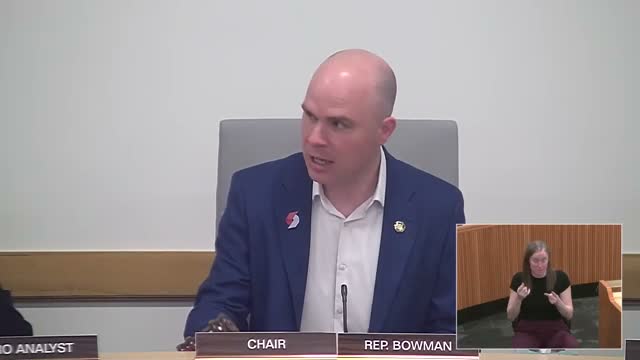
Chair Bowman opened a work session on Senate Bill 1585 and asked committee staff to summarize the measure. Aaron Seiler told the committee the bill, sponsored in the Senate by Senator Manning and Representative Diehl, sets tiered maximum matching-fund requirements for state grants to incorporated cities with populations under 20,000 and permits use of capital-construction and municipal-infrastructure grant money for all phases of funded projects, including engineering, planning and support. Seiler said the measure has minimal fiscal impact and no revenue impact and reported the Senate vote as 25 ayes and 3 nays.
Senator James Ivory Manning Jr., the bill sponsor, told the committee the measure is intended to make grant competitions fairer for smaller cities that cannot raise large local matches. "The point of this is to make everything fair for all Oregonians," Manning said, citing support from the League of Oregon Cities and examples of small cities that would benefit. He also said he intends to pursue inclusion of special districts and some parks in the 2027 legislative cycle and has instructed staff to draft a legislative concept (LC) to do so.
Representative Ed Deal, who said he brought a similar proposal previously, urged the committee to approve the bill, thanking the League of Oregon Cities and staff who worked on the measure.
Vice Chair Elmer moved to send Senate Bill 1585 to the floor with a "do pass" recommendation. Representative Graeber raised a process concern about the committee not holding a public hearing; Chair Bowman clarified the bill had received a public hearing on the House side earlier, and Representative Graeber retracted the objection. The clerk called the roll and members recorded on the roll call voted in the affirmative; the motion passed. Chair Bowman assigned Representative Deal to carry the bill on the floor.
The committee's action was procedural: the committee recommended the bill be placed on the House floor with a do-pass recommendation. There was discussion about pursuing separate legislation in 2027 to include special districts and parks, but no amendment was made in committee.
Senator James Ivory Manning Jr., the bill sponsor, told the committee the measure is intended to make grant competitions fairer for smaller cities that cannot raise large local matches. "The point of this is to make everything fair for all Oregonians," Manning said, citing support from the League of Oregon Cities and examples of small cities that would benefit. He also said he intends to pursue inclusion of special districts and some parks in the 2027 legislative cycle and has instructed staff to draft a legislative concept (LC) to do so.
Representative Ed Deal, who said he brought a similar proposal previously, urged the committee to approve the bill, thanking the League of Oregon Cities and staff who worked on the measure.
Vice Chair Elmer moved to send Senate Bill 1585 to the floor with a "do pass" recommendation. Representative Graeber raised a process concern about the committee not holding a public hearing; Chair Bowman clarified the bill had received a public hearing on the House side earlier, and Representative Graeber retracted the objection. The clerk called the roll and members recorded on the roll call voted in the affirmative; the motion passed. Chair Bowman assigned Representative Deal to carry the bill on the floor.
The committee's action was procedural: the committee recommended the bill be placed on the House floor with a do-pass recommendation. There was discussion about pursuing separate legislation in 2027 to include special districts and parks, but no amendment was made in committee.
Don't Miss a Word: See the Full Meeting!
Go beyond summaries. Unlock every video, transcript, and key insight with a Founder Membership.
✓
Get instant access to full meeting videos
✓
Search and clip any phrase from complete transcripts
✓
Receive AI-powered summaries & custom alerts
✓
Enjoy lifetime, unrestricted access to government data
30-day money-back guarantee
