Nebraska committee hears amendment to let patients pick up prepaid prescriptions at consenting health-care facilities
March 19, 2026 | 2026 Legislature NE, Nebraska
This article was created by AI summarizing key points discussed. AI makes mistakes, so for full details and context, please refer to the video of the full meeting. Please report any errors so we can fix them. Report an error »
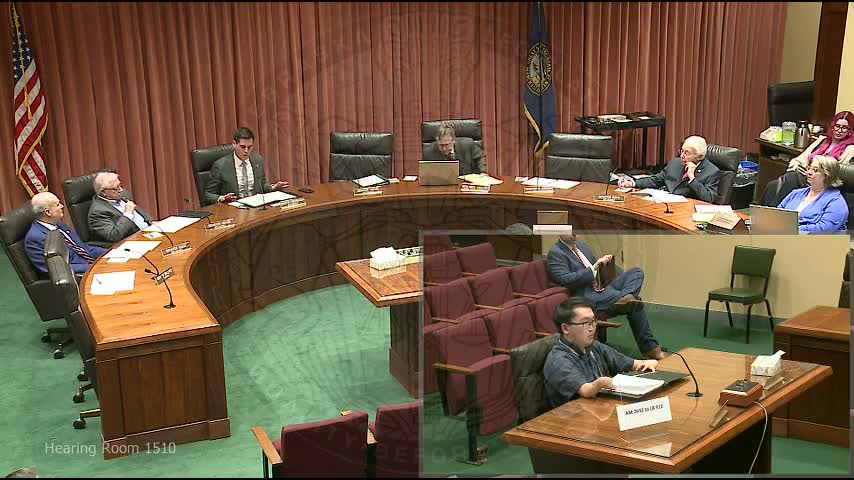
The Health and Human Services Committee of the Nebraska Legislature heard testimony on AM 2642 to LB 912, an amendment that would allow patients or caregivers to pick up prepaid prescription drugs and devices at consenting third‑party health‑care facilities under defined conditions.
Turner Adams, a legislative aide appearing for the bill’s sponsor, outlined the amendment’s key conditions: the drug or device must be prepaid by the patient or caregiver; the dispensing pharmacist must have offered patient counseling; the item must remain in manufacturer packaging and be stored separately from other facility medications; the item cannot be a controlled substance; items unclaimed after 30 days must be donated, destroyed, or returned to the dispensing pharmacy; the facility must have a written policy governing donation/destruction; and the facility must maintain documentation of delivery and pickup. Adams said the amendment would also limit facility liability for the contents of delivered drugs when the facility complies with the listed safeguards and would authorize the Department of Health and Human Services, with pharmacy board input, to adopt implementing rules and regulations.
"Again, there is a critical shortage of rural pharmacies," Adams said, arguing that allowing closer pickup locations could reduce long drives for elderly patients or those facing adverse weather.
Ryan McIntosh, representing the Nebraska Pharmacists Association, testified in support and distributed the same handout used previously in related LB 796 hearings. "Any opportunity I have to talk about the growing pharmacy desert in Nebraska, I will do so," McIntosh said, urging the committee to consider the amendment as a practical step to improve access for remote communities.
Dr. Timothy Tesmer, chief medical officer in the Division of Public Health at DHHS, testified in a neutral capacity. "AM 2642 increases prescription accessibility for Nebraska consumers and their caregivers by allowing them to pick up certain drugs or devices from a consenting health‑care facility rather than requiring them to drive a distance to their nearest pharmacy," Tesmer said, adding that the department believes the language maintains health and safety guardrails and appreciates the sponsor’s work to incorporate department feedback.
No opponents appeared to testify, the committee recorded no questions for the witnesses, and the hearing concluded with no online comments for AM 2642 to LB 912. The committee did not record a vote on the amendment during this hearing; any formal action would be taken later in committee or on the floor.
Turner Adams, a legislative aide appearing for the bill’s sponsor, outlined the amendment’s key conditions: the drug or device must be prepaid by the patient or caregiver; the dispensing pharmacist must have offered patient counseling; the item must remain in manufacturer packaging and be stored separately from other facility medications; the item cannot be a controlled substance; items unclaimed after 30 days must be donated, destroyed, or returned to the dispensing pharmacy; the facility must have a written policy governing donation/destruction; and the facility must maintain documentation of delivery and pickup. Adams said the amendment would also limit facility liability for the contents of delivered drugs when the facility complies with the listed safeguards and would authorize the Department of Health and Human Services, with pharmacy board input, to adopt implementing rules and regulations.
"Again, there is a critical shortage of rural pharmacies," Adams said, arguing that allowing closer pickup locations could reduce long drives for elderly patients or those facing adverse weather.
Ryan McIntosh, representing the Nebraska Pharmacists Association, testified in support and distributed the same handout used previously in related LB 796 hearings. "Any opportunity I have to talk about the growing pharmacy desert in Nebraska, I will do so," McIntosh said, urging the committee to consider the amendment as a practical step to improve access for remote communities.
Dr. Timothy Tesmer, chief medical officer in the Division of Public Health at DHHS, testified in a neutral capacity. "AM 2642 increases prescription accessibility for Nebraska consumers and their caregivers by allowing them to pick up certain drugs or devices from a consenting health‑care facility rather than requiring them to drive a distance to their nearest pharmacy," Tesmer said, adding that the department believes the language maintains health and safety guardrails and appreciates the sponsor’s work to incorporate department feedback.
No opponents appeared to testify, the committee recorded no questions for the witnesses, and the hearing concluded with no online comments for AM 2642 to LB 912. The committee did not record a vote on the amendment during this hearing; any formal action would be taken later in committee or on the floor.
Don't Miss a Word: See the Full Meeting!
Go beyond summaries. Unlock every video, transcript, and key insight with a Founder Membership.
✓
Get instant access to full meeting videos
✓
Search and clip any phrase from complete transcripts
✓
Receive AI-powered summaries & custom alerts
✓
Enjoy lifetime, unrestricted access to government data
30-day money-back guarantee
