Assistant commissioner: Read Act implementation shows early training and screening gains
March 24, 2026 | 2026 Legislature MN, Minnesota
This article was created by AI summarizing key points discussed. AI makes mistakes, so for full details and context, please refer to the video of the full meeting. Please report any errors so we can fix them. Report an error »
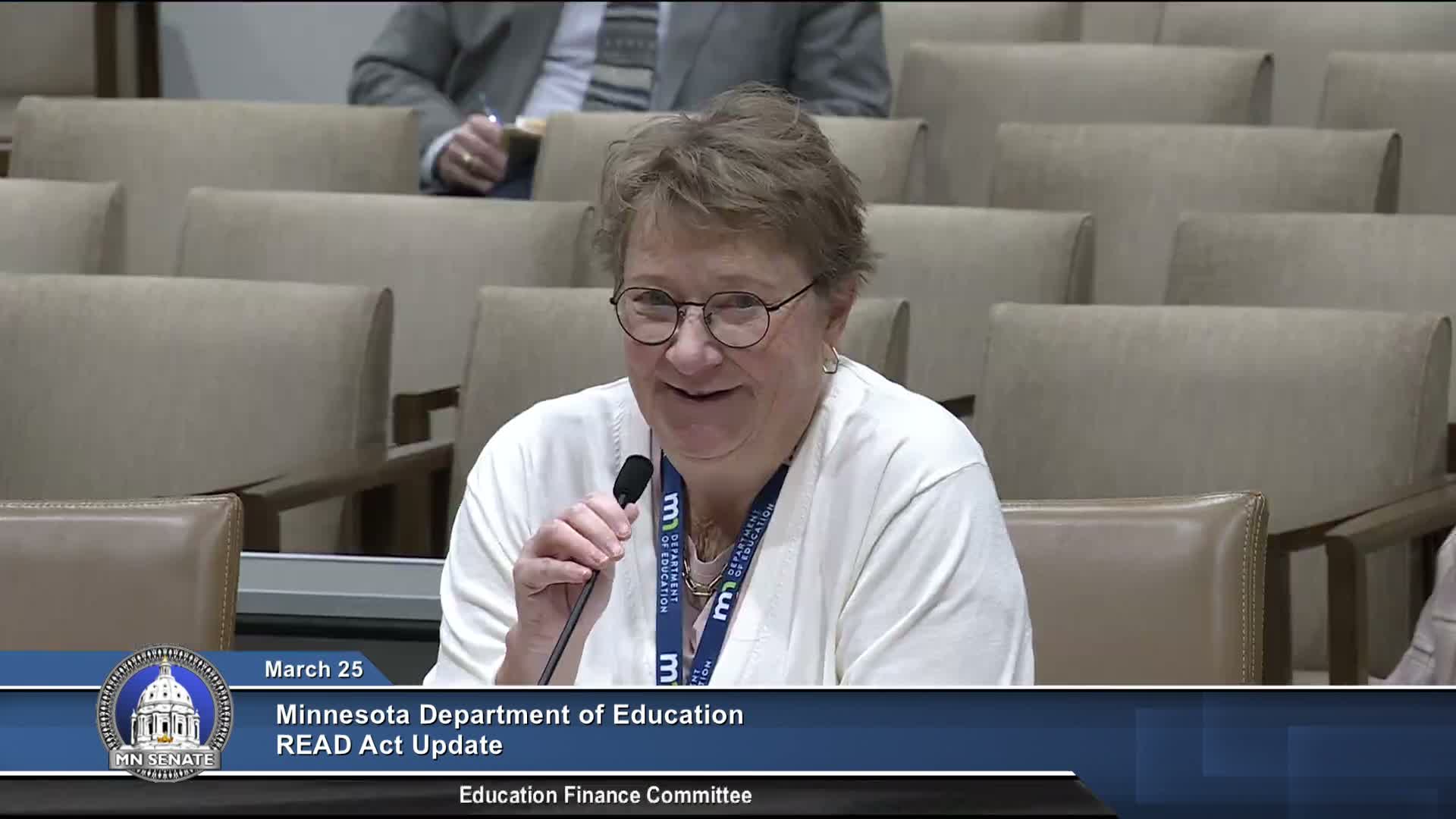
Assistant Commissioner Bobbie Burnham of the Minnesota Department of Education told the Senate Education Finance Committee on March 25 that the state has made substantial early progress implementing the Read Act, while cautioning that measurable statewide gains on the Minnesota Comprehensive Assessments (MCAs) will take several years.
"The goal of the Read Act is to ensure every child in Minnesota is reading at or above grade level beginning in kindergarten," Burnham said. She described a regional literacy network of nine literacy leads and 20 coaches housed in the state's service cooperatives that provides planning, monthly coaching and evaluation support to districts and charters.
Burnham reported that in the first full year of operation the regional literacy leads and coaches provided nearly 46,000 hours of professional development, coaching, consultation and implementation support, and that more than 90% of districts and charters engaged with the network. She said 89% of phase‑1 educators are either trained or in the process of training (with a June 2026 deadline) and about 35% of phase‑2 educators have begun training; phase 2 registration opened in December and participants have until June 2027 to complete that work.
On screening, Burnham said districts using the FastBridge screening tool — representing roughly 78% of districts — have screened between about 80% and 87% of their K–3 students, and that 99.9% of districts and charters are using an approved screener.
"Having consistent data from every district also helps the state make better decisions about training, resources, and supports to all students," she said, adding that the screening data will be a leading indicator of foundational reading proficiency and that some MCA improvement is expected beginning in 2027 with fuller impacts by about 2030.
Burnham described other capacity efforts: aligning teacher‑prep courses (she said roughly 89% of higher‑ed programs have demonstrated the reading standards and passed a reading audit), establishing LETRS cohorts, piloting literacy lab practicums for teacher candidates, hiring a multilingual literacy specialist, convening a deaf and hard‑of‑hearing working group, and forming a dual‑language immersion advisory committee focused on screening guidance.
Committee members asked whether missing the phase‑2 training deadlines would carry penalties. Burnham and members noted the deadline windows built into licensure renewal processes and said the work is intended to be instructive rather than punitive; the commissioner can grant extensions in certain circumstances.
Burnham also highlighted district‑reported early outcomes: several districts reported kindergarten proficiency above 80% in winter screening, and one district reported an increase from 79% to 89% after implementing a program with fidelity.
The committee thanked MDE for the update and had brief follow‑up questions; no committee action was taken on the presentation.
"The goal of the Read Act is to ensure every child in Minnesota is reading at or above grade level beginning in kindergarten," Burnham said. She described a regional literacy network of nine literacy leads and 20 coaches housed in the state's service cooperatives that provides planning, monthly coaching and evaluation support to districts and charters.
Burnham reported that in the first full year of operation the regional literacy leads and coaches provided nearly 46,000 hours of professional development, coaching, consultation and implementation support, and that more than 90% of districts and charters engaged with the network. She said 89% of phase‑1 educators are either trained or in the process of training (with a June 2026 deadline) and about 35% of phase‑2 educators have begun training; phase 2 registration opened in December and participants have until June 2027 to complete that work.
On screening, Burnham said districts using the FastBridge screening tool — representing roughly 78% of districts — have screened between about 80% and 87% of their K–3 students, and that 99.9% of districts and charters are using an approved screener.
"Having consistent data from every district also helps the state make better decisions about training, resources, and supports to all students," she said, adding that the screening data will be a leading indicator of foundational reading proficiency and that some MCA improvement is expected beginning in 2027 with fuller impacts by about 2030.
Burnham described other capacity efforts: aligning teacher‑prep courses (she said roughly 89% of higher‑ed programs have demonstrated the reading standards and passed a reading audit), establishing LETRS cohorts, piloting literacy lab practicums for teacher candidates, hiring a multilingual literacy specialist, convening a deaf and hard‑of‑hearing working group, and forming a dual‑language immersion advisory committee focused on screening guidance.
Committee members asked whether missing the phase‑2 training deadlines would carry penalties. Burnham and members noted the deadline windows built into licensure renewal processes and said the work is intended to be instructive rather than punitive; the commissioner can grant extensions in certain circumstances.
Burnham also highlighted district‑reported early outcomes: several districts reported kindergarten proficiency above 80% in winter screening, and one district reported an increase from 79% to 89% after implementing a program with fidelity.
The committee thanked MDE for the update and had brief follow‑up questions; no committee action was taken on the presentation.
Don't Miss a Word: See the Full Meeting!
Go beyond summaries. Unlock every video, transcript, and key insight with a Founder Membership.
✓
Get instant access to full meeting videos
✓
Search and clip any phrase from complete transcripts
✓
Receive AI-powered summaries & custom alerts
✓
Enjoy lifetime, unrestricted access to government data
30-day money-back guarantee
