Committee advances bill to create standardized ID for utility workers after Eaton Fire access problems
March 24, 2026 | California State Senate, Senate, Legislative, California
This article was created by AI summarizing key points discussed. AI makes mistakes, so for full details and context, please refer to the video of the full meeting. Please report any errors so we can fix them. Report an error »
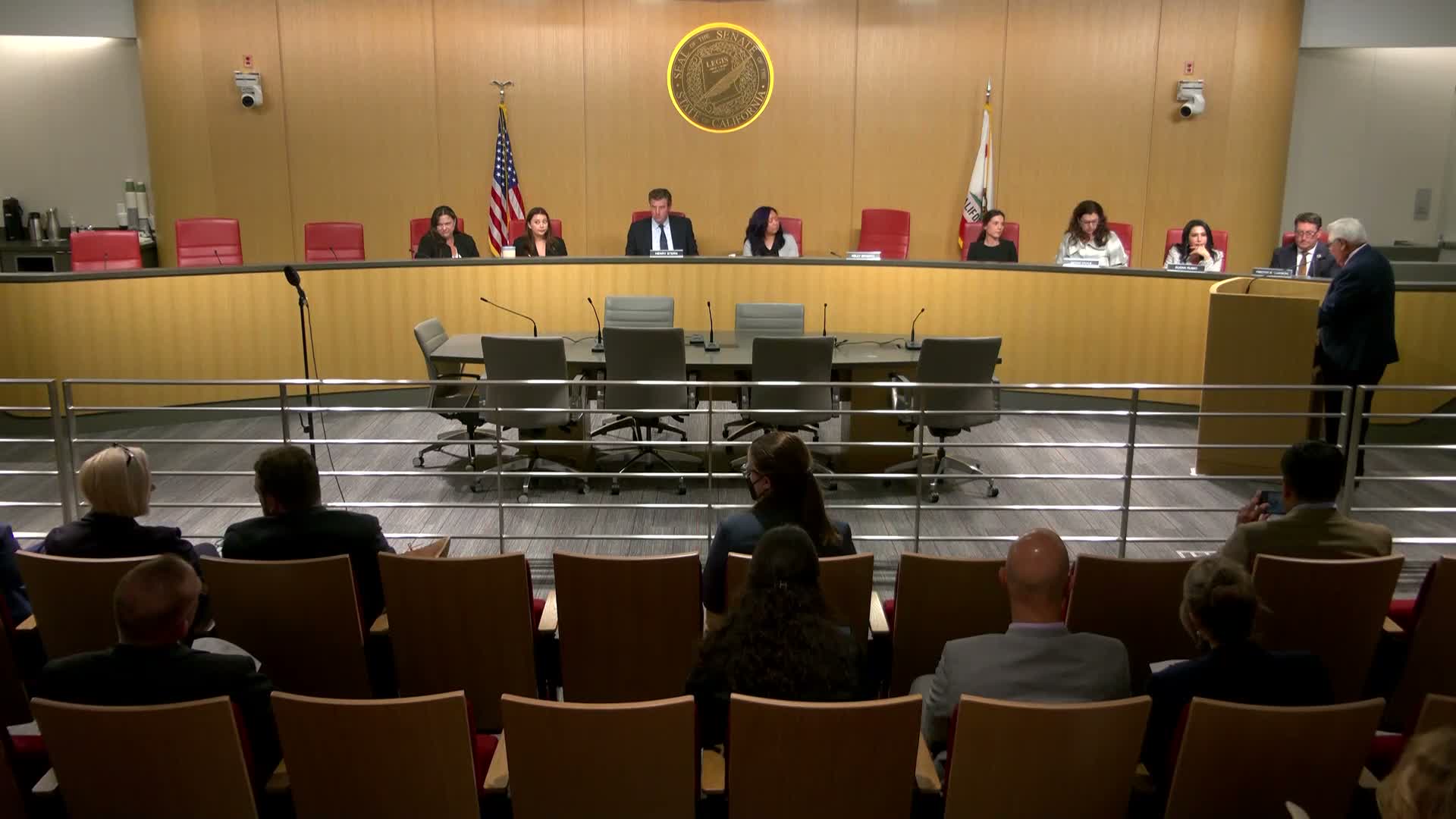
The Senate Emergency Management Committee on Thursday advanced SB 1001, a bill that would direct the Governor27s Office of Emergency Services to establish a standardized identification credential for essential utility workers whose duties require access to restricted emergency areas.
Senator Archuleta, the bill27s author, said the measure responds to cases in which utility crews with documentation and marked vehicles were denied entry during emergencies. "Without a universally recognizable authorization system, lines of communication between parties can fail, leading to hours, maybe even days, in delays or complete denial of access," he said while presenting the bill and citing the 2025 Eaton Fire.
Tom Coleman, general manager of Roland Water District, testified that his district had an employee identification program and dispatched seven trained employees after the Eaton Fire who were denied access at a law-enforcement checkpoint despite presenting ID and mutual-aid documentation. Coleman said crews were ultimately routed through alternate means, costing valuable time while he estimated water losses at up to 20 gallons per minute across roughly 500 homes.
Adrienne Beatty, chief executive officer of the Association of California Water Agencies Joint Powers Insurance Authority (ACWA JPA), a cosponsor, told the committee SB 1001 would provide a vetted credential that law enforcement can recognize and that it would preserve officers27 authority to deny access when conditions are unsafe. "The bill directs the Office of Emergency Services to establish a standardized identification credential for essential utility workers," Beatty said, adding the system would align credentialing with federal emergency management standards.
Committee staff reported no opposition on the record in the hearing room. After brief questions and comments from members, the committee voted to pass SB 1001 to the Public Safety Committee; the chair said there were sufficient votes to move the measure and the item was left on call for absent members.
SB 1001 aims to reduce ad-hoc verification at evacuation checkpoints and speed restoration of critical infrastructure during disasters. The committee left the measure on call for members not present at the roll call; the next procedural step is referral and consideration in the Assembly committee identified by the Senate referral.
Senator Archuleta, the bill27s author, said the measure responds to cases in which utility crews with documentation and marked vehicles were denied entry during emergencies. "Without a universally recognizable authorization system, lines of communication between parties can fail, leading to hours, maybe even days, in delays or complete denial of access," he said while presenting the bill and citing the 2025 Eaton Fire.
Tom Coleman, general manager of Roland Water District, testified that his district had an employee identification program and dispatched seven trained employees after the Eaton Fire who were denied access at a law-enforcement checkpoint despite presenting ID and mutual-aid documentation. Coleman said crews were ultimately routed through alternate means, costing valuable time while he estimated water losses at up to 20 gallons per minute across roughly 500 homes.
Adrienne Beatty, chief executive officer of the Association of California Water Agencies Joint Powers Insurance Authority (ACWA JPA), a cosponsor, told the committee SB 1001 would provide a vetted credential that law enforcement can recognize and that it would preserve officers27 authority to deny access when conditions are unsafe. "The bill directs the Office of Emergency Services to establish a standardized identification credential for essential utility workers," Beatty said, adding the system would align credentialing with federal emergency management standards.
Committee staff reported no opposition on the record in the hearing room. After brief questions and comments from members, the committee voted to pass SB 1001 to the Public Safety Committee; the chair said there were sufficient votes to move the measure and the item was left on call for absent members.
SB 1001 aims to reduce ad-hoc verification at evacuation checkpoints and speed restoration of critical infrastructure during disasters. The committee left the measure on call for members not present at the roll call; the next procedural step is referral and consideration in the Assembly committee identified by the Senate referral.
View the Full Meeting & All Its Details
This article offers just a summary. Unlock complete video, transcripts, and insights as a Founder Member.
✓
Watch full, unedited meeting videos
✓
Search every word spoken in unlimited transcripts
✓
AI summaries & real-time alerts (all government levels)
✓
Permanent access to expanding government content
30-day money-back guarantee
