Senate subcommittee hears OCS update on HB 151 implementation; agency cites staffing shortfalls, training changes and system funding gaps
March 24, 2026 | 2026 Legislature Alaska, Alaska
This article was created by AI summarizing key points discussed. AI makes mistakes, so for full details and context, please refer to the video of the full meeting. Please report any errors so we can fix them. Report an error »
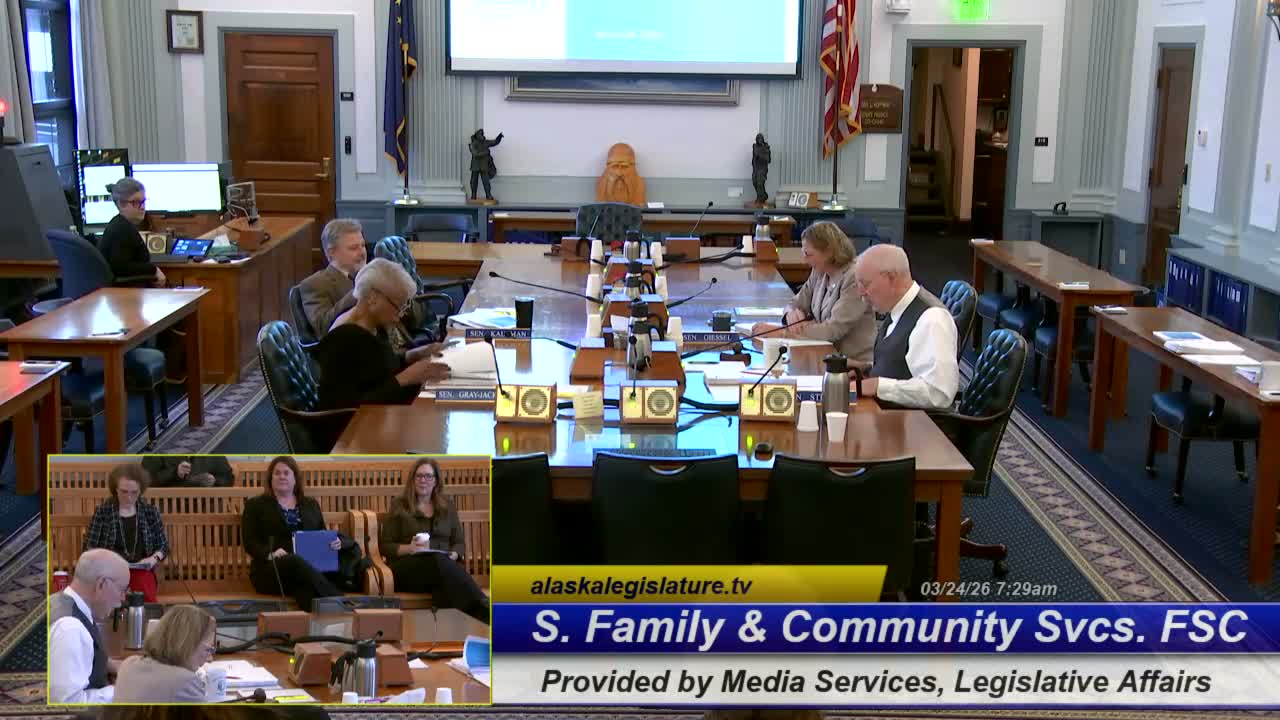
At a March 24, 2026 meeting of the Alaska Senate budget subcommittee for the Department of Family and Community Services, Acting Commissioner Tracy Dompley and Kim Graham, director of the Office of Children’s Services, reviewed implementation steps from the Part 3 audit of HB 151 and outlined continuing staffing, training and information-technology challenges.
Graham told the committee the Part 3 audit, published in July 2025, produced seven recommendations and that the agency has moved vacancy reporting into Smartsheet, expanded training and launched a talent-acquisition team to speed hiring. "We have a lot of vacancies, so things get sometimes lost in translation," Graham said, adding that the department has shifted to a six-week mixed training model with mentors assigned for the first six months.
Why it matters: OCS oversees child-protection casework that affects foster placements, reunification and permanency. Staffing, training and system capacity influence how quickly cases are handled and whether children have stable placements.
Key details from the briefing
- Staffing and turnover: Graham said OCS’s current vacancy rate is about 25%, frontline turnover is about 40%, and agency-wide turnover about 32%. She said hiring improved over the last six months but that retention remains the priority.
- Pay and qualifications: Senator Giesel urged higher qualification requirements and pay, arguing the state’s change to allow non-degree hires has diluted experience and increased training costs. "Those [criteria] were diluted significantly," Senator Giesel said, calling for higher pay to reduce turnover. Graham responded that the hiring changes were statewide and partly a response to COVID-era workforce shortages and that OCS seeks paths to recruit both degreed professionals and skilled non-degree hires.
- Starting pay: Graham said a Protective Service Specialist 1 in Anchorage begins at $28.50 per hour and that starting pay does not differ by degree; staff can be hired at higher PSS levels or advanced steps in limited circumstances.
- Training changes: OCS now uses a blended training model—Zoom classroom cohorts, field-based transfer-of-learning weeks with mentors, and an in-region week five or six that is in person. The agency is piloting courtroom simulations at the University of Alaska Anchorage and uses individual learning plans at the three-month mark to tailor continuing training.
- Federal programs and tribal options: On the Family First Prevention Services Act (FFPSA), Graham said Alaska initially pursued FFPSA but did not continue a statewide plan because of capacity limits and the program’s payer-of-last-resort design. She noted a 2024 change allowing tribal FFPSA plans and said two Alaska tribes are pursuing tribal plans.
- Child-welfare outcomes and tribal partnership: Graham said roughly 68–69% of children in care are Alaska Native and that about 56% of children are placed with relatives—both figures among the highest nationally—which OCS attributes in part to the Alaska Child Welfare Compact (signed 2017) and ongoing tribal coordination for diligent relative searches.
- IT system and federal reimbursement: Graham told senators the agency’s legacy case-management system, ORCA, is more than 20 years old and mobile-capability limited. She said the federal reimbursement rate for the system was reduced from 50% to 35% because the system is outdated, and that replacing ORCA could cost on the order of $40 million to $70 million; OCS plans to pursue rural health transformation and other funding to offset state costs.
- Federal review and fines: On the federal Child and Family Services Review (CFSR), Graham said Alaska entered a performance improvement plan after prior reviews, was unable to meet some measures and paid a $560,000 fine in 2024 related to PIP shortfalls.
- Placements and emergency accommodations: When asked about children spending nights in offices or hotels, Graham said that, occasionally, hotels or offices are used when therapeutic homes are unavailable and that OCS typically assigns two staff to supervise lone youths housed in hotels. She said OCS is working to recruit more foster/resource families to reduce such occurrences and will provide the committee more detailed counts on hotel or office use.
- Data gaps and next steps: Committee members asked about rows labeled "unknown" in placement data; Graham said the label often reflects late or missing data entry or classifications such as runaway status, and offered to provide more granular region-by-region data and trend counts on substance-related entries, placements by age and the magnitude of hotel/office use.
The committee requested follow-up information including the exact dollar figure for the loss in federal ORCA reimbursement, regional placement and relative-placement tables, counts of children placed temporarily in hotels or offices, and trend data on children entering care due to parental substance exposure. The panel adjourned at 8:28 a.m.
Graham told the committee the Part 3 audit, published in July 2025, produced seven recommendations and that the agency has moved vacancy reporting into Smartsheet, expanded training and launched a talent-acquisition team to speed hiring. "We have a lot of vacancies, so things get sometimes lost in translation," Graham said, adding that the department has shifted to a six-week mixed training model with mentors assigned for the first six months.
Why it matters: OCS oversees child-protection casework that affects foster placements, reunification and permanency. Staffing, training and system capacity influence how quickly cases are handled and whether children have stable placements.
Key details from the briefing
- Staffing and turnover: Graham said OCS’s current vacancy rate is about 25%, frontline turnover is about 40%, and agency-wide turnover about 32%. She said hiring improved over the last six months but that retention remains the priority.
- Pay and qualifications: Senator Giesel urged higher qualification requirements and pay, arguing the state’s change to allow non-degree hires has diluted experience and increased training costs. "Those [criteria] were diluted significantly," Senator Giesel said, calling for higher pay to reduce turnover. Graham responded that the hiring changes were statewide and partly a response to COVID-era workforce shortages and that OCS seeks paths to recruit both degreed professionals and skilled non-degree hires.
- Starting pay: Graham said a Protective Service Specialist 1 in Anchorage begins at $28.50 per hour and that starting pay does not differ by degree; staff can be hired at higher PSS levels or advanced steps in limited circumstances.
- Training changes: OCS now uses a blended training model—Zoom classroom cohorts, field-based transfer-of-learning weeks with mentors, and an in-region week five or six that is in person. The agency is piloting courtroom simulations at the University of Alaska Anchorage and uses individual learning plans at the three-month mark to tailor continuing training.
- Federal programs and tribal options: On the Family First Prevention Services Act (FFPSA), Graham said Alaska initially pursued FFPSA but did not continue a statewide plan because of capacity limits and the program’s payer-of-last-resort design. She noted a 2024 change allowing tribal FFPSA plans and said two Alaska tribes are pursuing tribal plans.
- Child-welfare outcomes and tribal partnership: Graham said roughly 68–69% of children in care are Alaska Native and that about 56% of children are placed with relatives—both figures among the highest nationally—which OCS attributes in part to the Alaska Child Welfare Compact (signed 2017) and ongoing tribal coordination for diligent relative searches.
- IT system and federal reimbursement: Graham told senators the agency’s legacy case-management system, ORCA, is more than 20 years old and mobile-capability limited. She said the federal reimbursement rate for the system was reduced from 50% to 35% because the system is outdated, and that replacing ORCA could cost on the order of $40 million to $70 million; OCS plans to pursue rural health transformation and other funding to offset state costs.
- Federal review and fines: On the federal Child and Family Services Review (CFSR), Graham said Alaska entered a performance improvement plan after prior reviews, was unable to meet some measures and paid a $560,000 fine in 2024 related to PIP shortfalls.
- Placements and emergency accommodations: When asked about children spending nights in offices or hotels, Graham said that, occasionally, hotels or offices are used when therapeutic homes are unavailable and that OCS typically assigns two staff to supervise lone youths housed in hotels. She said OCS is working to recruit more foster/resource families to reduce such occurrences and will provide the committee more detailed counts on hotel or office use.
- Data gaps and next steps: Committee members asked about rows labeled "unknown" in placement data; Graham said the label often reflects late or missing data entry or classifications such as runaway status, and offered to provide more granular region-by-region data and trend counts on substance-related entries, placements by age and the magnitude of hotel/office use.
The committee requested follow-up information including the exact dollar figure for the loss in federal ORCA reimbursement, regional placement and relative-placement tables, counts of children placed temporarily in hotels or offices, and trend data on children entering care due to parental substance exposure. The panel adjourned at 8:28 a.m.
View the Full Meeting & All Its Details
This article offers just a summary. Unlock complete video, transcripts, and insights as a Founder Member.
✓
Watch full, unedited meeting videos
✓
Search every word spoken in unlimited transcripts
✓
AI summaries & real-time alerts (all government levels)
✓
Permanent access to expanding government content
30-day money-back guarantee
