Insurers and environmental group urge changes to House Bill 369, criticizing utility liability and energy definition
March 24, 2026 | 2026 Legislature Alaska, Alaska
This article was created by AI summarizing key points discussed. AI makes mistakes, so for full details and context, please refer to the video of the full meeting. Please report any errors so we can fix them. Report an error »
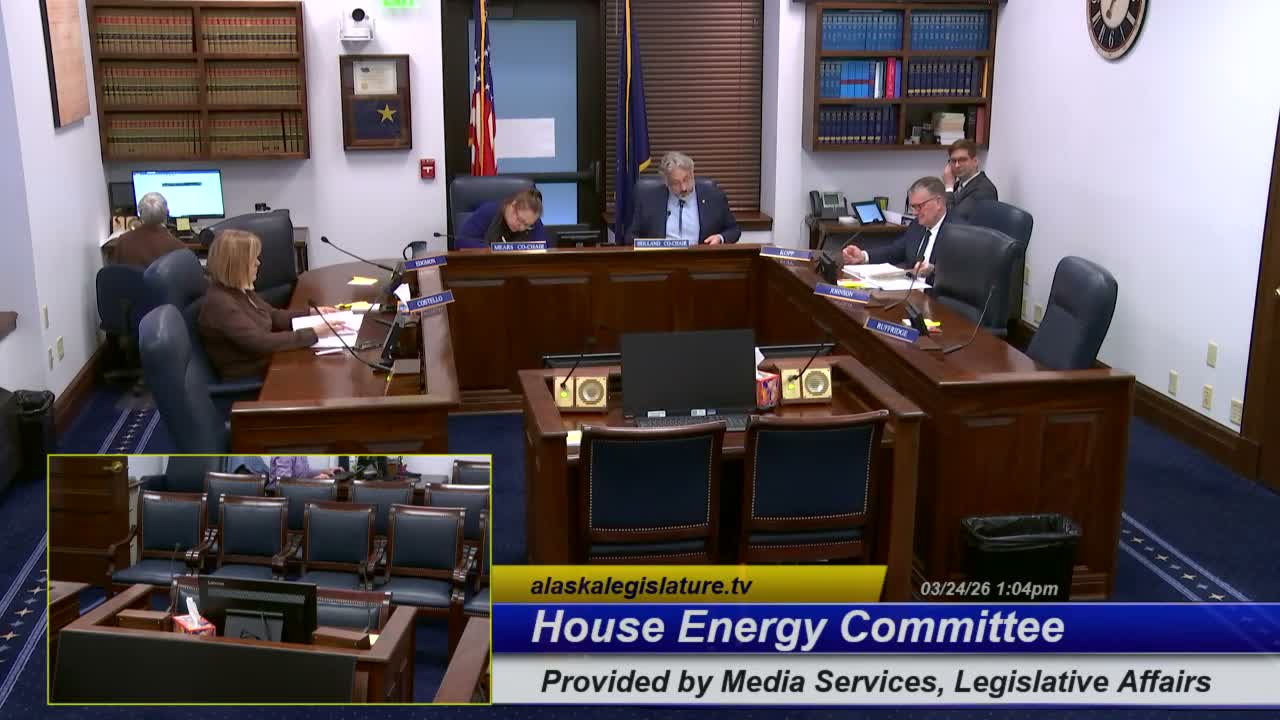
Cochair Representative Holland opened the House Energy Committee on March 24 and took public testimony on House Bill 369, an energy omnibus bill that includes a diversified portfolio standard for utilities and provisions on right-of-way and vegetation management.
Leanne Alexander, representing the American Property and Casualty Insurance Association, testified that APCIA "respectfully opposes House Bill 369 in its current form," focusing on sections 2 and 3 that address utility liability for fires. Alexander said the bill's language "ultimately establishes a liability framework that would significantly reduce utilities responsibility for fires that are ignited and spread by their equipment and activities," shifting "substantial financial risk on to Alaskans" and reducing utilities' incentives to pursue robust wildfire mitigation.
Alexander said the bill lacks clear standards, public engagement processes and meaningful state oversight for wildfire-mitigation plans, and warned that the drafting creates "a significant amount of uncertainty" about how the provisions would apply if enacted. Asked about examples from other states, she said APCIA opposed similar measures elsewhere and emphasized the basic legal principle that parties that cause harm should remain responsible for it.
Declan Farr, climate and clean energy program manager at the Alaska Center for the Environment, urged that the bill is too broad to be considered as a single omnibus measure and said individual elements should be considered separately to allow dedicated public input. Farr also said he opposes "a definition of diverse energy that includes, and in some cases, we believe favors continued reliance on fossil fuels," while expressing support for net metering and plug-in solar.
Christian Rattaj of the National Association of Mutual Insurance Companies urged the committee to preserve accountability and public-safety incentives, calling the proposed utility liability protections "contrary to this basic societal concept" of accountability and warning that the bill's liability structure is confusing, grants large legal advantages to utilities, and limits non-economic damages unless gross negligence is shown.
Committee members asked clarifying questions about how other states have approached similar legislation, whether homeowner insurance and inspection standards address danger trees near power lines, and how the bill draws the line between vegetation inside and outside utility rights-of-way. Witnesses suggested mitigation options such as undergrounding lines, insulating wires, targeted vegetation management, and public-safety power shutoffs as alternatives to broad liability shields, and said insurer and state practices vary by jurisdiction.
Cochair Holland closed public testimony after confirming no additional speakers and noted the committee would set HB 369 aside for the day; he also announced a Thursday presentation on the Alaska Energy Data Gateway from ASAP. The committee accepted written testimony by email to house.energy@akleg.gov and adjourned at 1:30 p.m.
Leanne Alexander, representing the American Property and Casualty Insurance Association, testified that APCIA "respectfully opposes House Bill 369 in its current form," focusing on sections 2 and 3 that address utility liability for fires. Alexander said the bill's language "ultimately establishes a liability framework that would significantly reduce utilities responsibility for fires that are ignited and spread by their equipment and activities," shifting "substantial financial risk on to Alaskans" and reducing utilities' incentives to pursue robust wildfire mitigation.
Alexander said the bill lacks clear standards, public engagement processes and meaningful state oversight for wildfire-mitigation plans, and warned that the drafting creates "a significant amount of uncertainty" about how the provisions would apply if enacted. Asked about examples from other states, she said APCIA opposed similar measures elsewhere and emphasized the basic legal principle that parties that cause harm should remain responsible for it.
Declan Farr, climate and clean energy program manager at the Alaska Center for the Environment, urged that the bill is too broad to be considered as a single omnibus measure and said individual elements should be considered separately to allow dedicated public input. Farr also said he opposes "a definition of diverse energy that includes, and in some cases, we believe favors continued reliance on fossil fuels," while expressing support for net metering and plug-in solar.
Christian Rattaj of the National Association of Mutual Insurance Companies urged the committee to preserve accountability and public-safety incentives, calling the proposed utility liability protections "contrary to this basic societal concept" of accountability and warning that the bill's liability structure is confusing, grants large legal advantages to utilities, and limits non-economic damages unless gross negligence is shown.
Committee members asked clarifying questions about how other states have approached similar legislation, whether homeowner insurance and inspection standards address danger trees near power lines, and how the bill draws the line between vegetation inside and outside utility rights-of-way. Witnesses suggested mitigation options such as undergrounding lines, insulating wires, targeted vegetation management, and public-safety power shutoffs as alternatives to broad liability shields, and said insurer and state practices vary by jurisdiction.
Cochair Holland closed public testimony after confirming no additional speakers and noted the committee would set HB 369 aside for the day; he also announced a Thursday presentation on the Alaska Energy Data Gateway from ASAP. The committee accepted written testimony by email to house.energy@akleg.gov and adjourned at 1:30 p.m.
View the Full Meeting & All Its Details
This article offers just a summary. Unlock complete video, transcripts, and insights as a Founder Member.
✓
Watch full, unedited meeting videos
✓
Search every word spoken in unlimited transcripts
✓
AI summaries & real-time alerts (all government levels)
✓
Permanent access to expanding government content
30-day money-back guarantee
