Committee rejects consolidation motion after heated debate over nuclear coordination and mining roles
March 11, 2026 | JOINT, Committees, Legislative, Idaho
This article was created by AI summarizing key points discussed. AI makes mistakes, so for full details and context, please refer to the video of the full meeting. Please report any errors so we can fix them. Report an error »
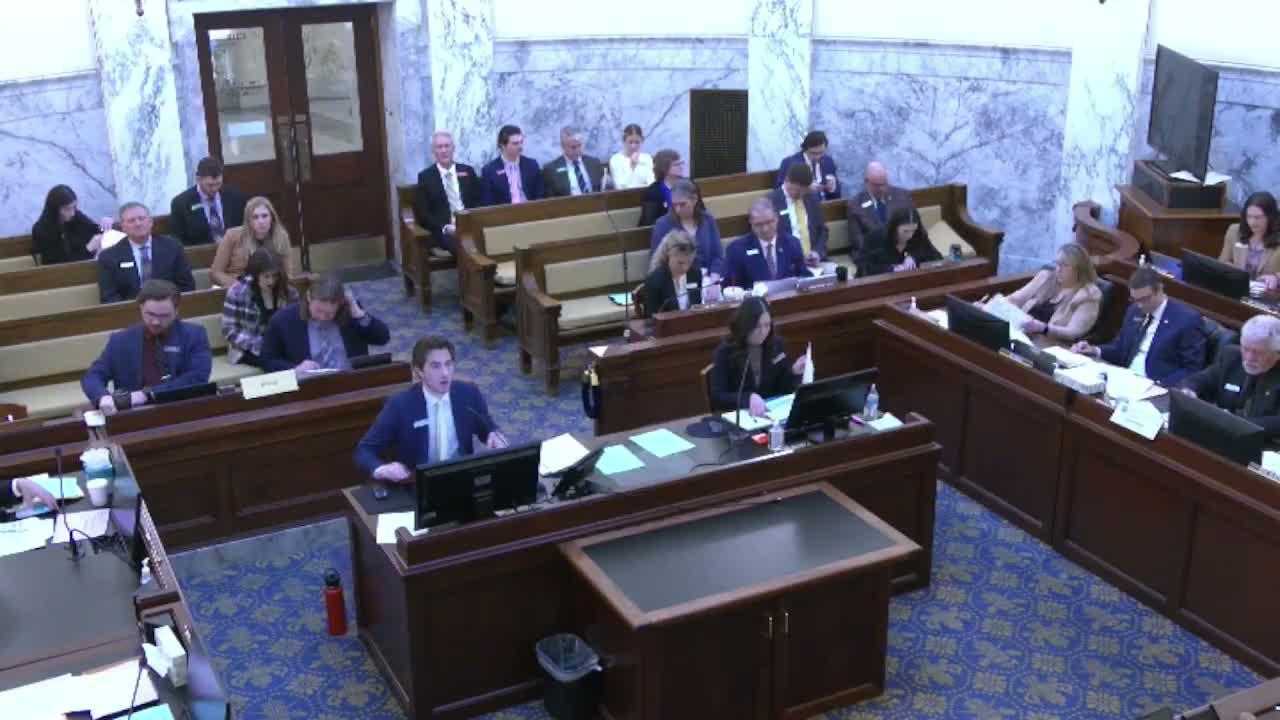
The joint Senate Finance and House Appropriations committees considered a broad consolidation that would merge the Office of Energy and Mineral Resources (OEMR) and the Office of Species Conservation into an Office of Species, Mineral, and Energy Coordination and add multiple enhancements including fisheries funding, an Idaho Orchestrating Nuclear (ION) staff line, and an energy‑resiliency reappropriation.
Noah Peterson and Janet Jessup briefed the committee about the proposed moves and associated fiscal figures. Peterson said OEMR is authorized by executive order and described three main requests for FY2027: a personnel/fund realignment, staffing for Idaho Orchestrating Nuclear (ION), and a home‑efficiency rebate program that the governor did not recommend.
Administrator Callie Younger of OEMR described her office’s role: coordinating state permitting and providing a single point of contact for businesses seeking to develop nuclear or critical‑mineral projects in Idaho. She said OEMR helps companies navigate multiple state agencies, including the Department of Environmental Quality, Department of Water Resources, and Department of Lands.
"What we've been trying to do is say, just come here to our office; we walk you through the entire thing so you don't have seven different points of contact," Younger said, describing the one‑stop coordination function she said helps speed permitting and attract projects.
Supporters argued that maintaining staff capacity for nuclear coordination and mining facilitation would help Idaho compete for major projects and federal partnerships. Senator Cook, Representative Furness and others said a small investment and two FTPs would support business development at Idaho National Laboratory and in critical‑minerals mining.
Opponents urged larger savings and argued the state should adhere to the policy bill’s direction to reduce FTPs. Lawmakers alternately proposed cutting 4 FTPs (substitute) or 2 FTPs while preserving minimal nuclear coordination staff. The substitute motion to adopt larger cuts failed in the Senate, and the original motion did not achieve a House majority and therefore failed to carry the committee’s recommendation.
Fiscal and implementation clarifications: OEMR financial staff and Legislative Services analysts noted differences between the fiscal note and substitute motion math, particularly across general, dedicated and federal funds. Louie Conkel, OEMR financial officer, explained the agency’s SOP breakdown and noted that the proposed reductions would affect multiple federal grant buckets.
Why it matters: the failed consolidation leaves pending questions about how Idaho will staff nuclear coordination and whether the state will brand itself to attract nuclear or critical‑mineral projects. The debate exposed tradeoffs between short‑term savings and longer‑term economic development aims.
Next steps: because the consolidation motion failed to secure a House affirmative vote, no committee recommendation will move forward on that combined package from this joint session. Agencies and lawmakers may revisit staffing and funding in future committee or floor proceedings.
Noah Peterson and Janet Jessup briefed the committee about the proposed moves and associated fiscal figures. Peterson said OEMR is authorized by executive order and described three main requests for FY2027: a personnel/fund realignment, staffing for Idaho Orchestrating Nuclear (ION), and a home‑efficiency rebate program that the governor did not recommend.
Administrator Callie Younger of OEMR described her office’s role: coordinating state permitting and providing a single point of contact for businesses seeking to develop nuclear or critical‑mineral projects in Idaho. She said OEMR helps companies navigate multiple state agencies, including the Department of Environmental Quality, Department of Water Resources, and Department of Lands.
"What we've been trying to do is say, just come here to our office; we walk you through the entire thing so you don't have seven different points of contact," Younger said, describing the one‑stop coordination function she said helps speed permitting and attract projects.
Supporters argued that maintaining staff capacity for nuclear coordination and mining facilitation would help Idaho compete for major projects and federal partnerships. Senator Cook, Representative Furness and others said a small investment and two FTPs would support business development at Idaho National Laboratory and in critical‑minerals mining.
Opponents urged larger savings and argued the state should adhere to the policy bill’s direction to reduce FTPs. Lawmakers alternately proposed cutting 4 FTPs (substitute) or 2 FTPs while preserving minimal nuclear coordination staff. The substitute motion to adopt larger cuts failed in the Senate, and the original motion did not achieve a House majority and therefore failed to carry the committee’s recommendation.
Fiscal and implementation clarifications: OEMR financial staff and Legislative Services analysts noted differences between the fiscal note and substitute motion math, particularly across general, dedicated and federal funds. Louie Conkel, OEMR financial officer, explained the agency’s SOP breakdown and noted that the proposed reductions would affect multiple federal grant buckets.
Why it matters: the failed consolidation leaves pending questions about how Idaho will staff nuclear coordination and whether the state will brand itself to attract nuclear or critical‑mineral projects. The debate exposed tradeoffs between short‑term savings and longer‑term economic development aims.
Next steps: because the consolidation motion failed to secure a House affirmative vote, no committee recommendation will move forward on that combined package from this joint session. Agencies and lawmakers may revisit staffing and funding in future committee or floor proceedings.
Don't Miss a Word: See the Full Meeting!
Go beyond summaries. Unlock every video, transcript, and key insight with a Founder Membership.
✓
Get instant access to full meeting videos
✓
Search and clip any phrase from complete transcripts
✓
Receive AI-powered summaries & custom alerts
✓
Enjoy lifetime, unrestricted access to government data
30-day money-back guarantee
