Alaska coalition tells Senate committee 'Housing is health care,' urges data sharing and stable funding
March 24, 2026 | 2026 Legislature Alaska, Alaska
This article was created by AI summarizing key points discussed. AI makes mistakes, so for full details and context, please refer to the video of the full meeting. Please report any errors so we can fix them. Report an error »
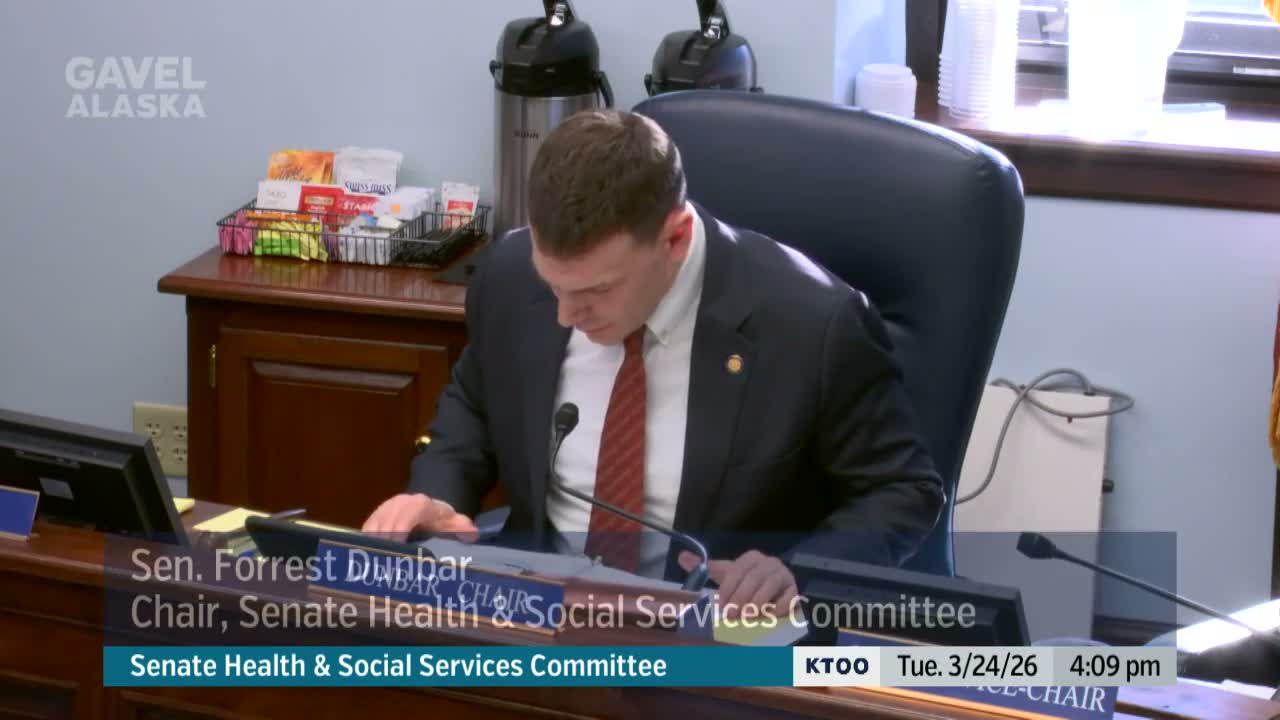
Owen Brooks, director of organizational development for the Alaska Coalition on Housing and Homelessness, presented to the Senate Health and Social Services Committee on how housing conditions and homelessness affect health outcomes across Alaska.
Brooks told the committee that social and economic factors — including housing quality, neighborhood conditions, and economic stability — have major impacts on population health. Citing the National Health Care for the Homeless, he said people experiencing homelessness are "3 to 4 times more likely to die prematurely," face higher rates of heart attack and stroke, and have a life expectancy around 48 years — roughly three decades less than the general population. He also summarized AHFC (2018) data and a Johns Hopkins study showing correlations between poor housing quality (structural deficiencies, lack of plumbing, indoor air risks), overcrowding and worse self‑reported health.
Brooks described effective interventions — Housing First, mobile and integrated health services, co‑located clinics and case management — and highlighted the role of HUD Continuums of Care (CoC) in administering federal grants. He said HMIS (Homeless Management Information System) currently lacks interoperability and that the coalition has been piloting data sharing with the Department of Health since November 2025 to transmit a single data element (Medicaid enrollment status) so programs can enroll eligible people in Medicaid more quickly. Brian Wilson (executive director, Alaska Coalition) explained that nonmedical HMIS data have been shared since about 2018 but the inclusion of Department of Health verification of Medicaid status is the recent change.
Brooks warned about funding instability: last year the state homeless assistance program was increased to $10,150,000 but the governor's budget proposed cutting it to roughly $5,000,000, a reduction program leaders said would sharply constrain services. Senators asked about kitchen quality, overcrowding and local street‑medicine pilots; Brooks and others described local mobile health teams and suggested municipalities are piloting street medicine while statewide coordination remains limited.
Brooks concluded by urging improved data systems, stable funding and continued coordination between housing and health providers to reduce emergency care use and improve long‑term outcomes.
Brooks told the committee that social and economic factors — including housing quality, neighborhood conditions, and economic stability — have major impacts on population health. Citing the National Health Care for the Homeless, he said people experiencing homelessness are "3 to 4 times more likely to die prematurely," face higher rates of heart attack and stroke, and have a life expectancy around 48 years — roughly three decades less than the general population. He also summarized AHFC (2018) data and a Johns Hopkins study showing correlations between poor housing quality (structural deficiencies, lack of plumbing, indoor air risks), overcrowding and worse self‑reported health.
Brooks described effective interventions — Housing First, mobile and integrated health services, co‑located clinics and case management — and highlighted the role of HUD Continuums of Care (CoC) in administering federal grants. He said HMIS (Homeless Management Information System) currently lacks interoperability and that the coalition has been piloting data sharing with the Department of Health since November 2025 to transmit a single data element (Medicaid enrollment status) so programs can enroll eligible people in Medicaid more quickly. Brian Wilson (executive director, Alaska Coalition) explained that nonmedical HMIS data have been shared since about 2018 but the inclusion of Department of Health verification of Medicaid status is the recent change.
Brooks warned about funding instability: last year the state homeless assistance program was increased to $10,150,000 but the governor's budget proposed cutting it to roughly $5,000,000, a reduction program leaders said would sharply constrain services. Senators asked about kitchen quality, overcrowding and local street‑medicine pilots; Brooks and others described local mobile health teams and suggested municipalities are piloting street medicine while statewide coordination remains limited.
Brooks concluded by urging improved data systems, stable funding and continued coordination between housing and health providers to reduce emergency care use and improve long‑term outcomes.
View the Full Meeting & All Its Details
This article offers just a summary. Unlock complete video, transcripts, and insights as a Founder Member.
✓
Watch full, unedited meeting videos
✓
Search every word spoken in unlimited transcripts
✓
AI summaries & real-time alerts (all government levels)
✓
Permanent access to expanding government content
30-day money-back guarantee
