Senate approves GPS monitoring for certain high‑risk domestic‑violence defendants after debate over cost and presumption of innocence
March 24, 2026 | 2026 Legislature OK, Oklahoma
This article was created by AI summarizing key points discussed. AI makes mistakes, so for full details and context, please refer to the video of the full meeting. Please report any errors so we can fix them. Report an error »
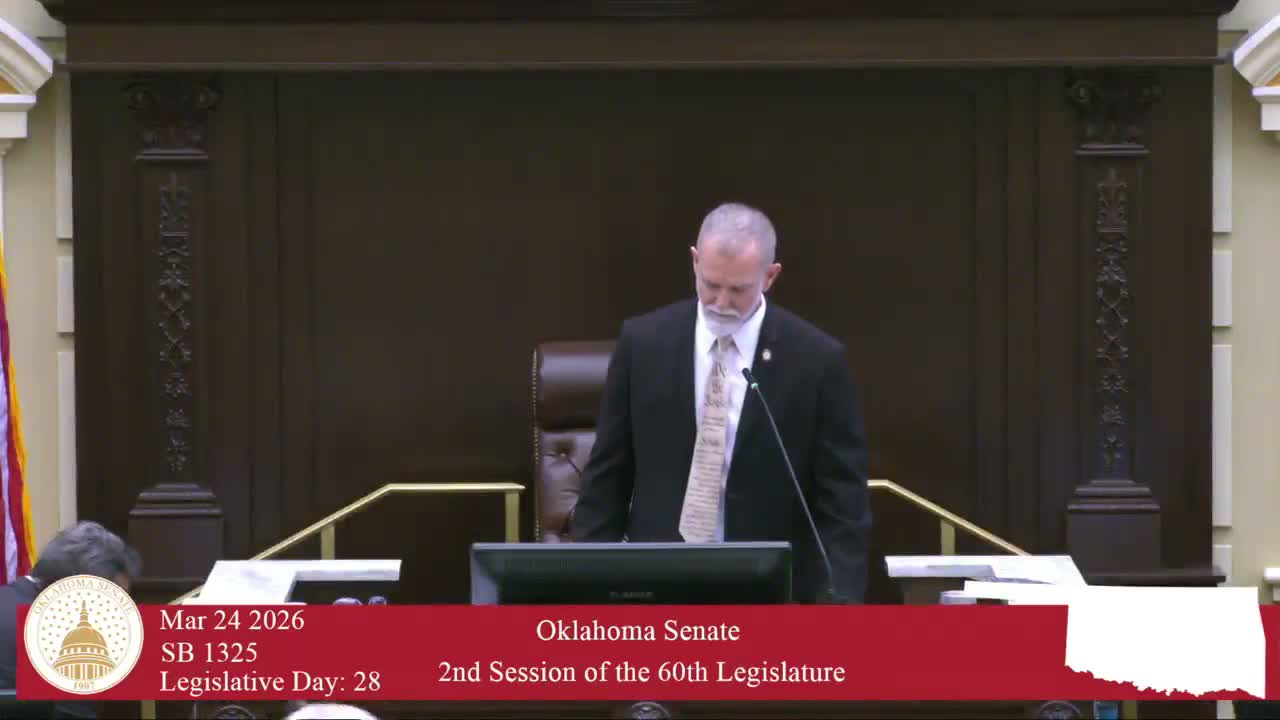
The Oklahoma Senate passed SB1325, a bill targeting high‑risk domestic‑violence cases that would require defendants charged with strangulation or use of a deadly weapon to wear a GPS ankle monitor as a condition of pretrial release.
Sponsor Senator Coleman said the bill is narrowly focused on the highest‑risk incidents and seeks to provide victims and law enforcement early warning if a defendant approaches. "GPS monitoring gives law enforcement and victims early warning if a defendant gets too close," the sponsor said while explaining the bill.
The chamber adopted an amendment allowing the Department of Corrections to outsource monitoring to approved private providers; the sponsor said the defendant would pay the monitoring cost (the floor record cites a $3.98 per‑day monitoring fee and an $800 one‑time equipment fee). Senators pressed the sponsor on several points: how a vendor would be paid, what happens if a defendant cannot afford fees, whether judges retain discretion, and how the requirement aligns with the presumption of innocence.
"If they don't pay for the monitoring system, they will not be released on bond," the sponsor said, prompting questions from senators about the practical effect: whether inability to pay would amount to mandatory detention. The sponsor responded that current draft places the cost on the defendant and that a refund mechanism for exonerated defendants is intended to be added, though not yet in the bill's text.
Other senators pressed whether the bill creates a blanket requirement or leaves room for judicial discretion; the sponsor said judges would have a role and that the bill is aimed at the most dangerous cases rather than all domestic‑violence charges.
Supporters argued the approach has saved lives in other states and would provide victims with real‑time notice and law enforcement with early warning; critics warned about constitutional and practical implications if pretrial conditions operate as de facto punishment for those not yet convicted.
After extended questioning and debate, the Senate adopted the amendment, struck title, and passed SB1325 on third reading by roll call (47–0). The bill was declared an emergency measure on the floor.
Sponsor Senator Coleman said the bill is narrowly focused on the highest‑risk incidents and seeks to provide victims and law enforcement early warning if a defendant approaches. "GPS monitoring gives law enforcement and victims early warning if a defendant gets too close," the sponsor said while explaining the bill.
The chamber adopted an amendment allowing the Department of Corrections to outsource monitoring to approved private providers; the sponsor said the defendant would pay the monitoring cost (the floor record cites a $3.98 per‑day monitoring fee and an $800 one‑time equipment fee). Senators pressed the sponsor on several points: how a vendor would be paid, what happens if a defendant cannot afford fees, whether judges retain discretion, and how the requirement aligns with the presumption of innocence.
"If they don't pay for the monitoring system, they will not be released on bond," the sponsor said, prompting questions from senators about the practical effect: whether inability to pay would amount to mandatory detention. The sponsor responded that current draft places the cost on the defendant and that a refund mechanism for exonerated defendants is intended to be added, though not yet in the bill's text.
Other senators pressed whether the bill creates a blanket requirement or leaves room for judicial discretion; the sponsor said judges would have a role and that the bill is aimed at the most dangerous cases rather than all domestic‑violence charges.
Supporters argued the approach has saved lives in other states and would provide victims with real‑time notice and law enforcement with early warning; critics warned about constitutional and practical implications if pretrial conditions operate as de facto punishment for those not yet convicted.
After extended questioning and debate, the Senate adopted the amendment, struck title, and passed SB1325 on third reading by roll call (47–0). The bill was declared an emergency measure on the floor.
View the Full Meeting & All Its Details
This article offers just a summary. Unlock complete video, transcripts, and insights as a Founder Member.
✓
Watch full, unedited meeting videos
✓
Search every word spoken in unlimited transcripts
✓
AI summaries & real-time alerts (all government levels)
✓
Permanent access to expanding government content
30-day money-back guarantee
