Austin artists press commission over Elevate grant rubrics and Spanish-language access
March 23, 2026 | Austin, Travis County, Texas
This article was created by AI summarizing key points discussed. AI makes mistakes, so for full details and context, please refer to the video of the full meeting. Please report any errors so we can fix them. Report an error »
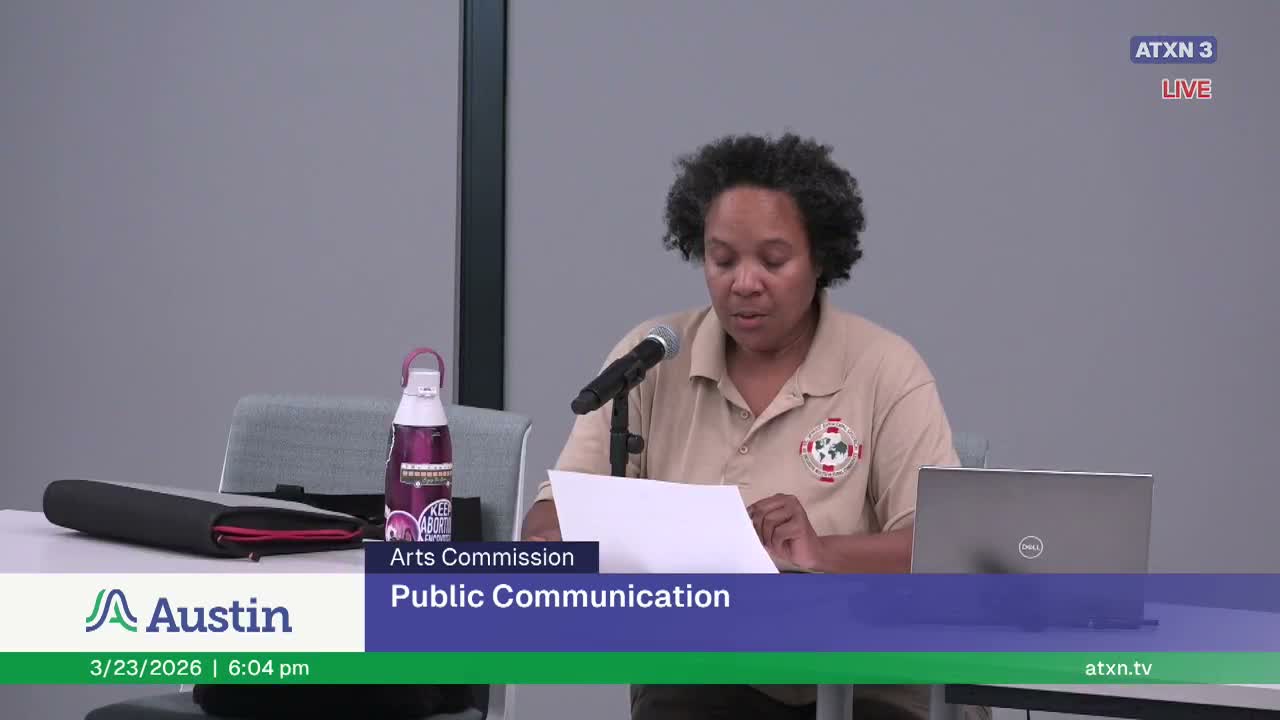
Public comment at the Austin Arts Commission focused heavily on concerns about the Elevate cultural grants, with several Spanish-speaking applicants and arts organizers describing translation problems, unclear timelines, and what they called unfair review practices.
Maggie Meador, who identified herself as "Maggie Meador" of Summer Bridal Theater, told commissioners the grant rubric was not available during application and said reviewers’ written comments could be harmful: "it was very hurtful that they didn't even write in complete sentences," Meador said, urging clearer reviewer standards and reconsideration of a policy that removed staff feedback for applicants.
Joel LaViolette, director of the Rattletree School of Marimba, said his group was misclassified after awards were published: "When the awards were published, this project was listed under my personal name and categorized as an individual artist award," LaViolette said, adding that the change capped funding at the individual level and misrepresented the organization that will deliver the programming. He asked the commission to direct staff to review and correct the classification.
Several other public commenters, speaking in Spanish and English, described a pattern of problems: workshops not publicized in Spanish; translated materials that changed the meaning of eligibility guidance; late "green-light" eligibility messages sent hours before application deadlines; and high-scoring Spanish-language applications later marked ineligible. Maria Luisa Gutierrez told the commission she was left out of the funding cycle "even though it was my highest application score to date" and asked why translation and interpretation services were inadequate.
Staff acknowledged the complaints and described current practices. Jaime Castillo, manager for Art in Public Places, and Morgan Mesic, assistant director, said translations are produced in parallel with English materials, reviewed by human translators on an approved master agreement, and that staff will continue improving outreach and translation testing. Mesic said ACME will follow up with teams and noted the division is constrained by master-contractor lists and policy regarding hiring translators.
The commission did not take immediate action on those requests at the meeting; speakers asked the commission to support recommendations from the Hispanic Quality of Life Commission (including emergency funding options and a community navigator to assist Spanish-language applicants) and to direct staff to review classifications such as the Rattletree listing. Commissioners also asked staff to report back on steps to increase transparency about when Spanish-language workshops are publicized and how translations and rubrics are validated.
The most immediate next steps recorded at the meeting were staff follow-ups: ACME said it would meet with community stakeholders, investigate individual classification cases, and consider returning some feedback processes that applicants had in prior cycles.
Maggie Meador, who identified herself as "Maggie Meador" of Summer Bridal Theater, told commissioners the grant rubric was not available during application and said reviewers’ written comments could be harmful: "it was very hurtful that they didn't even write in complete sentences," Meador said, urging clearer reviewer standards and reconsideration of a policy that removed staff feedback for applicants.
Joel LaViolette, director of the Rattletree School of Marimba, said his group was misclassified after awards were published: "When the awards were published, this project was listed under my personal name and categorized as an individual artist award," LaViolette said, adding that the change capped funding at the individual level and misrepresented the organization that will deliver the programming. He asked the commission to direct staff to review and correct the classification.
Several other public commenters, speaking in Spanish and English, described a pattern of problems: workshops not publicized in Spanish; translated materials that changed the meaning of eligibility guidance; late "green-light" eligibility messages sent hours before application deadlines; and high-scoring Spanish-language applications later marked ineligible. Maria Luisa Gutierrez told the commission she was left out of the funding cycle "even though it was my highest application score to date" and asked why translation and interpretation services were inadequate.
Staff acknowledged the complaints and described current practices. Jaime Castillo, manager for Art in Public Places, and Morgan Mesic, assistant director, said translations are produced in parallel with English materials, reviewed by human translators on an approved master agreement, and that staff will continue improving outreach and translation testing. Mesic said ACME will follow up with teams and noted the division is constrained by master-contractor lists and policy regarding hiring translators.
The commission did not take immediate action on those requests at the meeting; speakers asked the commission to support recommendations from the Hispanic Quality of Life Commission (including emergency funding options and a community navigator to assist Spanish-language applicants) and to direct staff to review classifications such as the Rattletree listing. Commissioners also asked staff to report back on steps to increase transparency about when Spanish-language workshops are publicized and how translations and rubrics are validated.
The most immediate next steps recorded at the meeting were staff follow-ups: ACME said it would meet with community stakeholders, investigate individual classification cases, and consider returning some feedback processes that applicants had in prior cycles.
View the Full Meeting & All Its Details
This article offers just a summary. Unlock complete video, transcripts, and insights as a Founder Member.
✓
Watch full, unedited meeting videos
✓
Search every word spoken in unlimited transcripts
✓
AI summaries & real-time alerts (all government levels)
✓
Permanent access to expanding government content
30-day money-back guarantee
