Commission debates proposed changes to Art in Public Places ordinance, asks for transparency on 2% calculations
March 23, 2026 | Austin, Travis County, Texas
This article was created by AI summarizing key points discussed. AI makes mistakes, so for full details and context, please refer to the video of the full meeting. Please report any errors so we can fix them. Report an error »
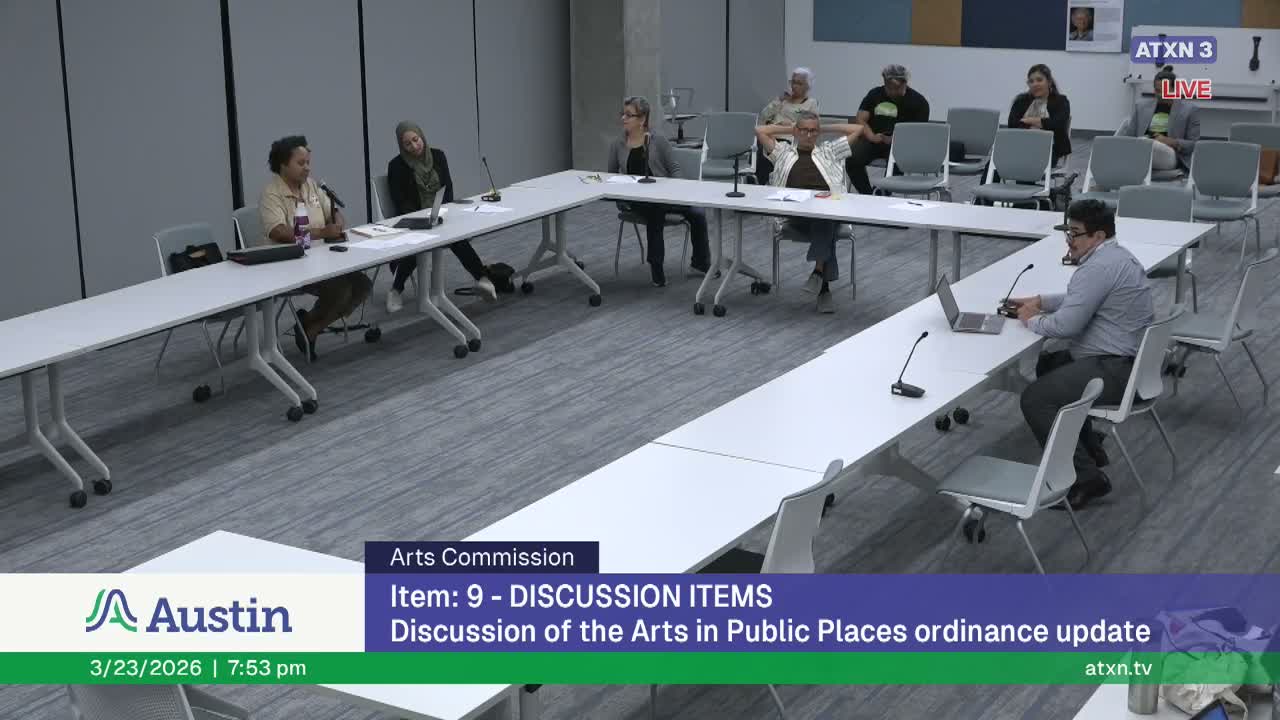
City staff presented recommended updates to the Art in Public Places ordinance and associated guidelines, prompting extended discussion among commissioners about transparency, compliance, and the fund’s effective allocation.
Jaime Castillo, manager for Art in Public Places, summarized the review process and the council resolution that directed it. Castillo said staff benchmarked 13 peer cities, surveyed the AIPP collection (about 400 artworks, currently about $20 million in capital assets), and held stakeholder focus groups and cross‑department working sessions. He described proposed changes intended to align ordinance language with industry practice and to address prior problems, including the convention-center deaccession experience.
One notable proposed edit would clarify the definition of construction costs (moving to a capital-project-costs definition) and add a set of allowable deductions that staff said reflect industry practice. Commissioner Schmalbach asked whether adding many deductions effectively reduces the percent-for-art allocation and warned that delegating exemption authority away from the Arts Commission and council to the city manager could make the ordinance toothless. "If you can be exempted from it at any time, to the city manager's office... that means that the policy just kinda doesn't mean anything," Schmalbach said.
Staff acknowledged compliance gaps and said that historically the ordinance was not always followed consistently across departments. Assistant director Morgan Mesic said ACME lacks access to some departmental budget tools and committed to seeking more integrated engagement in bond and capital planning and to requesting calculation spreadsheets where possible. "There've been compliance issues over time and so that is something that came out during this look at the ordinance," Mesic said.
Commissioners pressed staff for concrete transparency measures: public documentation of how the 2% is calculated; consistent early involvement of AIPP in bond and large-project planning; and clearer rules to prevent the effective reduction of the public-art set‑aside through expansive deductions. Staff proposed bringing a redline of the ordinance to the commission in a subsequent meeting and to supply benchmarking spreadsheets and examples used in the review.
No final vote was taken on the ordinance language at the meeting. Commissioners asked staff to remove or rework two items before the next formal review (the delegation of exemption authority and the long list of industry‑term deductions) and to provide a spreadsheet comparing recent project calculations so the commission can assess the practical funding gap and chart options before a council recommendation.
Jaime Castillo, manager for Art in Public Places, summarized the review process and the council resolution that directed it. Castillo said staff benchmarked 13 peer cities, surveyed the AIPP collection (about 400 artworks, currently about $20 million in capital assets), and held stakeholder focus groups and cross‑department working sessions. He described proposed changes intended to align ordinance language with industry practice and to address prior problems, including the convention-center deaccession experience.
One notable proposed edit would clarify the definition of construction costs (moving to a capital-project-costs definition) and add a set of allowable deductions that staff said reflect industry practice. Commissioner Schmalbach asked whether adding many deductions effectively reduces the percent-for-art allocation and warned that delegating exemption authority away from the Arts Commission and council to the city manager could make the ordinance toothless. "If you can be exempted from it at any time, to the city manager's office... that means that the policy just kinda doesn't mean anything," Schmalbach said.
Staff acknowledged compliance gaps and said that historically the ordinance was not always followed consistently across departments. Assistant director Morgan Mesic said ACME lacks access to some departmental budget tools and committed to seeking more integrated engagement in bond and capital planning and to requesting calculation spreadsheets where possible. "There've been compliance issues over time and so that is something that came out during this look at the ordinance," Mesic said.
Commissioners pressed staff for concrete transparency measures: public documentation of how the 2% is calculated; consistent early involvement of AIPP in bond and large-project planning; and clearer rules to prevent the effective reduction of the public-art set‑aside through expansive deductions. Staff proposed bringing a redline of the ordinance to the commission in a subsequent meeting and to supply benchmarking spreadsheets and examples used in the review.
No final vote was taken on the ordinance language at the meeting. Commissioners asked staff to remove or rework two items before the next formal review (the delegation of exemption authority and the long list of industry‑term deductions) and to provide a spreadsheet comparing recent project calculations so the commission can assess the practical funding gap and chart options before a council recommendation.
View the Full Meeting & All Its Details
This article offers just a summary. Unlock complete video, transcripts, and insights as a Founder Member.
✓
Watch full, unedited meeting videos
✓
Search every word spoken in unlimited transcripts
✓
AI summaries & real-time alerts (all government levels)
✓
Permanent access to expanding government content
30-day money-back guarantee
