Utility Services details $100M infrastructure work and reuse system in ISIP update
April 08, 2024 | Boca Raton, Palm Beach County, Florida
This article was created by AI summarizing key points discussed. AI makes mistakes, so for full details and context, please refer to the video of the full meeting. Please report any errors so we can fix them. Report an error »
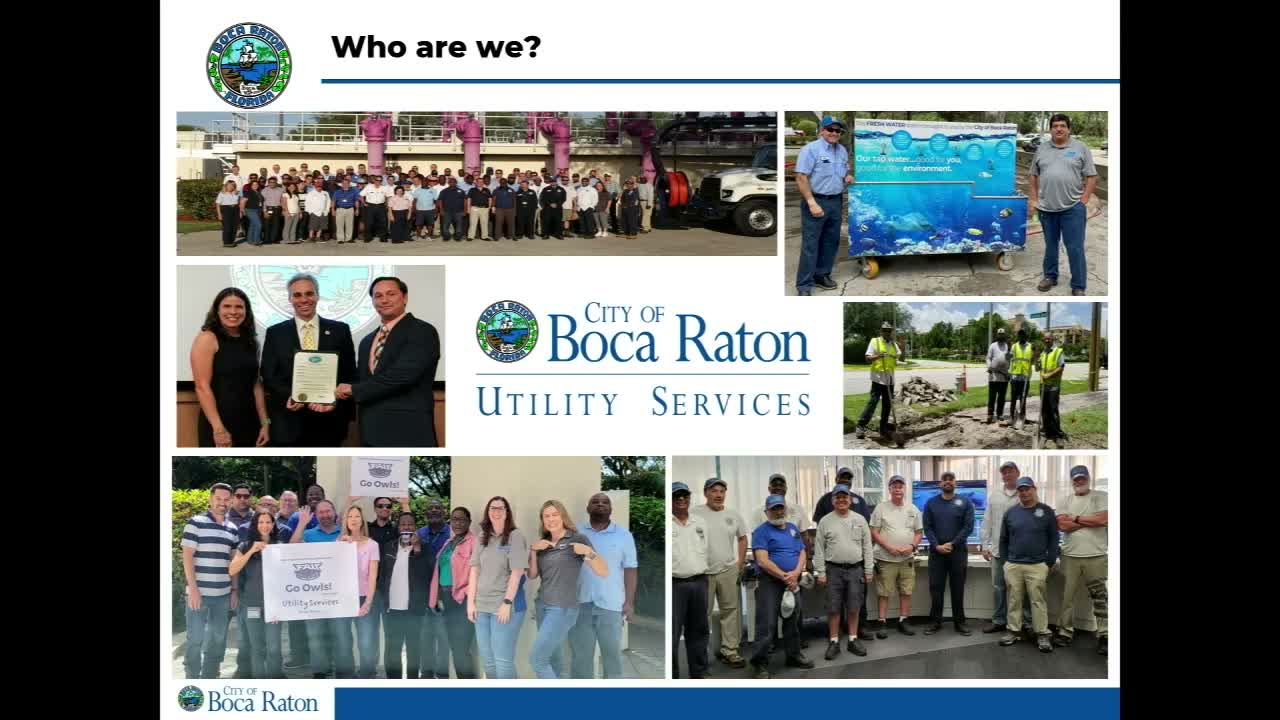
Utility Services on Monday gave a status update on the Innovative Sustainable Infrastructure Program (ISIP), outlining recent work across neighborhoods, long‑term assets and coordination steps the city takes with developers and other agencies.
Chris Helfrich, speaking for Utility Services, said the department employs about 176 staff across electricians, mechanics, plant operators and wastewater crews and operates four treatment facilities with a combined production of roughly 34 million gallons per day and a combined capacity of about 70 million gallons per day. “We are one of the only utilities in South Florida that has a 100% reuse facility,” Helfrich said, noting reclaimed water is used across nine golf courses and supplied to approximately 1,600 residential and commercial customers.
Helfrich described the ISIP approach as data‑driven and regulatory‑aligned, with neighborhood projects selected by risk and consequence of failure, pipe age and material, and pavement condition. He said the city maintains roughly 1,200 miles of pipelines — some dating to the 1940s — and that the current portfolio of on‑site construction projects is “roughly about a $100,000,000 worth of construction.”
The program includes outreach and mitigation steps during construction: staff meet homeowners during design and prior to construction, provide door hangers and on‑site contacts, and restore driveways and repave roads after work is complete. Helfrich also noted coordination with developers and larger projects (for example, hospital renovations) so utilities work can be designed and funded contemporaneously.
Council members praised the utility team's proactive work and asked technical questions. Councilmember Wigder asked whether FEMA’s changing flood maps would change the department’s construction guidelines; Helfrich said existing work (sealing gravity sewer systems and other measures) does not require new construction guidelines under the FEMA revisions. Helfrich confirmed staff coordinate with FPL and Palm Beach County on undergrounding work and said communications contractors typically remain on FPL poles while utility construction focuses on roadway and sod impacts.
Next steps: staff will continue neighborhood ISIP rollouts, coordinate sequencing with development projects, and return to council as projects are designed and scheduled.
Chris Helfrich, speaking for Utility Services, said the department employs about 176 staff across electricians, mechanics, plant operators and wastewater crews and operates four treatment facilities with a combined production of roughly 34 million gallons per day and a combined capacity of about 70 million gallons per day. “We are one of the only utilities in South Florida that has a 100% reuse facility,” Helfrich said, noting reclaimed water is used across nine golf courses and supplied to approximately 1,600 residential and commercial customers.
Helfrich described the ISIP approach as data‑driven and regulatory‑aligned, with neighborhood projects selected by risk and consequence of failure, pipe age and material, and pavement condition. He said the city maintains roughly 1,200 miles of pipelines — some dating to the 1940s — and that the current portfolio of on‑site construction projects is “roughly about a $100,000,000 worth of construction.”
The program includes outreach and mitigation steps during construction: staff meet homeowners during design and prior to construction, provide door hangers and on‑site contacts, and restore driveways and repave roads after work is complete. Helfrich also noted coordination with developers and larger projects (for example, hospital renovations) so utilities work can be designed and funded contemporaneously.
Council members praised the utility team's proactive work and asked technical questions. Councilmember Wigder asked whether FEMA’s changing flood maps would change the department’s construction guidelines; Helfrich said existing work (sealing gravity sewer systems and other measures) does not require new construction guidelines under the FEMA revisions. Helfrich confirmed staff coordinate with FPL and Palm Beach County on undergrounding work and said communications contractors typically remain on FPL poles while utility construction focuses on roadway and sod impacts.
Next steps: staff will continue neighborhood ISIP rollouts, coordinate sequencing with development projects, and return to council as projects are designed and scheduled.
Don't Miss a Word: See the Full Meeting!
Go beyond summaries. Unlock every video, transcript, and key insight with a Founder Membership.
✓
Get instant access to full meeting videos
✓
Search and clip any phrase from complete transcripts
✓
Receive AI-powered summaries & custom alerts
✓
Enjoy lifetime, unrestricted access to government data
30-day money-back guarantee
