Sen. Cabaldon’s SB 1159 to let agencies disregard AI-generated input advances from Senate Judiciary subcommittee
March 24, 2026 | California State Senate, Senate, Legislative, California
This article was created by AI summarizing key points discussed. AI makes mistakes, so for full details and context, please refer to the video of the full meeting. Please report any errors so we can fix them. Report an error »
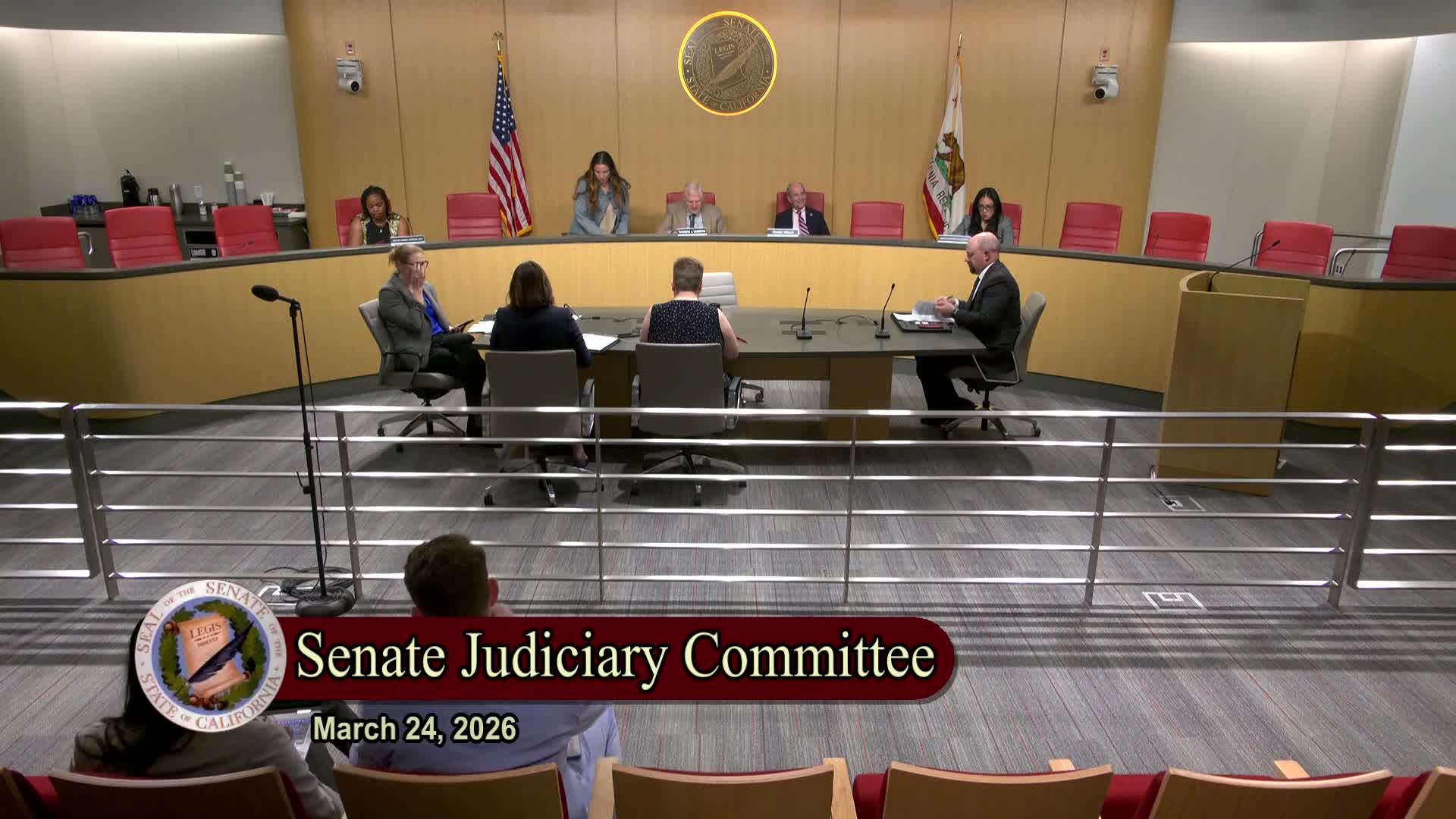
Sen. Cabaldon introduced SB 1159 to the Senate Judiciary subcommittee as a bill to protect local governments and genuine constituents from being overwhelmed by automated or AI-generated public engagement.
The bill’s author said SB 1159 ‘‘makes clear that government agencies are not required to treat engagement by a bot or AI… as though it were a human being.’’ He framed the measure as a response to mass-generation of comments that can drown out authentic participation and strain small local governments.
Why it matters: Proponents told the committee the proliferation of AI-generated comments has already affected rule-making and planning processes at state and regional agencies, and that small jurisdictions lack the staff to filter inauthentic mass submissions. Gabriela Fazio, senior policy strategist with Sierra Club California, said consulting firms have used AI to generate ‘‘over 20,000 comments’’ opposing environmental standards, which ‘‘buried’’ the voices of communities that had worked through the public process.
Sierra Club testimony and local impacts
Gabriela Fazio testified that firms used AI platforms to flood comment portals and that some comments were submitted under real residents’ names without their consent, which she called ‘‘deeply troubling.’’ Dr. Michael Silva, vice mayor of Vacaville, told the committee a city clerk responding to public records or planning requests typically has statutory deadlines (he cited a 10‑day example for certain records requests) and said AI floods can delay essential local services such as permitting and records responses.
Committee concerns and the detection problem
Committee members expressed support for the bill’s aim but pressed the author about enforcement and how local governments would reliably distinguish bots from real people. Sen. Niello asked who would be accountable if a consulting firm or an overseas actor flooded a jurisdiction; Sen. Cabaldon responded that SB 1159 does not create new enforcement duties but clarifies that public‑participation statutes (for example the Brown Act and Bagley‑Keene Act) were written for people and need not be applied to synthetic agents.
‘‘There’s nothing to enforce in the bill,’’ the author said, noting the challenge lies in detection technologies and protocols. He acknowledged text‑only submissions are harder to verify than synthetic images or video and said the committee will need to develop procedural and technological standards if the bill advances.
Opposition and safeguards
No organized opposition appeared at the hearing, but multiple members warned about legal risks if detection is imperfect — for example, the consequences for a human commenter mistakenly identified as nonhuman. The author accepted amendments to make explicit references to the various acts the bill touches and described work ahead on safe‑harbor standards and detection protocols.
Vote and next steps
A motion to move SB 1159 passed in committee and the bill was placed on the consent calendar; the committee recorded unanimous support as members completed subsequent roll calls and the measure advanced from the Judiciary Committee.
The committee left detection methodologies and precise enforcement mechanisms to later deliberations if the bill proceeds out of committee.
The bill’s author said SB 1159 ‘‘makes clear that government agencies are not required to treat engagement by a bot or AI… as though it were a human being.’’ He framed the measure as a response to mass-generation of comments that can drown out authentic participation and strain small local governments.
Why it matters: Proponents told the committee the proliferation of AI-generated comments has already affected rule-making and planning processes at state and regional agencies, and that small jurisdictions lack the staff to filter inauthentic mass submissions. Gabriela Fazio, senior policy strategist with Sierra Club California, said consulting firms have used AI to generate ‘‘over 20,000 comments’’ opposing environmental standards, which ‘‘buried’’ the voices of communities that had worked through the public process.
Sierra Club testimony and local impacts
Gabriela Fazio testified that firms used AI platforms to flood comment portals and that some comments were submitted under real residents’ names without their consent, which she called ‘‘deeply troubling.’’ Dr. Michael Silva, vice mayor of Vacaville, told the committee a city clerk responding to public records or planning requests typically has statutory deadlines (he cited a 10‑day example for certain records requests) and said AI floods can delay essential local services such as permitting and records responses.
Committee concerns and the detection problem
Committee members expressed support for the bill’s aim but pressed the author about enforcement and how local governments would reliably distinguish bots from real people. Sen. Niello asked who would be accountable if a consulting firm or an overseas actor flooded a jurisdiction; Sen. Cabaldon responded that SB 1159 does not create new enforcement duties but clarifies that public‑participation statutes (for example the Brown Act and Bagley‑Keene Act) were written for people and need not be applied to synthetic agents.
‘‘There’s nothing to enforce in the bill,’’ the author said, noting the challenge lies in detection technologies and protocols. He acknowledged text‑only submissions are harder to verify than synthetic images or video and said the committee will need to develop procedural and technological standards if the bill advances.
Opposition and safeguards
No organized opposition appeared at the hearing, but multiple members warned about legal risks if detection is imperfect — for example, the consequences for a human commenter mistakenly identified as nonhuman. The author accepted amendments to make explicit references to the various acts the bill touches and described work ahead on safe‑harbor standards and detection protocols.
Vote and next steps
A motion to move SB 1159 passed in committee and the bill was placed on the consent calendar; the committee recorded unanimous support as members completed subsequent roll calls and the measure advanced from the Judiciary Committee.
The committee left detection methodologies and precise enforcement mechanisms to later deliberations if the bill proceeds out of committee.
View the Full Meeting & All Its Details
This article offers just a summary. Unlock complete video, transcripts, and insights as a Founder Member.
✓
Watch full, unedited meeting videos
✓
Search every word spoken in unlimited transcripts
✓
AI summaries & real-time alerts (all government levels)
✓
Permanent access to expanding government content
30-day money-back guarantee
