DEED briefs committee on Youth at Work and YouthBuild funding and outcomes
March 24, 2026 | 2026 Legislature MN, Minnesota
This article was created by AI summarizing key points discussed. AI makes mistakes, so for full details and context, please refer to the video of the full meeting. Please report any errors so we can fix them. Report an error »
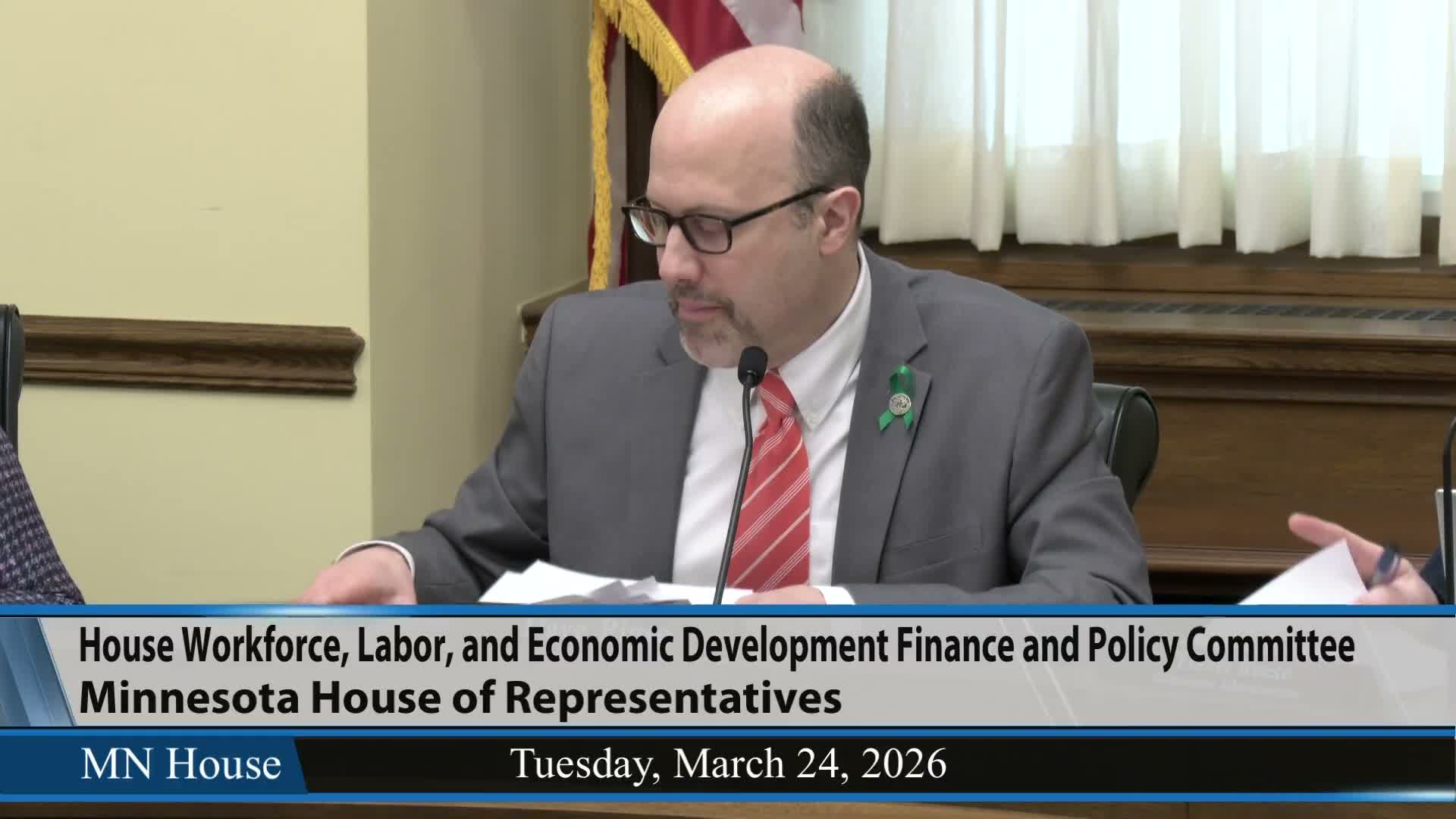
Devin Boudry, government relations director at the Department of Employment and Economic Development (DEED), briefed the committee on two youth workforce programs: Youth at Work and YouthBuild. He said Youth at Work (ages 14–24) provides grants to organizations serving economically disadvantaged or at‑risk youth and prioritizes programs that lead to industry‑recognized credentials, paid internships, and postsecondary supports. DEED reported roughly 11,800 youth served through Youth at Work, with 78 percent identified as from communities of color and 17 percent served who have a disability; award sizes varied by grantee, with the largest awards around $700,000 and smaller awards near $50,000.
Boudry described YouthBuild as a program serving 16–24 year olds who have not completed a high school diploma; grantees focus on construction and rehabilitation projects for low‑income or homeless households and also provide education and job‑readiness training. DEED said YouthBuild maximum awards are about $150,000 and that YouthBuild funding (~$1,000,000 per year) is generally stable in the base budget.
Members asked how DEED measures outcomes such as "attained work readiness and/or education goals" and whether goals are participant‑set; DEED said outcomes are disaggregated in the packet and that education and credential attainment or re‑engagement in secondary education are typical YouthBuild outcomes. Members also confirmed that Youth at Work age limits align with federal Workforce Innovation and Opportunity Act definitions and Minnesota statute. The committee invited further input from youth programming organizations and closed the meeting.
Boudry described YouthBuild as a program serving 16–24 year olds who have not completed a high school diploma; grantees focus on construction and rehabilitation projects for low‑income or homeless households and also provide education and job‑readiness training. DEED said YouthBuild maximum awards are about $150,000 and that YouthBuild funding (~$1,000,000 per year) is generally stable in the base budget.
Members asked how DEED measures outcomes such as "attained work readiness and/or education goals" and whether goals are participant‑set; DEED said outcomes are disaggregated in the packet and that education and credential attainment or re‑engagement in secondary education are typical YouthBuild outcomes. Members also confirmed that Youth at Work age limits align with federal Workforce Innovation and Opportunity Act definitions and Minnesota statute. The committee invited further input from youth programming organizations and closed the meeting.
Don't Miss a Word: See the Full Meeting!
Go beyond summaries. Unlock every video, transcript, and key insight with a Founder Membership.
✓
Get instant access to full meeting videos
✓
Search and clip any phrase from complete transcripts
✓
Receive AI-powered summaries & custom alerts
✓
Enjoy lifetime, unrestricted access to government data
30-day money-back guarantee
