Tennessee committee deadlocks on bill to ban LGBTQ flags and official recognition of Pride periods
March 24, 2026 | 2026 Legislature TN, Tennessee
This article was created by AI summarizing key points discussed. AI makes mistakes, so for full details and context, please refer to the video of the full meeting. Please report any errors so we can fix them. Report an error »
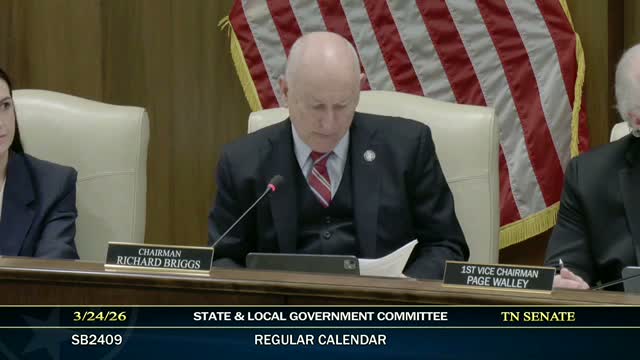
The Tennessee Senate State and Local Government Committee on Jan. 24 considered SB 24-09, a bill that would ban the display of LGBTQ flags or emblems on state-owned property or the grounds of public buildings and prohibit official recognition of a Pride month or similar period by state agencies.
Sponsor Sen. Anthony Hensley said the bill was prompted by complaints from parents and school communities and that it targets displays in public buildings and schools, not private off-duty expression. “This bill specifically does not regulate off-the-job behavior of an employee or volunteer,” Hensley said, adding, “This is just for publicly owned buildings and public schools.”
Committee discussion focused on the amendment offered by the sponsor to remove a private right of action and limit remedies to injunctive relief without damages. Josh Houston of Legal Services told the committee the amendment “removes the private right of action … and replaces it with a statute-based injunctive remedy but no damages.”
Opponents warned the bill’s text would be broader than intended and could chill speech. A committee member said the language could reach small symbols such as an emblem on a coffee cup, arguing, “If I was holding this and it had a flag emblem on it, I would be displaying it on the grounds of a public building.” Another senator raised a neutrality concern, saying state buildings should not present any offensive flags — and asked whether restricting one group would force allowance of others, naming extreme examples to illustrate the point.
Several senators also raised a local-control objection. “Local government is important,” one member said. “I’m always reluctant to remove local authority.” Others warned the bill might set a precedent that compels recognition of other symbols.
When the committee voted on the amended bill, the tally was three in favor, three opposed and three present-not-voting; the chair announced the bill remains in committee.
Where it stands: SB 24-09 did not advance out of committee. The sponsor and supporters argued the measure protects neutrality in public buildings and shields children in schools from political messaging; opponents said the statutory language as written is overbroad and could chill lawful private expression and local discretion.
What’s next: Because the committee did not report the measure, it will not go to the full Senate calendar from this committee at this time.
Reported from the State and Local Government Committee hearing. Quotes and attributions are from committee proceedings.
Sponsor Sen. Anthony Hensley said the bill was prompted by complaints from parents and school communities and that it targets displays in public buildings and schools, not private off-duty expression. “This bill specifically does not regulate off-the-job behavior of an employee or volunteer,” Hensley said, adding, “This is just for publicly owned buildings and public schools.”
Committee discussion focused on the amendment offered by the sponsor to remove a private right of action and limit remedies to injunctive relief without damages. Josh Houston of Legal Services told the committee the amendment “removes the private right of action … and replaces it with a statute-based injunctive remedy but no damages.”
Opponents warned the bill’s text would be broader than intended and could chill speech. A committee member said the language could reach small symbols such as an emblem on a coffee cup, arguing, “If I was holding this and it had a flag emblem on it, I would be displaying it on the grounds of a public building.” Another senator raised a neutrality concern, saying state buildings should not present any offensive flags — and asked whether restricting one group would force allowance of others, naming extreme examples to illustrate the point.
Several senators also raised a local-control objection. “Local government is important,” one member said. “I’m always reluctant to remove local authority.” Others warned the bill might set a precedent that compels recognition of other symbols.
When the committee voted on the amended bill, the tally was three in favor, three opposed and three present-not-voting; the chair announced the bill remains in committee.
Where it stands: SB 24-09 did not advance out of committee. The sponsor and supporters argued the measure protects neutrality in public buildings and shields children in schools from political messaging; opponents said the statutory language as written is overbroad and could chill lawful private expression and local discretion.
What’s next: Because the committee did not report the measure, it will not go to the full Senate calendar from this committee at this time.
Reported from the State and Local Government Committee hearing. Quotes and attributions are from committee proceedings.
Don't Miss a Word: See the Full Meeting!
Go beyond summaries. Unlock every video, transcript, and key insight with a Founder Membership.
✓
Get instant access to full meeting videos
✓
Search and clip any phrase from complete transcripts
✓
Receive AI-powered summaries & custom alerts
✓
Enjoy lifetime, unrestricted access to government data
30-day money-back guarantee
