Senate panel advances bill to raise manufacturing tax credit for rural Arizona
March 23, 2026 | 2026 Legislature Arizona, Arizona
This article was created by AI summarizing key points discussed. AI makes mistakes, so for full details and context, please refer to the video of the full meeting. Please report any errors so we can fix them. Report an error »
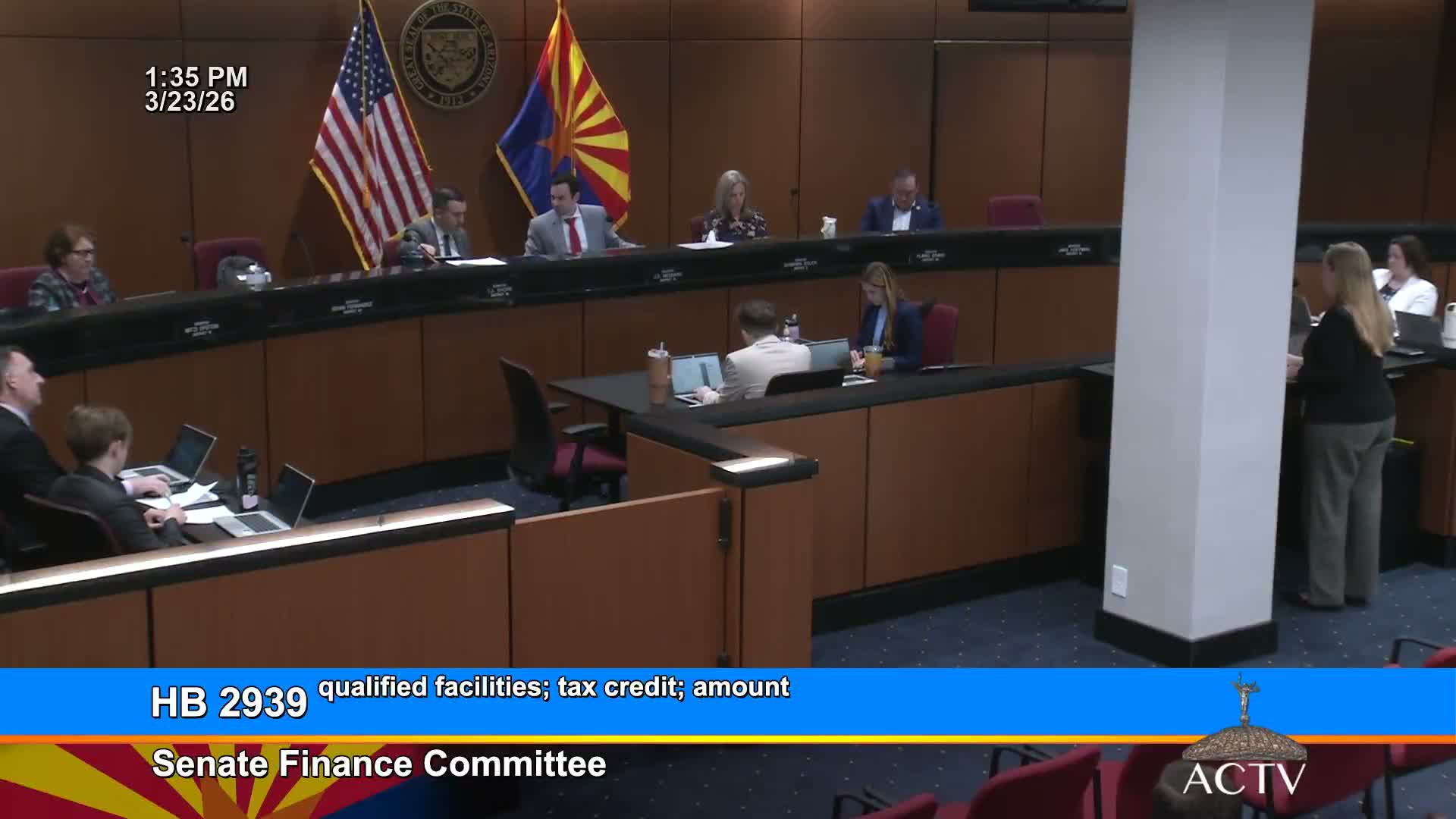
The Arizona Senate Finance Committee on March 20 advanced House Bill 2939, a change to the Qualified Facilities Tax Credit that would boost the per-job credit for certain rural manufacturing facilities from $20,000 to $25,000.
Brian Murray, testifying on behalf of Lucid Motors, described the proposal as narrow: it would apply to manufacturing projects with capital investment between $300 million and $2 billion in rural Arizona. "Our proposal is very simple," Murray said. "If you do manufacturing in rural Arizona and you have that 300,000,000 to 2,000,000,000, then you could get $25,000 per employee." He said the intent is to give the Arizona Commerce Authority an additional tool to recruit plants and related supply-chain jobs to nonurban parts of the state.
Senators pressed staff and the witness on how the credit is timed and scored. Committee members and staff noted that JLBC’s fiscal note treats post-approval outlays differently from calendar-year preapprovals and that the program cap — cited in testimony as $125 million — complicates multi-year cost estimates. A senator asked whether the credit is taken annually or over a multi-year phase; staff confirmed the credit is phased and can be taken in installments.
Opponents during the roll call expressed skepticism about whether a $5,000 increase per job would change companies’ location decisions. One senator said, "It's very curious to me that the $20,000 per job was not enough to recruit a new company to come to Casa Grande, but somehow $25,000 per job would be enough." Committee members also noted the fiscal note’s estimate that, if the program hit statutory caps, costs could rise by tens of millions annually.
The bill passed out of committee with a due-pass recommendation. Next steps include floor consideration and any additional amendments on the House or Senate floors.
Brian Murray, testifying on behalf of Lucid Motors, described the proposal as narrow: it would apply to manufacturing projects with capital investment between $300 million and $2 billion in rural Arizona. "Our proposal is very simple," Murray said. "If you do manufacturing in rural Arizona and you have that 300,000,000 to 2,000,000,000, then you could get $25,000 per employee." He said the intent is to give the Arizona Commerce Authority an additional tool to recruit plants and related supply-chain jobs to nonurban parts of the state.
Senators pressed staff and the witness on how the credit is timed and scored. Committee members and staff noted that JLBC’s fiscal note treats post-approval outlays differently from calendar-year preapprovals and that the program cap — cited in testimony as $125 million — complicates multi-year cost estimates. A senator asked whether the credit is taken annually or over a multi-year phase; staff confirmed the credit is phased and can be taken in installments.
Opponents during the roll call expressed skepticism about whether a $5,000 increase per job would change companies’ location decisions. One senator said, "It's very curious to me that the $20,000 per job was not enough to recruit a new company to come to Casa Grande, but somehow $25,000 per job would be enough." Committee members also noted the fiscal note’s estimate that, if the program hit statutory caps, costs could rise by tens of millions annually.
The bill passed out of committee with a due-pass recommendation. Next steps include floor consideration and any additional amendments on the House or Senate floors.
View the Full Meeting & All Its Details
This article offers just a summary. Unlock complete video, transcripts, and insights as a Founder Member.
✓
Watch full, unedited meeting videos
✓
Search every word spoken in unlimited transcripts
✓
AI summaries & real-time alerts (all government levels)
✓
Permanent access to expanding government content
30-day money-back guarantee
