Commission lays over bill to exempt J‑1 exchange teachers from TRA contributions after mixed testimony
March 23, 2026 | 2026 Legislature MN, Minnesota
This article was created by AI summarizing key points discussed. AI makes mistakes, so for full details and context, please refer to the video of the full meeting. Please report any errors so we can fix them. Report an error »
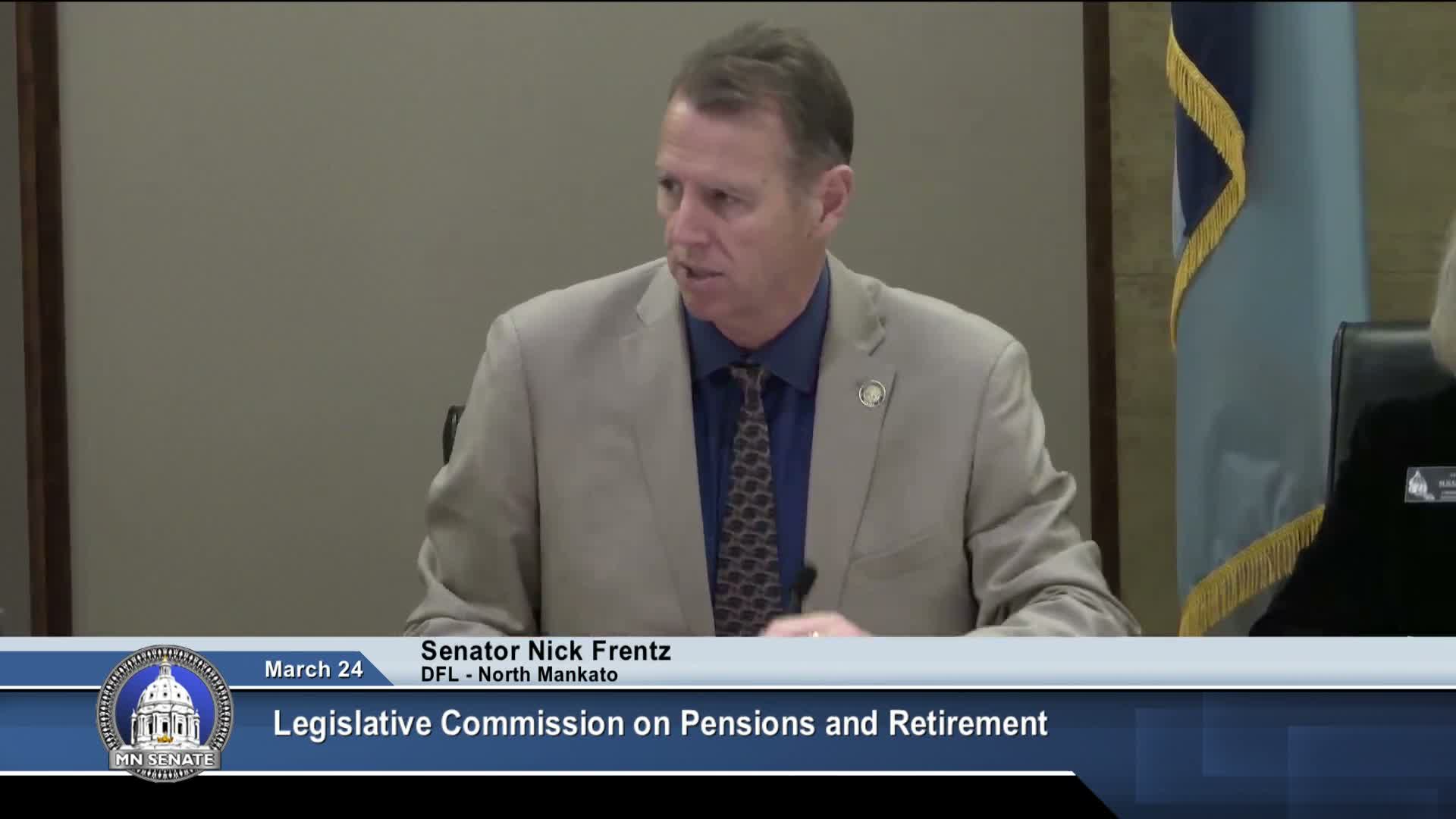
Senators and representatives on the Legislative Commission on Pensions and Retirement debated a proposal March 24, 2026, to exempt J‑1 exchange teachers and their employing school districts from pension contribution requirements to the Teachers Retirement Association (TRA). The commission accepted testimony from bill authors, district officials and labor representatives and ultimately laid the measure over for further consideration.
Senator Pappas, the bill’s author, said the exemption in Senate File 4410 / House File 4069 would redirect employer pension contributions toward onboarding, housing deposits and other immediate costs facing incoming J‑1 teachers. "They don't stay long enough for TRA to benefit them," Pappas said, arguing many J‑1 participants are capped by federal rules at five years in the U.S. and face immediate out‑of‑pocket expenses.
Representative Feist, who co‑authored the proposal, framed the change as analogous to F‑1 tax treatment and said she had discussed the draft with at least one J‑1 teacher who preferred to receive more pay up front while settling into the U.S. "She said she would prefer to have that money in her paycheck as she is getting settled," Feist said.
Proponents from Minnesota school districts and cultural exchange programs said the change would improve recruitment for hard‑to‑fill special‑education and English‑learner positions. "Exempting them from TRA lets them keep somewhere between $4,000 and $5,000 of their own money to cover those costs," said Matthew Conley, founder of Lattice Global Teachers, who testified the exemption would make districts more competitive in hiring international candidates.
Education Minnesota’s Caitlin Snyder urged caution. Snyder said the bill would remove teachers’ choice and could permanently exclude some J‑1 participants from later retirement benefits. "We don't believe that we address the teacher shortage by lowering compensation for our members," Snyder said, adding that the draft lacks safeguards requiring redirected employer funds be dedicated to housing or settlement supports.
Members pressed authors on scale and equity. Senator Nelson and others asked whether the exemption would ask J‑1 teachers to give up roughly 9.8% of pay and whether that loss is warranted given that some J‑1 participants later obtain different visas and could return to the U.S. Representative Cha and other members noted two letters of district support in the packet and asked for more direct teacher input.
After discussion about possible changes — including an opt‑in approach — Senator Pappas said she preferred to include the bill in the omnibus pension bill but accepted that members wanted more time to consult stakeholders. The commission laid the file over for further work and follow‑up.
The commission did not take a roll‑call vote on the policy itself; the action recorded was the decision to lay the bill over for additional consideration and stakeholder outreach.
What happens next: The authors and staff will collect more teacher input and consider revisions including an optional opt‑in and language that would specify how redirected employer contributions should be used. The commission indicated it may revisit the proposal during its next meeting series.
Senator Pappas, the bill’s author, said the exemption in Senate File 4410 / House File 4069 would redirect employer pension contributions toward onboarding, housing deposits and other immediate costs facing incoming J‑1 teachers. "They don't stay long enough for TRA to benefit them," Pappas said, arguing many J‑1 participants are capped by federal rules at five years in the U.S. and face immediate out‑of‑pocket expenses.
Representative Feist, who co‑authored the proposal, framed the change as analogous to F‑1 tax treatment and said she had discussed the draft with at least one J‑1 teacher who preferred to receive more pay up front while settling into the U.S. "She said she would prefer to have that money in her paycheck as she is getting settled," Feist said.
Proponents from Minnesota school districts and cultural exchange programs said the change would improve recruitment for hard‑to‑fill special‑education and English‑learner positions. "Exempting them from TRA lets them keep somewhere between $4,000 and $5,000 of their own money to cover those costs," said Matthew Conley, founder of Lattice Global Teachers, who testified the exemption would make districts more competitive in hiring international candidates.
Education Minnesota’s Caitlin Snyder urged caution. Snyder said the bill would remove teachers’ choice and could permanently exclude some J‑1 participants from later retirement benefits. "We don't believe that we address the teacher shortage by lowering compensation for our members," Snyder said, adding that the draft lacks safeguards requiring redirected employer funds be dedicated to housing or settlement supports.
Members pressed authors on scale and equity. Senator Nelson and others asked whether the exemption would ask J‑1 teachers to give up roughly 9.8% of pay and whether that loss is warranted given that some J‑1 participants later obtain different visas and could return to the U.S. Representative Cha and other members noted two letters of district support in the packet and asked for more direct teacher input.
After discussion about possible changes — including an opt‑in approach — Senator Pappas said she preferred to include the bill in the omnibus pension bill but accepted that members wanted more time to consult stakeholders. The commission laid the file over for further work and follow‑up.
The commission did not take a roll‑call vote on the policy itself; the action recorded was the decision to lay the bill over for additional consideration and stakeholder outreach.
What happens next: The authors and staff will collect more teacher input and consider revisions including an optional opt‑in and language that would specify how redirected employer contributions should be used. The commission indicated it may revisit the proposal during its next meeting series.
Don't Miss a Word: See the Full Meeting!
Go beyond summaries. Unlock every video, transcript, and key insight with a Founder Membership.
✓
Get instant access to full meeting videos
✓
Search and clip any phrase from complete transcripts
✓
Receive AI-powered summaries & custom alerts
✓
Enjoy lifetime, unrestricted access to government data
30-day money-back guarantee
