Work group backs new pension plans for probation officers and 911 telecommunicators; commission lays bills over amid funding questions
March 23, 2026 | 2026 Legislature MN, Minnesota
This article was created by AI summarizing key points discussed. AI makes mistakes, so for full details and context, please refer to the video of the full meeting. Please report any errors so we can fix them. Report an error »
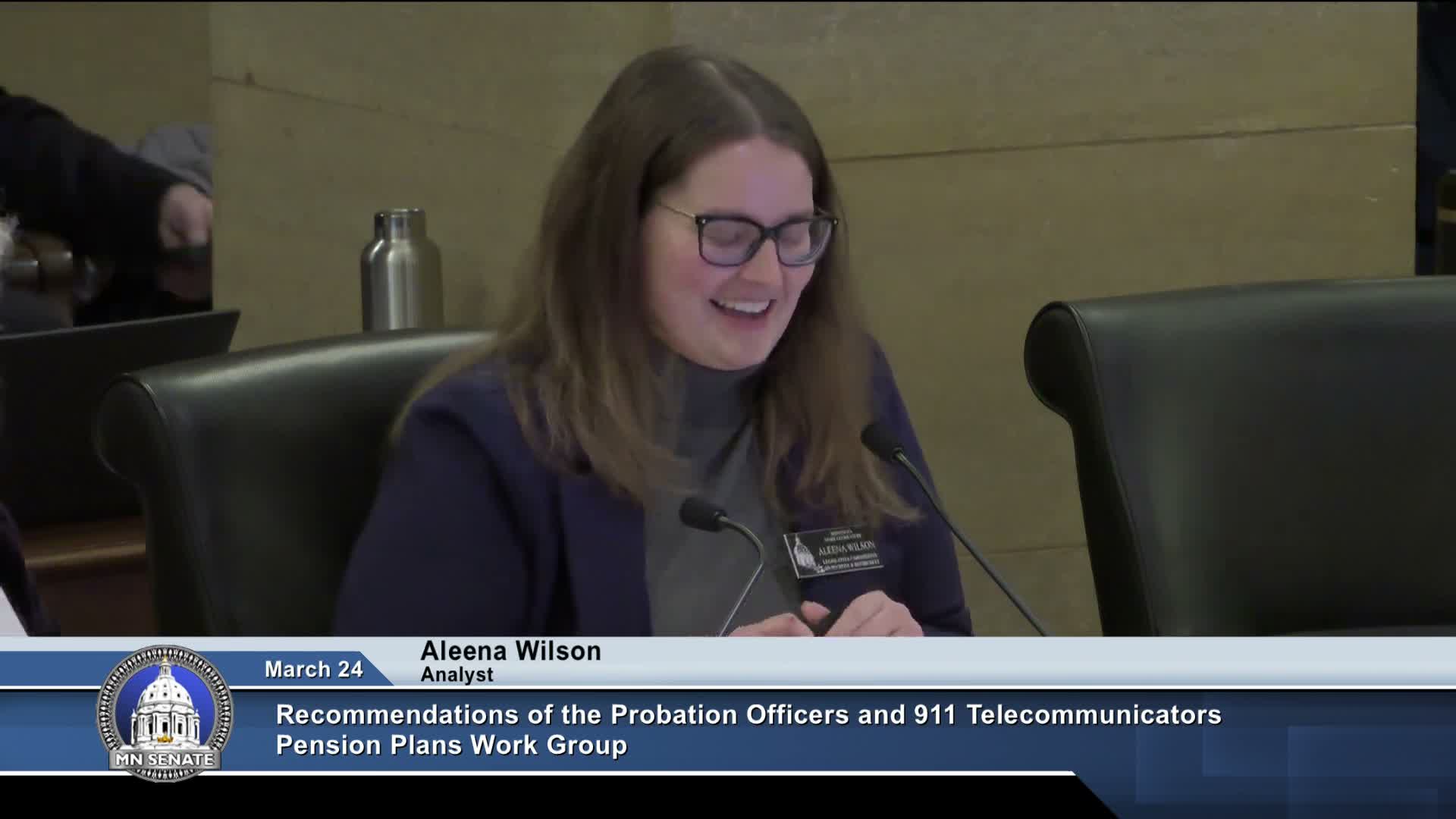
Commission staff presented the final report of a work group that spent months drafting pension changes for probation officers and 911 telecommunicators and introduced three draft bills (LCPR 26‑013 for an MSRS subplan, LCPR 26‑017 for a PERA para plan, and LCPR 26‑012 to make technical changes). Staff, co‑chairs and stakeholders described the outcome as the product of inclusive, multi‑party negotiation and urged members to adopt the findings, but members deferred final action pending resolution of funding and appropriation entries.
Staff explained key recommendations: include transit control center supervisors as eligible telecommunicators; transfer assets and liabilities attributable to moving members from the PERA general plan into the new para plan to avoid leaving the general plan worse off (PERA estimated a potential $33 million deficit if not addressed); allow a one‑time opportunity for members to purchase past service credit prior to retirement with an actuarial purchase price; and offer a mixed service annuity approach so members can take the new plan benefit earlier without reducing the general plan annuity if they delay the latter.
Aaron Leonard, executive director of MSRS, said the proposed MSRS subplan — which lowers the normal retirement age to 60 for eligible state employees — would cost roughly 4.71% of pay (about $1.7 million per year) and that the cost split proposed in the draft includes a 2% employer contribution. Several union and employer witnesses, including Anne Finn (League of Minnesota Cities), Scott Badness (Minnesota Professional Firefighters), Darlene Panconi (APCO) and Mike LeDoux (LELS), supported the plan as responsive to work‑related stress and recruitment/retention needs.
Speakers representing probation officers and community corrections stressed that the new plan would better reflect the physical and mental demands of their work and that a funded appropriation program could offset transitional inequities that otherwise leave older employees with lower replacement ratios. "This proposal is thoughtful and fiscally responsible," said probation director Tammy Jo Lieberg, but she urged an appropriation to help older officers purchase past service credit and avoid an unacceptable replacement‑ratio gap.
Members focused on the funding mechanics. Representative Nadeau flagged the draft’s blank appropriation sections and offered an A1 amendment (26‑017‑1A) to change contribution option to one the actuaries calculated would eliminate an initial deficiency; the amendment was debated. PERA’s actuary, Doug Anderson, told members the plan’s normal cost is expected to decline over time if assumptions are met and said the work group had chosen a fixed rate approach for practical reasons. Representative Nadeau ultimately withdrew the A1 amendment pending additional work.
The commission agreed to lay the three LCPR files over so staff and members can resolve appropriation amounts, the initial funding posture of the new PERA plan and the mechanics for purchase of past service credit. Chair France set a return to the commission on April 7 for follow‑up.
What happens next: Staff will refine appropriation language and funding targets, engage actuaries for scenario analysis, and report back to members at a subsequent meeting. The work group recommendations remain available as the draft for committee consideration.
Staff explained key recommendations: include transit control center supervisors as eligible telecommunicators; transfer assets and liabilities attributable to moving members from the PERA general plan into the new para plan to avoid leaving the general plan worse off (PERA estimated a potential $33 million deficit if not addressed); allow a one‑time opportunity for members to purchase past service credit prior to retirement with an actuarial purchase price; and offer a mixed service annuity approach so members can take the new plan benefit earlier without reducing the general plan annuity if they delay the latter.
Aaron Leonard, executive director of MSRS, said the proposed MSRS subplan — which lowers the normal retirement age to 60 for eligible state employees — would cost roughly 4.71% of pay (about $1.7 million per year) and that the cost split proposed in the draft includes a 2% employer contribution. Several union and employer witnesses, including Anne Finn (League of Minnesota Cities), Scott Badness (Minnesota Professional Firefighters), Darlene Panconi (APCO) and Mike LeDoux (LELS), supported the plan as responsive to work‑related stress and recruitment/retention needs.
Speakers representing probation officers and community corrections stressed that the new plan would better reflect the physical and mental demands of their work and that a funded appropriation program could offset transitional inequities that otherwise leave older employees with lower replacement ratios. "This proposal is thoughtful and fiscally responsible," said probation director Tammy Jo Lieberg, but she urged an appropriation to help older officers purchase past service credit and avoid an unacceptable replacement‑ratio gap.
Members focused on the funding mechanics. Representative Nadeau flagged the draft’s blank appropriation sections and offered an A1 amendment (26‑017‑1A) to change contribution option to one the actuaries calculated would eliminate an initial deficiency; the amendment was debated. PERA’s actuary, Doug Anderson, told members the plan’s normal cost is expected to decline over time if assumptions are met and said the work group had chosen a fixed rate approach for practical reasons. Representative Nadeau ultimately withdrew the A1 amendment pending additional work.
The commission agreed to lay the three LCPR files over so staff and members can resolve appropriation amounts, the initial funding posture of the new PERA plan and the mechanics for purchase of past service credit. Chair France set a return to the commission on April 7 for follow‑up.
What happens next: Staff will refine appropriation language and funding targets, engage actuaries for scenario analysis, and report back to members at a subsequent meeting. The work group recommendations remain available as the draft for committee consideration.
View the Full Meeting & All Its Details
This article offers just a summary. Unlock complete video, transcripts, and insights as a Founder Member.
✓
Watch full, unedited meeting videos
✓
Search every word spoken in unlimited transcripts
✓
AI summaries & real-time alerts (all government levels)
✓
Permanent access to expanding government content
30-day money-back guarantee
