Committee hears Alyssa’s Law bill to equip school staff with wearable panic buttons
March 24, 2026 | 2026 Legislature MO, Missouri
This article was created by AI summarizing key points discussed. AI makes mistakes, so for full details and context, please refer to the video of the full meeting. Please report any errors so we can fix them. Report an error »
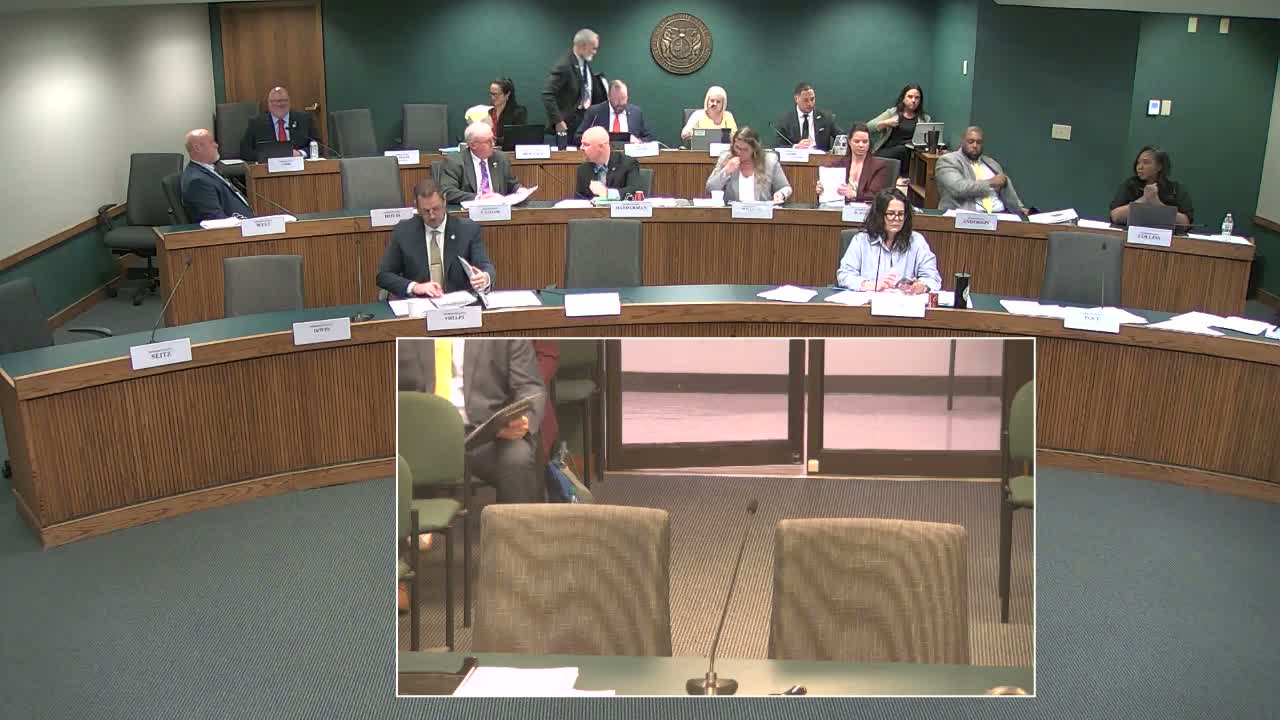
Representative Doyle Justice introduced House Bill 3174, described in testimony as Missouri’s version of Alyssa’s Law, which would require every school employee to have access to a wearable panic alert system that connects directly to local emergency responders and school personnel. The sponsor said the bill establishes a qualified vendor list and is subject to appropriations, noting implementation depends on available funding.
Committee members pressed the sponsor on several practical points: how schools would be prioritized if funding is limited, potential liability for schools that do not have the system, whether the measure changes any age thresholds, and how the wearable system would integrate with existing 9‑1‑1 systems. The sponsor acknowledged the fiscal constraints and said that appropriations and further implementation work would follow committee approval; he also said some schools have already implemented similar systems but that funding limits broad rollout in the near term.
Lori Alhadeff, Alyssa’s mother, testified in support and described why she and advocates favor the technology. "Time equals life," Alhadeff said, urging lawmakers to pass the bill so staff can quickly alert first responders. She described the device as a wearable badge with a panic button that can trigger a mass notification in a building and provide precise location information to responders. In her testimony she cited examples she said demonstrated rapid response: at one school she referenced, a teacher saw a lockdown alert before hearing gunfire; in Broward County she said roughly 2,914 alerts were issued over a November–January period and that 41% of alerts were behavioral rather than violent incidents.
Lawmakers indicated support for the policy aim but raised fiscal and equity concerns: one member cited a fiscal estimate from a vendor of about $8,000 per school building per year for badges and software and asked how schools would be selected if statewide funding were limited. The sponsor said the bill allows for private donations to a fund and suggested the Department of Elementary and Secondary Education could help develop the qualified‑vendor list and allocation plan if the bill becomes law.
No committee vote on HB 3174 was recorded at the hearing; the committee concluded the public testimony and moved on to the next agenda item. The sponsor and witnesses said they are available to provide further information to lawmakers as the bill advances.
Committee members pressed the sponsor on several practical points: how schools would be prioritized if funding is limited, potential liability for schools that do not have the system, whether the measure changes any age thresholds, and how the wearable system would integrate with existing 9‑1‑1 systems. The sponsor acknowledged the fiscal constraints and said that appropriations and further implementation work would follow committee approval; he also said some schools have already implemented similar systems but that funding limits broad rollout in the near term.
Lori Alhadeff, Alyssa’s mother, testified in support and described why she and advocates favor the technology. "Time equals life," Alhadeff said, urging lawmakers to pass the bill so staff can quickly alert first responders. She described the device as a wearable badge with a panic button that can trigger a mass notification in a building and provide precise location information to responders. In her testimony she cited examples she said demonstrated rapid response: at one school she referenced, a teacher saw a lockdown alert before hearing gunfire; in Broward County she said roughly 2,914 alerts were issued over a November–January period and that 41% of alerts were behavioral rather than violent incidents.
Lawmakers indicated support for the policy aim but raised fiscal and equity concerns: one member cited a fiscal estimate from a vendor of about $8,000 per school building per year for badges and software and asked how schools would be selected if statewide funding were limited. The sponsor said the bill allows for private donations to a fund and suggested the Department of Elementary and Secondary Education could help develop the qualified‑vendor list and allocation plan if the bill becomes law.
No committee vote on HB 3174 was recorded at the hearing; the committee concluded the public testimony and moved on to the next agenda item. The sponsor and witnesses said they are available to provide further information to lawmakers as the bill advances.
View the Full Meeting & All Its Details
This article offers just a summary. Unlock complete video, transcripts, and insights as a Founder Member.
✓
Watch full, unedited meeting videos
✓
Search every word spoken in unlimited transcripts
✓
AI summaries & real-time alerts (all government levels)
✓
Permanent access to expanding government content
30-day money-back guarantee
