Committee advances bill to require Cal OES to fill catastrophic-planning gaps
March 23, 2026 | California State Assembly, House, Legislative, California
This article was created by AI summarizing key points discussed. AI makes mistakes, so for full details and context, please refer to the video of the full meeting. Please report any errors so we can fix them. Report an error »
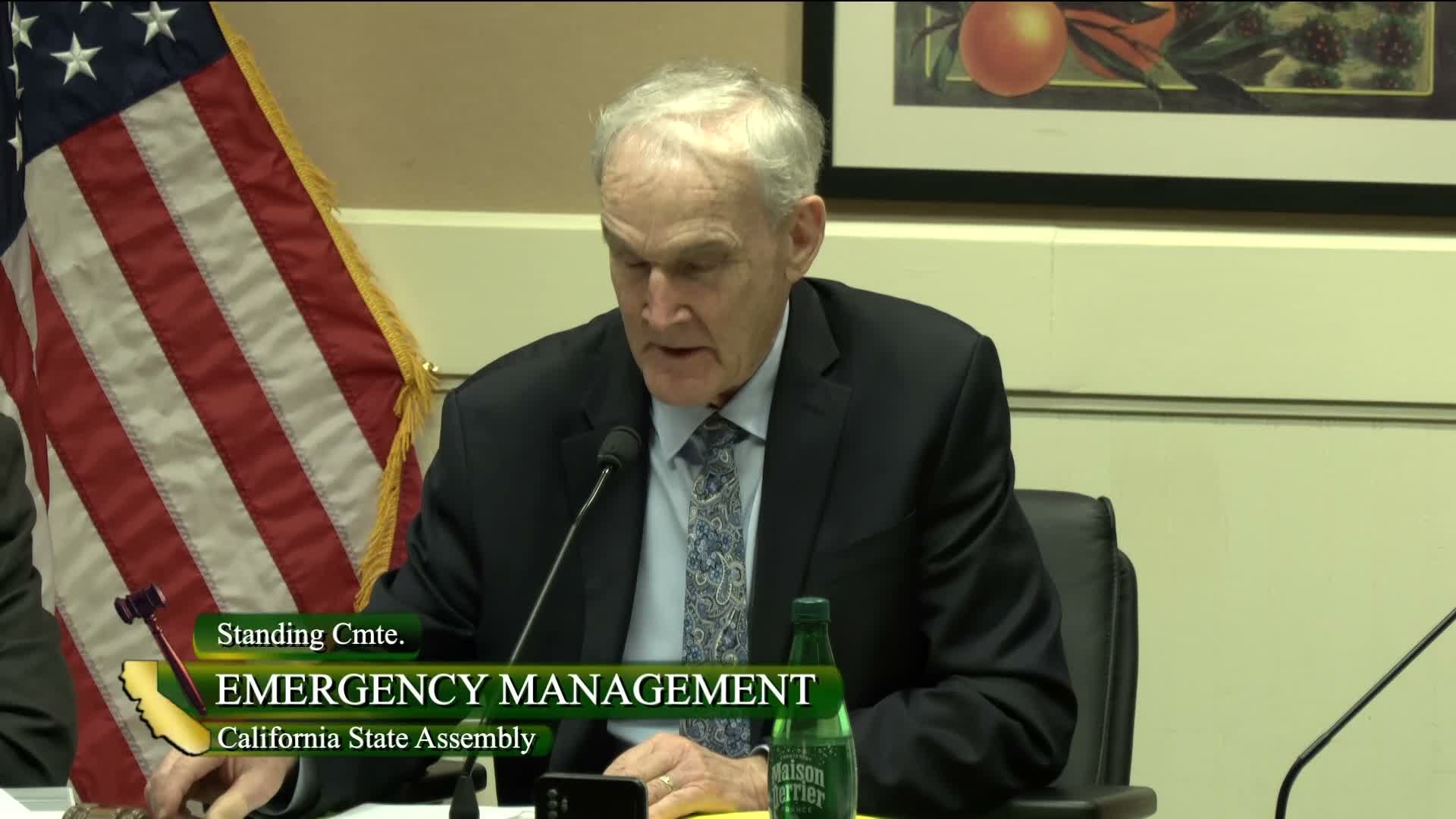
The Assembly Committee on Emergency Management voted to due-pass AB 2472, Assemblymember Rhodesia Ransom’s bill that would require the Governor’s Office of Emergency Services (Cal OES) to develop additional catastrophic incident plans to fill gaps identified in earlier state planning.
In her presentation, Chair Ransom said California is among the nation’s most disaster-prone states and argued the state must ensure lessons from COVID-19 and CBRNE events inform future responses. She told the committee the bill would codify plans referenced in the California Catastrophic Incident-Based Plan Concept of Operations developed jointly by Cal OES and FEMA in 2008 and would require Cal OES to develop a Pandemic Incident Plan, a Chemical, Biological, Radiological, Nuclear and Explosive (CBRNE) plan, and a wildland-urban interface incident plan.
A committee member raised a minority concern that the legislation could duplicate existing planning documents and suggested language allowing Cal OES to rely on or augment existing plans where they already contain required information. Chair Ransom said the bill’s intent is to fill gaps and to harmonize with existing work, noting she welcomed discussion on amendments to avoid unnecessary duplication.
The committee moved and seconded the measure, the clerk called the roll, and members recorded 'aye' votes from Ransom, Alanis, Arambula, Bennett, Avila Farias and DeMayo. The motion passed and the bill was due-passed to the Committee on Appropriations.
The bill directs Cal OES to produce additional catastrophic incident plans; details on implementation timelines, budget impacts and specific statutory language will be developed as the bill moves through Appropriations and subsequent analyses.
In her presentation, Chair Ransom said California is among the nation’s most disaster-prone states and argued the state must ensure lessons from COVID-19 and CBRNE events inform future responses. She told the committee the bill would codify plans referenced in the California Catastrophic Incident-Based Plan Concept of Operations developed jointly by Cal OES and FEMA in 2008 and would require Cal OES to develop a Pandemic Incident Plan, a Chemical, Biological, Radiological, Nuclear and Explosive (CBRNE) plan, and a wildland-urban interface incident plan.
A committee member raised a minority concern that the legislation could duplicate existing planning documents and suggested language allowing Cal OES to rely on or augment existing plans where they already contain required information. Chair Ransom said the bill’s intent is to fill gaps and to harmonize with existing work, noting she welcomed discussion on amendments to avoid unnecessary duplication.
The committee moved and seconded the measure, the clerk called the roll, and members recorded 'aye' votes from Ransom, Alanis, Arambula, Bennett, Avila Farias and DeMayo. The motion passed and the bill was due-passed to the Committee on Appropriations.
The bill directs Cal OES to produce additional catastrophic incident plans; details on implementation timelines, budget impacts and specific statutory language will be developed as the bill moves through Appropriations and subsequent analyses.
View the Full Meeting & All Its Details
This article offers just a summary. Unlock complete video, transcripts, and insights as a Founder Member.
✓
Watch full, unedited meeting videos
✓
Search every word spoken in unlimited transcripts
✓
AI summaries & real-time alerts (all government levels)
✓
Permanent access to expanding government content
30-day money-back guarantee
