Chief Justice Patricia Guerrero urges support for judicial security, remote proceedings and court funding in State of the Judiciary address
March 23, 2026 | California State Senate, Senate, Legislative, California
This article was created by AI summarizing key points discussed. AI makes mistakes, so for full details and context, please refer to the video of the full meeting. Please report any errors so we can fix them. Report an error »
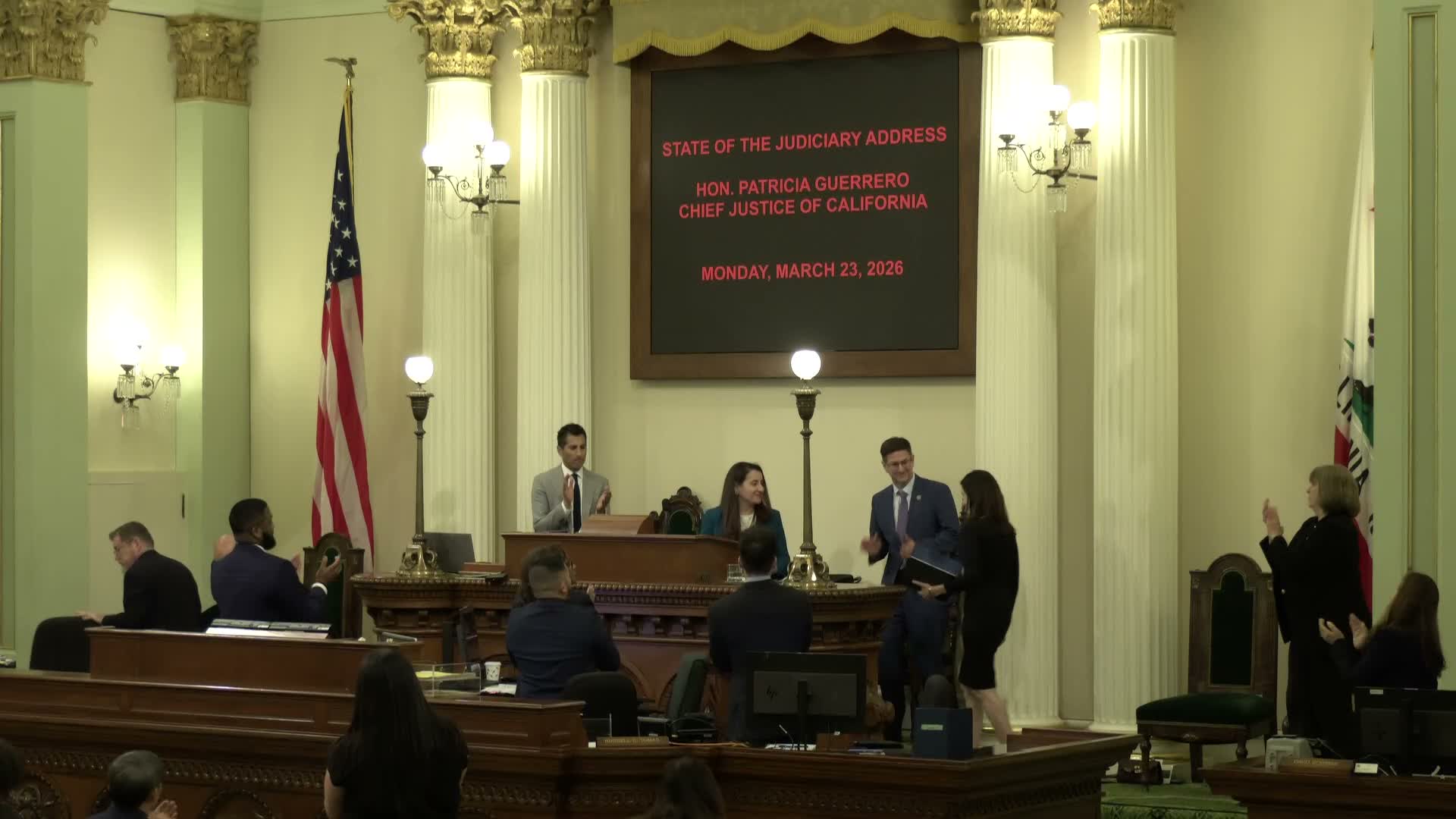
Chief Justice Patricia Guerrero delivered the 2026 State of the Judiciary address to a joint legislative convention at the State Capitol, urging lawmakers to support judicial security, preserve remote court access and fund additional judgeships and court operations.
Guerrero framed her remarks around three priorities: protecting judicial officers and court users from physical and online threats, maintaining remote proceedings that have served millions, and addressing long-standing resource gaps in the trial courts. She also reviewed implementation data for the Community Assistance, Recovery and Empowerment (CARE) Act, described guidance on artificial intelligence for courts, and recounted corrective steps taken after problems with the February 2025 bar exam.
The chief justice told the chamber that the Judicial Council has made judicial security a legislative priority and asked for sufficient resources "to protect personnel, the public, and court systems from physical, online, and cyber threats." She warned that "service on the bench can pose significant safety risks," saying recent events have brought security concerns into sharp relief.
On remote proceedings, Guerrero said that since March 2022 "over 6,000,000 proceedings have been conducted with remote technology," with an average of roughly 7,000 remote proceedings per day between September 2024 and August 2025 and an overall satisfaction rate near 95%. She noted, however, that statutory authority for some remote-proceeding rules is scheduled to expire at the end of the year and identified January 1, 2027 as the date certain authorities lapse unless the Legislature acts.
Guerrero outlined CARE Act implementation numbers to show the program’s reach: the CARE Act is fully operational in all 58 counties; between October 2023 and January 2026 courts received 3,810 petitions, issued 925 court-ordered care agreements, and have 1,835 people still actively engaged in proceedings. The Judicial Council, she said, publishes CARE Act data on its California Courts website.
On court resources and staffing, Guerrero said the governor’s budget proposal includes $70,000,000 in ongoing funding for trial court operations but stressed an ongoing shortfall in judgeships. Citing the Judicial Council’s October 2022 assessment, she said the state still needed about 98 additional judicial officers and described courtroom congestion that has resulted in case dismissals in some counties.
Guerrero described the Judicial Council’s work on technology and evidence, saying a 2025 AI task force produced guidance for generative AI and that the Council is now focusing on deepfakes and the admissibility of AI-generated material. She added the Council has approved a new rule and standards for court-related AI use emphasizing accuracy, oversight and human judgment.
Turning to attorney licensing, Guerrero called the February 2025 bar exam "disastrous," and said the court has taken several corrective steps, including scoring adjustments, expanding provisional licensing, returning to in-person testing using the Multistate Bar Examination, and amending rules governing question review, proctoring and subpoena authority. She said the court has required mandated cost-benefit analysis before any proposed changes to the exam.
Guerrero also raised the issue of federal enforcement activity at courthouses, saying federal officers have been present in at least 17 state courthouses and that the Judicial Council will consider a proposed rule to formalize data collection on civil arrests at state courthouses to inform future action.
She closed by noting the Judicial Council’s 100th anniversary and by thanking the Legislature and governor for collaboration on three-branch solutions. By unanimous consent, the convention ordered the address printed in the journal as a separate appendix; a reception with the court was announced at the Third District Court of Appeal later that evening.
The chief justice’s full remarks and the Judicial Council’s supporting data (including CARE Act reporting and guidance on AI) are available on the California Courts website, the chief justice said.
Guerrero framed her remarks around three priorities: protecting judicial officers and court users from physical and online threats, maintaining remote proceedings that have served millions, and addressing long-standing resource gaps in the trial courts. She also reviewed implementation data for the Community Assistance, Recovery and Empowerment (CARE) Act, described guidance on artificial intelligence for courts, and recounted corrective steps taken after problems with the February 2025 bar exam.
The chief justice told the chamber that the Judicial Council has made judicial security a legislative priority and asked for sufficient resources "to protect personnel, the public, and court systems from physical, online, and cyber threats." She warned that "service on the bench can pose significant safety risks," saying recent events have brought security concerns into sharp relief.
On remote proceedings, Guerrero said that since March 2022 "over 6,000,000 proceedings have been conducted with remote technology," with an average of roughly 7,000 remote proceedings per day between September 2024 and August 2025 and an overall satisfaction rate near 95%. She noted, however, that statutory authority for some remote-proceeding rules is scheduled to expire at the end of the year and identified January 1, 2027 as the date certain authorities lapse unless the Legislature acts.
Guerrero outlined CARE Act implementation numbers to show the program’s reach: the CARE Act is fully operational in all 58 counties; between October 2023 and January 2026 courts received 3,810 petitions, issued 925 court-ordered care agreements, and have 1,835 people still actively engaged in proceedings. The Judicial Council, she said, publishes CARE Act data on its California Courts website.
On court resources and staffing, Guerrero said the governor’s budget proposal includes $70,000,000 in ongoing funding for trial court operations but stressed an ongoing shortfall in judgeships. Citing the Judicial Council’s October 2022 assessment, she said the state still needed about 98 additional judicial officers and described courtroom congestion that has resulted in case dismissals in some counties.
Guerrero described the Judicial Council’s work on technology and evidence, saying a 2025 AI task force produced guidance for generative AI and that the Council is now focusing on deepfakes and the admissibility of AI-generated material. She added the Council has approved a new rule and standards for court-related AI use emphasizing accuracy, oversight and human judgment.
Turning to attorney licensing, Guerrero called the February 2025 bar exam "disastrous," and said the court has taken several corrective steps, including scoring adjustments, expanding provisional licensing, returning to in-person testing using the Multistate Bar Examination, and amending rules governing question review, proctoring and subpoena authority. She said the court has required mandated cost-benefit analysis before any proposed changes to the exam.
Guerrero also raised the issue of federal enforcement activity at courthouses, saying federal officers have been present in at least 17 state courthouses and that the Judicial Council will consider a proposed rule to formalize data collection on civil arrests at state courthouses to inform future action.
She closed by noting the Judicial Council’s 100th anniversary and by thanking the Legislature and governor for collaboration on three-branch solutions. By unanimous consent, the convention ordered the address printed in the journal as a separate appendix; a reception with the court was announced at the Third District Court of Appeal later that evening.
The chief justice’s full remarks and the Judicial Council’s supporting data (including CARE Act reporting and guidance on AI) are available on the California Courts website, the chief justice said.
Don't Miss a Word: See the Full Meeting!
Go beyond summaries. Unlock every video, transcript, and key insight with a Founder Membership.
✓
Get instant access to full meeting videos
✓
Search and clip any phrase from complete transcripts
✓
Receive AI-powered summaries & custom alerts
✓
Enjoy lifetime, unrestricted access to government data
30-day money-back guarantee
