Students urge Arkansas lawmakers to teach AI with ethics, propose statewide 'AI library'
March 18, 2026 | 2026 Legislature AR, Arkansas
This article was created by AI summarizing key points discussed. AI makes mistakes, so for full details and context, please refer to the video of the full meeting. Please report any errors so we can fix them. Report an error »
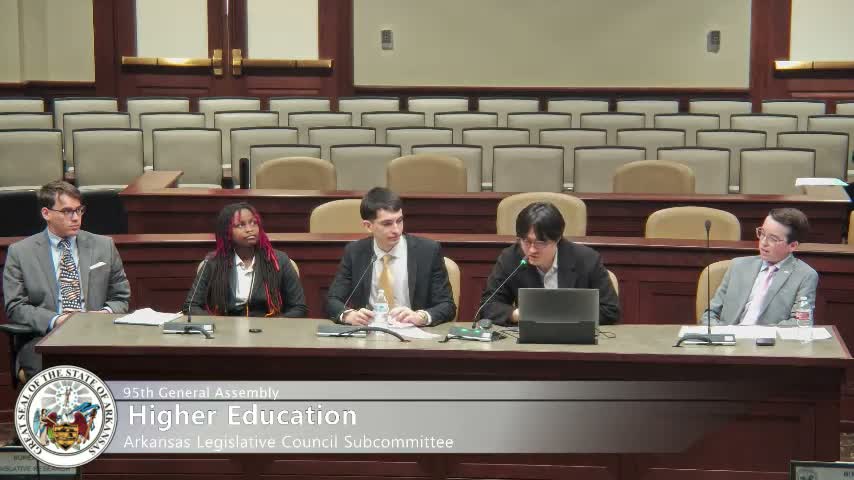
Student presenters told a legislative committee that Arkansas should move quickly to integrate artificial intelligence into K–12 and higher education, urging ethics training for students and teachers and proposing a statewide "AI library" to give consistent access to tools and curricula.
The students — including Seung Ho Jeon, a master’s student at Arkansas State University, and Johnny Toma, a double-major student at Arkansas State University — told members the state risks missing economic opportunities unless educators prepare students for AI-driven jobs. "If we teach students when they're young how to master AI, they'll be more prepared to contribute to society when they're ready to enter the workforce," Toma said.
Why it matters: Presenters argued that Arkansas is becoming a tech hub and that local data-center investments mean jobs will grow in the state. They said consistent access and training would help retain those jobs for Arkansas residents and reduce inequities among students who lack AI tools.
The students presented survey results they said covered nine districts (Little Rock, Springdale, Jonesboro, Fort Smith, Fayetteville, Hot Springs, Texarkana, El Dorado and Stuttgart). According to the presenters, 73% of surveyed teachers agreed schools should teach responsible AI use, 74% said students with less access to AI would be disadvantaged, and 66% opposed allowing students to use AI on homework. "Over 97% of teachers agree that AI needs to be managed at least in a district level," Seung Ho Jeon said, urging legislative support for infrastructure and standardization.
Presenters described current campus tools to show what students could access: AI tutors, AI-generated practice exams and course-specific uses such as data analysis projects and image-processing for climate science. "UCA has a center for teaching and excellence with book groups on ethics and trainings for professors and students," Honey Norfolk (University of Central Arkansas) said, noting faculty-led tools that give feedback on homework.
Presenters also raised concerns about misuse and cybersecurity. Toma cited studies and law-enforcement observations to argue young people are disproportionately represented in cybercrime statistics and that AI has made phishing and other scams more effective, saying ethics education could reduce misuse.
On policy, the students proposed an "AI library" built on existing statewide course-transfer infrastructure (the Access Act) to provide standardized AI tools and syllabi across districts, and asked the legislature to support teacher training and district-level management of AI.
Committee members asked about students' attitudes and whether peers were broadly supportive; presenters said reactions were mixed, with arts students frequently raising copyright and authenticity concerns while students in some technical fields welcomed AI as a practical tool.
The committee did not take formal action during the session; the student presenters were thanked and dismissed, and members were invited to meet them in the foyer after the hearing.
The students — including Seung Ho Jeon, a master’s student at Arkansas State University, and Johnny Toma, a double-major student at Arkansas State University — told members the state risks missing economic opportunities unless educators prepare students for AI-driven jobs. "If we teach students when they're young how to master AI, they'll be more prepared to contribute to society when they're ready to enter the workforce," Toma said.
Why it matters: Presenters argued that Arkansas is becoming a tech hub and that local data-center investments mean jobs will grow in the state. They said consistent access and training would help retain those jobs for Arkansas residents and reduce inequities among students who lack AI tools.
The students presented survey results they said covered nine districts (Little Rock, Springdale, Jonesboro, Fort Smith, Fayetteville, Hot Springs, Texarkana, El Dorado and Stuttgart). According to the presenters, 73% of surveyed teachers agreed schools should teach responsible AI use, 74% said students with less access to AI would be disadvantaged, and 66% opposed allowing students to use AI on homework. "Over 97% of teachers agree that AI needs to be managed at least in a district level," Seung Ho Jeon said, urging legislative support for infrastructure and standardization.
Presenters described current campus tools to show what students could access: AI tutors, AI-generated practice exams and course-specific uses such as data analysis projects and image-processing for climate science. "UCA has a center for teaching and excellence with book groups on ethics and trainings for professors and students," Honey Norfolk (University of Central Arkansas) said, noting faculty-led tools that give feedback on homework.
Presenters also raised concerns about misuse and cybersecurity. Toma cited studies and law-enforcement observations to argue young people are disproportionately represented in cybercrime statistics and that AI has made phishing and other scams more effective, saying ethics education could reduce misuse.
On policy, the students proposed an "AI library" built on existing statewide course-transfer infrastructure (the Access Act) to provide standardized AI tools and syllabi across districts, and asked the legislature to support teacher training and district-level management of AI.
Committee members asked about students' attitudes and whether peers were broadly supportive; presenters said reactions were mixed, with arts students frequently raising copyright and authenticity concerns while students in some technical fields welcomed AI as a practical tool.
The committee did not take formal action during the session; the student presenters were thanked and dismissed, and members were invited to meet them in the foyer after the hearing.
Don't Miss a Word: See the Full Meeting!
Go beyond summaries. Unlock every video, transcript, and key insight with a Founder Membership.
✓
Get instant access to full meeting videos
✓
Search and clip any phrase from complete transcripts
✓
Receive AI-powered summaries & custom alerts
✓
Enjoy lifetime, unrestricted access to government data
30-day money-back guarantee
