Commissioner Farmer urges Austin Energy to strengthen EV charging and home‑battery incentives
March 24, 2026 | Austin, Travis County, Texas
This article was created by AI summarizing key points discussed. AI makes mistakes, so for full details and context, please refer to the video of the full meeting. Please report any errors so we can fix them. Report an error »
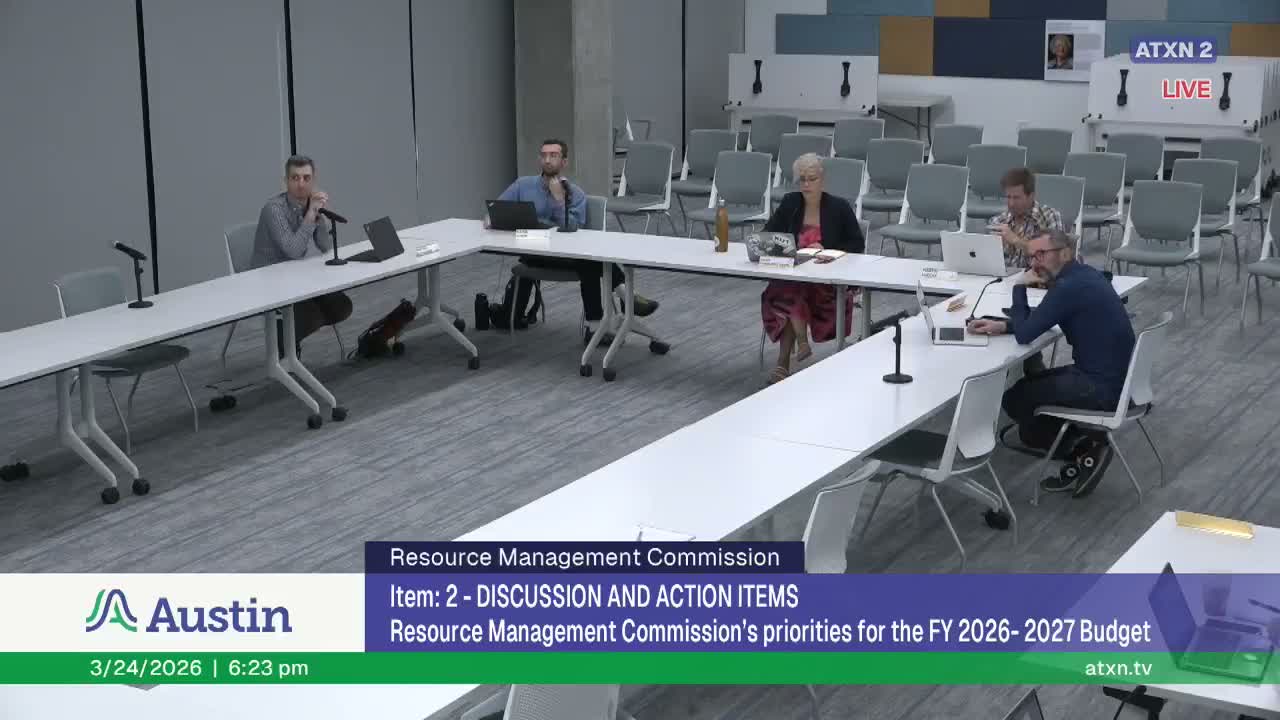
Commissioner Farmer pressed Austin Energy to revise its EV charging and small home‑battery incentives, telling the Resource Management Commission that current programs are too weak to drive broad adoption or capture grid benefits.
"It's like a 45‑year payback period on a battery here, given this incentive," Farmer said, contrasting that with an 8–10 year payback outside Austin and commercial offers that can deliver far larger customer compensation. He recommended a benchmarking study and said the commission should aim to move these programs into the top decile nationally.
The argument centered on both customer uptake and grid value. Farmer and other commissioners said better‑designed incentives could increase adoption of batteries and managed EV charging, which in turn could lower congestion and carbon intensity on Austin's grid. Farmer announced a working‑group meeting with Austin Energy staff and commissioners the next morning to begin redesign efforts.
Commissioner Silverstein supported the call for deeper, utility‑level analysis. "We should be viewing managed EV charging and home battery management usage as opportunities to improve affordability and deliver important high‑quality grid services," Silverstein said, urging staff to show the math on grid services, congestion cost reductions and participant compensation.
Other commissioners emphasized equity and implementation mechanics. Commissioner Cook said the programs could be a way to increase customer buy‑in and urged attention to barriers for lower‑income households. Vice Chair Robbins and others urged examining time‑of‑use rates as a complementary strategy; Silverstein cautioned that TOU rates are difficult to design and recommended pursuing managed‑charging and battery programs in parallel so one does not delay the other.
Commissioners and staff discussed concrete incentive levels and program design details — for example, commissioners noted the current Austin Energy EV program limits payouts to about $35 per year (roughly $150 over five years) and compared those figures to larger payouts available from some non‑utility providers. No formal Commission vote was held on specific program changes; the immediate next step is the working‑group meeting to develop recommended design options for Austin Energy and to report back to the commission.
"It's like a 45‑year payback period on a battery here, given this incentive," Farmer said, contrasting that with an 8–10 year payback outside Austin and commercial offers that can deliver far larger customer compensation. He recommended a benchmarking study and said the commission should aim to move these programs into the top decile nationally.
The argument centered on both customer uptake and grid value. Farmer and other commissioners said better‑designed incentives could increase adoption of batteries and managed EV charging, which in turn could lower congestion and carbon intensity on Austin's grid. Farmer announced a working‑group meeting with Austin Energy staff and commissioners the next morning to begin redesign efforts.
Commissioner Silverstein supported the call for deeper, utility‑level analysis. "We should be viewing managed EV charging and home battery management usage as opportunities to improve affordability and deliver important high‑quality grid services," Silverstein said, urging staff to show the math on grid services, congestion cost reductions and participant compensation.
Other commissioners emphasized equity and implementation mechanics. Commissioner Cook said the programs could be a way to increase customer buy‑in and urged attention to barriers for lower‑income households. Vice Chair Robbins and others urged examining time‑of‑use rates as a complementary strategy; Silverstein cautioned that TOU rates are difficult to design and recommended pursuing managed‑charging and battery programs in parallel so one does not delay the other.
Commissioners and staff discussed concrete incentive levels and program design details — for example, commissioners noted the current Austin Energy EV program limits payouts to about $35 per year (roughly $150 over five years) and compared those figures to larger payouts available from some non‑utility providers. No formal Commission vote was held on specific program changes; the immediate next step is the working‑group meeting to develop recommended design options for Austin Energy and to report back to the commission.
View the Full Meeting & All Its Details
This article offers just a summary. Unlock complete video, transcripts, and insights as a Founder Member.
✓
Watch full, unedited meeting videos
✓
Search every word spoken in unlimited transcripts
✓
AI summaries & real-time alerts (all government levels)
✓
Permanent access to expanding government content
30-day money-back guarantee
