Austin Energy launches customer battery demand‑response pilot with $500 rebate and $75/kW performance pay
March 24, 2026 | Austin, Travis County, Texas
This article was created by AI summarizing key points discussed. AI makes mistakes, so for full details and context, please refer to the video of the full meeting. Please report any errors so we can fix them. Report an error »
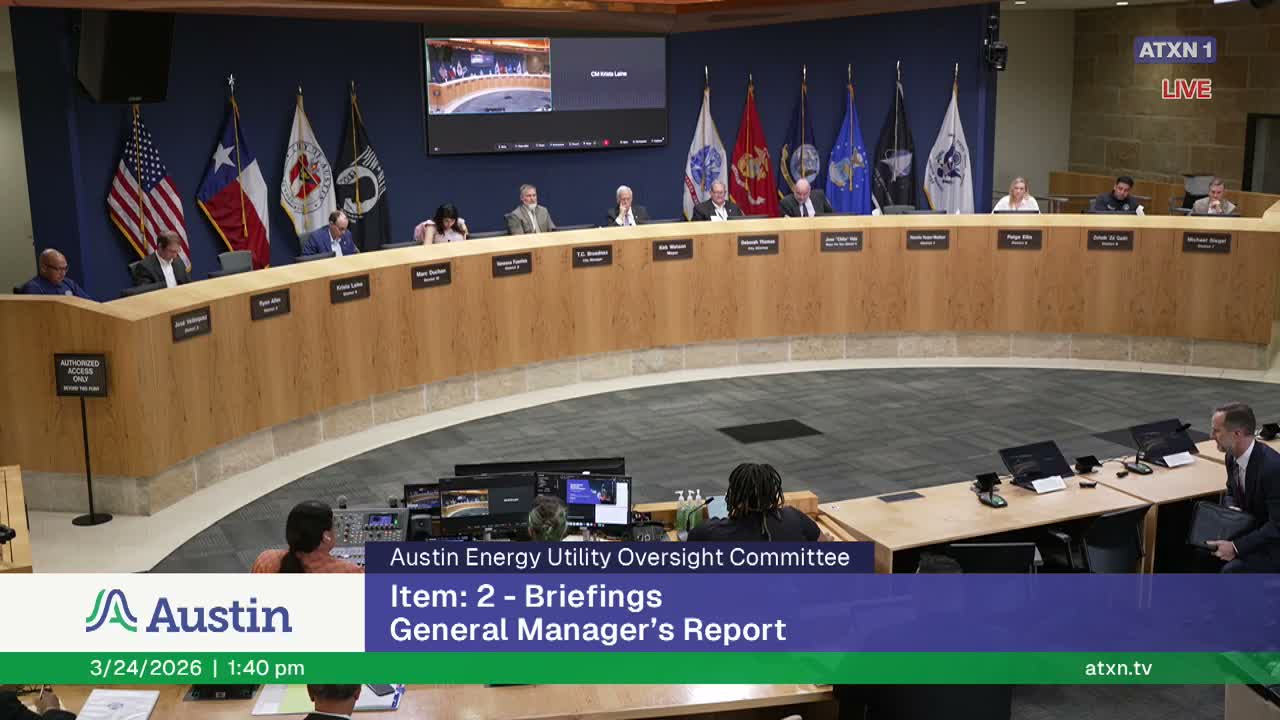
Austin Energy this month launched a customer‑sited battery demand‑response pilot that pays customers to make battery capacity available to the utility during grid events while keeping a 20% reserve for homeowner use.
Richard Genesee, vice president of Customer Energy Solutions, told the Utility Oversight Committee the pilot offers a $500 upfront incentive for new residential batteries (the $500 incentive is capped at 1,500 systems) and up to $75 per kilowatt in annual performance payments; staff will call a maximum of 40 events per year. Genesee said the program launched with four OEM partners and two enrolled customers and that Austin Energy has retained an independent evaluation, measurement and verification (EM&V) consultant to assess cost effectiveness and inform scaling decisions.
The pilot is presented as one element of Austin Energy’s demand‑response strategy to help the utility reach resource goals in its generation plan. “We pay customers on a performance basis based on how those batteries perform when we need them to perform,” Genesee said. He added that customers can enroll either directly with OEMs or through Austin Energy and that existing battery owners are eligible for the $75 per‑kW performance payments even if they do not qualify for the $500 new‑system rebate.
Committee members pressed staff on program design. Councilmember Walter compared the pilot to a third‑party installation and dispatch model used elsewhere and asked whether Austin Energy had considered outsourcing administration. Genesee said the utility is “considering all options” and that the scale of the climate and reliability challenge means the utility will likely pursue “all of the above” — utility‑scale batteries, landfill projects and customer batteries — while maintaining independent EM&V oversight.
Genesee added that customers who join the program will retain at least 20% of battery capacity for personal use in emergencies. He said the pilot will allow the utility to determine whether to expand enrollment, add OEM partners and convert the pilot into a permanent program.
Austin Energy plans to return to the committee with enrollment data and cost‑effectiveness results as the EM&V work progresses; staff described the current phase as an early pilot intended to inform broader deployment and contract decisions.
Richard Genesee, vice president of Customer Energy Solutions, told the Utility Oversight Committee the pilot offers a $500 upfront incentive for new residential batteries (the $500 incentive is capped at 1,500 systems) and up to $75 per kilowatt in annual performance payments; staff will call a maximum of 40 events per year. Genesee said the program launched with four OEM partners and two enrolled customers and that Austin Energy has retained an independent evaluation, measurement and verification (EM&V) consultant to assess cost effectiveness and inform scaling decisions.
The pilot is presented as one element of Austin Energy’s demand‑response strategy to help the utility reach resource goals in its generation plan. “We pay customers on a performance basis based on how those batteries perform when we need them to perform,” Genesee said. He added that customers can enroll either directly with OEMs or through Austin Energy and that existing battery owners are eligible for the $75 per‑kW performance payments even if they do not qualify for the $500 new‑system rebate.
Committee members pressed staff on program design. Councilmember Walter compared the pilot to a third‑party installation and dispatch model used elsewhere and asked whether Austin Energy had considered outsourcing administration. Genesee said the utility is “considering all options” and that the scale of the climate and reliability challenge means the utility will likely pursue “all of the above” — utility‑scale batteries, landfill projects and customer batteries — while maintaining independent EM&V oversight.
Genesee added that customers who join the program will retain at least 20% of battery capacity for personal use in emergencies. He said the pilot will allow the utility to determine whether to expand enrollment, add OEM partners and convert the pilot into a permanent program.
Austin Energy plans to return to the committee with enrollment data and cost‑effectiveness results as the EM&V work progresses; staff described the current phase as an early pilot intended to inform broader deployment and contract decisions.
View the Full Meeting & All Its Details
This article offers just a summary. Unlock complete video, transcripts, and insights as a Founder Member.
✓
Watch full, unedited meeting videos
✓
Search every word spoken in unlimited transcripts
✓
AI summaries & real-time alerts (all government levels)
✓
Permanent access to expanding government content
30-day money-back guarantee
