Council weighs limits on digital transit kiosks amid revenue and neighborhood concerns
March 24, 2026 | Austin, Travis County, Texas
This article was created by AI summarizing key points discussed. AI makes mistakes, so for full details and context, please refer to the video of the full meeting. Please report any errors so we can fix them. Report an error »
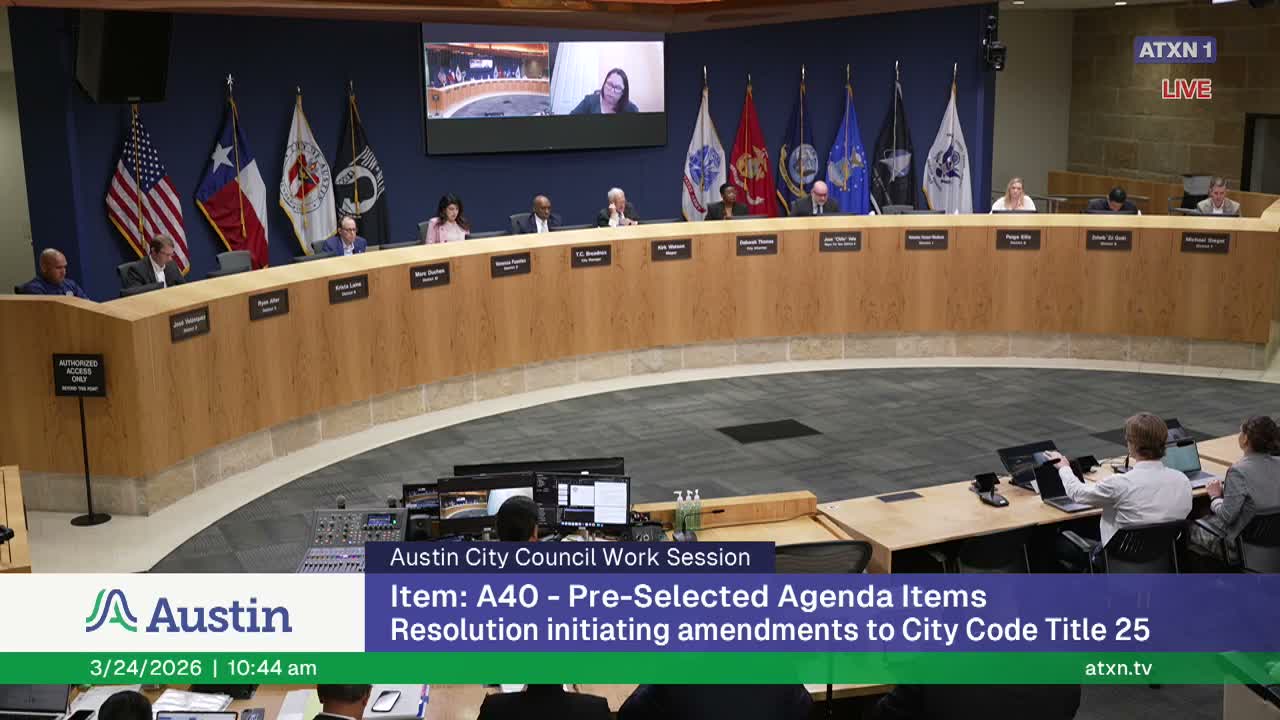
Councilmember Mike Siegel, who pulled item A66, offered two amendments: ban large digital signs in single‑family residential zones (SF‑1, SF‑2, SF‑3) and cap new off‑premise kiosks at 200, permitting transit and bike‑share signage in high‑capacity corridors while limiting proliferation.
Siegel said he is proud Austin blocked billboards historically and wants to prevent a sudden proliferation of advertising kiosks. “Two of the biggest concerns I’ve heard... are the impact of digital signs on residential areas and the possibility that we would suddenly have thousands of these signs,” he said. He proposed the amendments to balance transit wayfinding and rider information with neighborhood protections.
Trish Link of the city law department told council that on‑premise digital signage (for businesses and school sites) is already permitted under current code, and that the proposed amendments would create one standard for public‑right‑of‑way transit signage tied to transit uses. Samantha Baez, CapMetro’s EVP of experience and engagement, said ePaper and other digital arrival displays provide riders with real‑time arrival information and can improve usage and accessibility for less tech‑savvy customers.
Vendor representatives from Ike presented revenue context. Michael Way said kiosks in comparable cities produced stabilized gross revenues ranging from roughly $121,000 to $177,000 per kiosk in 2025; Ike’s underwriting projects about $130,679 per kiosk in stabilized gross revenue and a $2,000,000 annual guaranteed stream to the city across 100 kiosks. Anna Behrman, vice president at Ike Development, said the vendor expects strong demand for advertising in Austin and highlighted a guaranteed minimum revenue commitment.
Councilmembers raised concerns about maintenance and data feed reliability (CapMetro noted ePaper maintenance and backend data challenges), possible inequities in monetizing city right‑of‑way, and the risk of creating a privilege for a single vendor while private operators remain restricted. Multiple members suggested a limited pilot or tighter geographic and size limits rather than a broad numeric cap alone.
Next steps: Council noted the item will return (scheduled on the agenda before Thursday’s full council) so members can refine amendments and receive additional staff and partner input, including from Capital Metro and the law department.
Siegel said he is proud Austin blocked billboards historically and wants to prevent a sudden proliferation of advertising kiosks. “Two of the biggest concerns I’ve heard... are the impact of digital signs on residential areas and the possibility that we would suddenly have thousands of these signs,” he said. He proposed the amendments to balance transit wayfinding and rider information with neighborhood protections.
Trish Link of the city law department told council that on‑premise digital signage (for businesses and school sites) is already permitted under current code, and that the proposed amendments would create one standard for public‑right‑of‑way transit signage tied to transit uses. Samantha Baez, CapMetro’s EVP of experience and engagement, said ePaper and other digital arrival displays provide riders with real‑time arrival information and can improve usage and accessibility for less tech‑savvy customers.
Vendor representatives from Ike presented revenue context. Michael Way said kiosks in comparable cities produced stabilized gross revenues ranging from roughly $121,000 to $177,000 per kiosk in 2025; Ike’s underwriting projects about $130,679 per kiosk in stabilized gross revenue and a $2,000,000 annual guaranteed stream to the city across 100 kiosks. Anna Behrman, vice president at Ike Development, said the vendor expects strong demand for advertising in Austin and highlighted a guaranteed minimum revenue commitment.
Councilmembers raised concerns about maintenance and data feed reliability (CapMetro noted ePaper maintenance and backend data challenges), possible inequities in monetizing city right‑of‑way, and the risk of creating a privilege for a single vendor while private operators remain restricted. Multiple members suggested a limited pilot or tighter geographic and size limits rather than a broad numeric cap alone.
Next steps: Council noted the item will return (scheduled on the agenda before Thursday’s full council) so members can refine amendments and receive additional staff and partner input, including from Capital Metro and the law department.
Don't Miss a Word: See the Full Meeting!
Go beyond summaries. Unlock every video, transcript, and key insight with a Founder Membership.
✓
Get instant access to full meeting videos
✓
Search and clip any phrase from complete transcripts
✓
Receive AI-powered summaries & custom alerts
✓
Enjoy lifetime, unrestricted access to government data
30-day money-back guarantee
