Angola commissioners weigh paying for city water-capacity study to back economic development
March 12, 2026 | Angola City, Steuben County, Indiana
This article was created by AI summarizing key points discussed. AI makes mistakes, so for full details and context, please refer to the video of the full meeting. Please report any errors so we can fix them. Report an error »
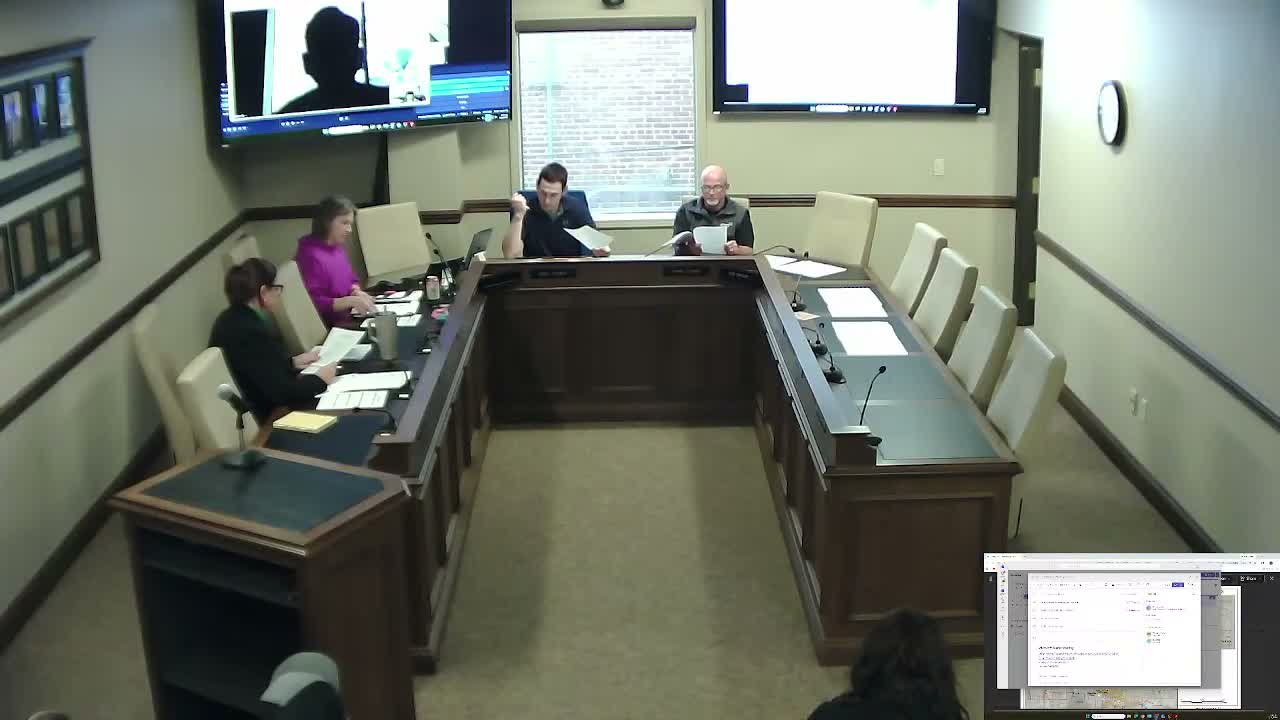
Angola redevelopment commissioners on March 11 heard a presentation of a recent wastewater master plan and discussed funding a proposed water-capacity study to help attract and serve new development.
City engineer Amanda Cope summarized the wastewater study and modeling conducted for a 20-year horizon. “Our plant is permitted to treat 1,700,000 gallons per day,” she said, and staff are currently averaging about 1,150,000 gallons per day — roughly 70% of the permitted average. Cope told commissioners that if the city grows within seven prioritized areas identified in the study, modeled demand could rise to an estimated 2.79 million gallons per day, exceeding the current permit and triggering the need for upgrades.
The consultant’s work mapped both the collection system and the treatment plant, identified bottlenecks (including a Trine University lift station that is at capacity), and produced deliverables that staff said make it quicker for potential developers to learn whether a parcel can be served. Cope described a GIS-based hydraulic modeling tool staff can run on specific sites so the city can provide developers near-immediate guidance on available capacity and likely upgrade costs.
Commissioners and staff framed the water study as a complementary piece. Cope said the same firm that did the wastewater work (FNB) proposed a water scope with a six-month timeline. A commissioner noted a study cost of about $63,000, and commissioners discussed whether the redevelopment commission — and possibly utility departments — should chip in. The presenter said the detailed cost breakdown in the consultant report had not yet been shared with the mayor and that line-item costs remained internal for now.
Members also discussed regional coordination. Commissioners raised capacity concerns for electric and natural-gas service, noting that utilities such as NIPSCO have sometimes disputed third-party findings; the commission asked staff to invite Isaac (county/utility liaison) to explain available electric/gas capacity at the next meeting.
Following discussion, commissioners agreed staff would circulate the water-study scope to the board and check available budgets. The board set April 8 as the next meeting and asked staff (including Mitch, introduced as the water superintendent) to return with a recommended contribution for the water study so commissioners could take a vote.
The presentation highlighted trade-offs: existing wastewater capacity will accommodate modest, historical growth (Cope said average flows would remain within the permit under low-growth projections) but targeted, near-term development in several identified sites would exceed current permits and require capital investment. The study provides both the technical basis to forecast those costs and a tool commissioners said will make Angola more competitive in discussions with developers.
Next steps: staff will email and print the scope of work, check departmental budgets for possible contributions, invite utility representatives to the next meeting, and return with a funding recommendation for formal action on April 8.
City engineer Amanda Cope summarized the wastewater study and modeling conducted for a 20-year horizon. “Our plant is permitted to treat 1,700,000 gallons per day,” she said, and staff are currently averaging about 1,150,000 gallons per day — roughly 70% of the permitted average. Cope told commissioners that if the city grows within seven prioritized areas identified in the study, modeled demand could rise to an estimated 2.79 million gallons per day, exceeding the current permit and triggering the need for upgrades.
The consultant’s work mapped both the collection system and the treatment plant, identified bottlenecks (including a Trine University lift station that is at capacity), and produced deliverables that staff said make it quicker for potential developers to learn whether a parcel can be served. Cope described a GIS-based hydraulic modeling tool staff can run on specific sites so the city can provide developers near-immediate guidance on available capacity and likely upgrade costs.
Commissioners and staff framed the water study as a complementary piece. Cope said the same firm that did the wastewater work (FNB) proposed a water scope with a six-month timeline. A commissioner noted a study cost of about $63,000, and commissioners discussed whether the redevelopment commission — and possibly utility departments — should chip in. The presenter said the detailed cost breakdown in the consultant report had not yet been shared with the mayor and that line-item costs remained internal for now.
Members also discussed regional coordination. Commissioners raised capacity concerns for electric and natural-gas service, noting that utilities such as NIPSCO have sometimes disputed third-party findings; the commission asked staff to invite Isaac (county/utility liaison) to explain available electric/gas capacity at the next meeting.
Following discussion, commissioners agreed staff would circulate the water-study scope to the board and check available budgets. The board set April 8 as the next meeting and asked staff (including Mitch, introduced as the water superintendent) to return with a recommended contribution for the water study so commissioners could take a vote.
The presentation highlighted trade-offs: existing wastewater capacity will accommodate modest, historical growth (Cope said average flows would remain within the permit under low-growth projections) but targeted, near-term development in several identified sites would exceed current permits and require capital investment. The study provides both the technical basis to forecast those costs and a tool commissioners said will make Angola more competitive in discussions with developers.
Next steps: staff will email and print the scope of work, check departmental budgets for possible contributions, invite utility representatives to the next meeting, and return with a funding recommendation for formal action on April 8.
Don't Miss a Word: See the Full Meeting!
Go beyond summaries. Unlock every video, transcript, and key insight with a Founder Membership.
✓
Get instant access to full meeting videos
✓
Search and clip any phrase from complete transcripts
✓
Receive AI-powered summaries & custom alerts
✓
Enjoy lifetime, unrestricted access to government data
30-day money-back guarantee
