Survivors and lawyers press committee to treat domestic violence as central to custody decisions; bill advances
March 23, 2026 | 2026 Legislature Arizona, Arizona
This article was created by AI summarizing key points discussed. AI makes mistakes, so for full details and context, please refer to the video of the full meeting. Please report any errors so we can fix them. Report an error »
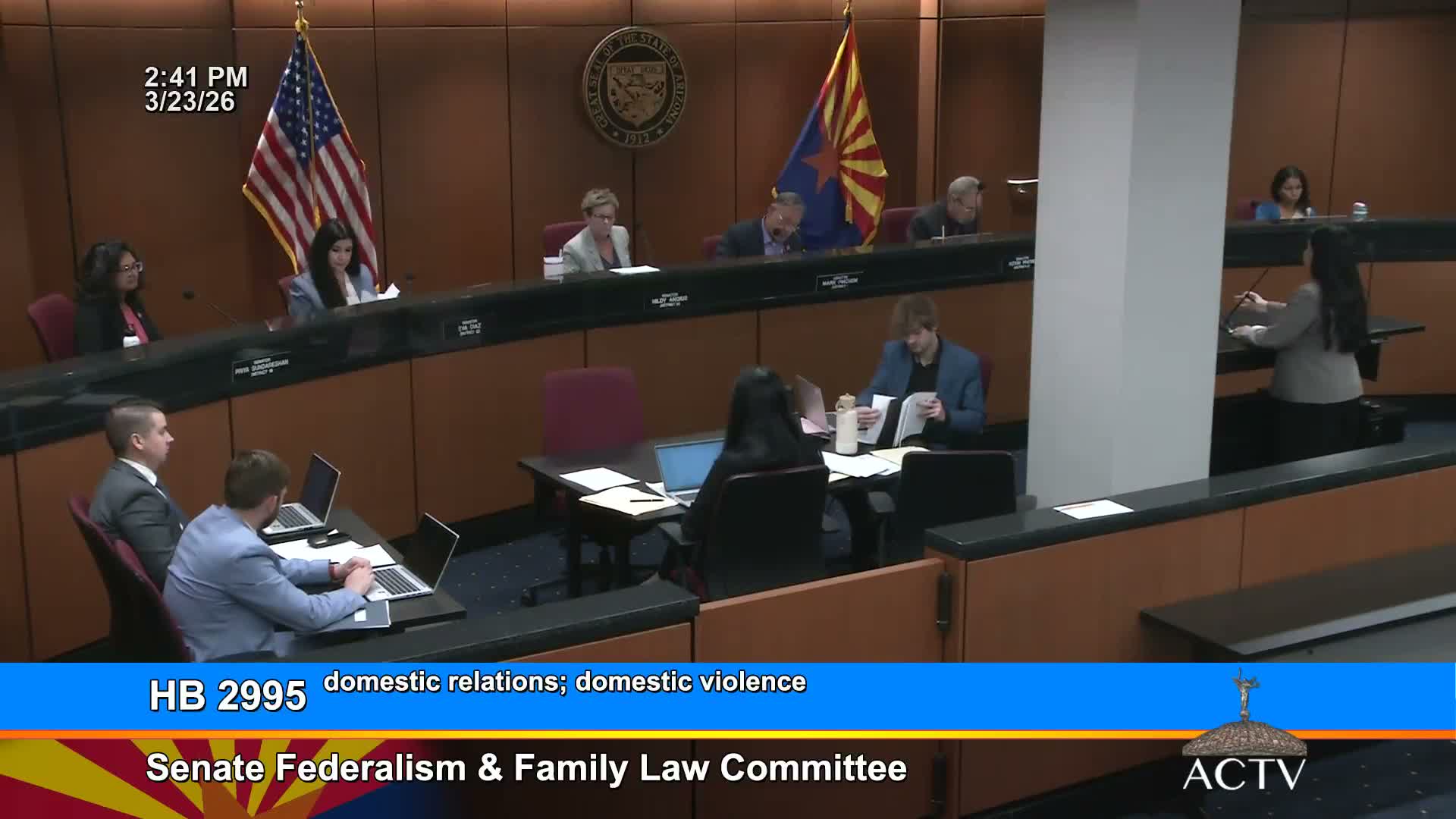
The Federalism and Family Law Committee voted 4–3 to advance House Bill 2995, a package of family-court changes sponsors said are designed to ensure courts treat domestic violence — including coercive control and nonphysical abuse — as a principal factor when awarding legal decision-making and parenting time.
Representative Lisa Fink, who presented the bill, said the measure responds to judges’ requests for statutory clarity on how to treat domestic-violence allegations and to reduce the mischaracterization of abuse as mere conflict.
Multiple witnesses told painful stories of court decisions they said failed to protect children and survivors. Hope Hooten delivered a detailed account of strangulation, coercive control and psychiatric crises during separation, then described the fatal outcome in which her two children were killed by their father during an unsupervised visit. “This bill gives the courts the tools to recognize risk earlier, to evaluate danger more completely, and to protect children before it's too late,” Hooten said.
Other witnesses, family-law attorneys and advocates — including Thomas Solange (private practitioner) and Patricia Madsen (Community Legal Services) — urged the committee to eliminate the statutory “significant” threshold that they said allowed many domestic-violence findings to be minimized, and they supported clearer evidentiary guidance and required judicial findings on the record.
Several senators expressed concern about implementation details: how courts would apply preponderance-of-the-evidence standards without requiring corroboration, whether mutual allegations could flip protective presumptions, and the burden the bill’s required findings might place on already-burdened family courts. Supporters said the bill preserves rebuttable pathways and contains subsections specifying how a parent may overcome presumptions.
Senators who opposed the measure in committee said they supported the goal of protecting victims but worried the drafting could produce unintended consequences and urged further refinement before floor action. The committee nevertheless gave HB 2995 a due-pass recommendation by a 4–3 vote.
The bill’s authors and advocates said they intend to continue stakeholder discussions during the next stage of the legislative process to clarify evidentiary and implementation questions.
Representative Lisa Fink, who presented the bill, said the measure responds to judges’ requests for statutory clarity on how to treat domestic-violence allegations and to reduce the mischaracterization of abuse as mere conflict.
Multiple witnesses told painful stories of court decisions they said failed to protect children and survivors. Hope Hooten delivered a detailed account of strangulation, coercive control and psychiatric crises during separation, then described the fatal outcome in which her two children were killed by their father during an unsupervised visit. “This bill gives the courts the tools to recognize risk earlier, to evaluate danger more completely, and to protect children before it's too late,” Hooten said.
Other witnesses, family-law attorneys and advocates — including Thomas Solange (private practitioner) and Patricia Madsen (Community Legal Services) — urged the committee to eliminate the statutory “significant” threshold that they said allowed many domestic-violence findings to be minimized, and they supported clearer evidentiary guidance and required judicial findings on the record.
Several senators expressed concern about implementation details: how courts would apply preponderance-of-the-evidence standards without requiring corroboration, whether mutual allegations could flip protective presumptions, and the burden the bill’s required findings might place on already-burdened family courts. Supporters said the bill preserves rebuttable pathways and contains subsections specifying how a parent may overcome presumptions.
Senators who opposed the measure in committee said they supported the goal of protecting victims but worried the drafting could produce unintended consequences and urged further refinement before floor action. The committee nevertheless gave HB 2995 a due-pass recommendation by a 4–3 vote.
The bill’s authors and advocates said they intend to continue stakeholder discussions during the next stage of the legislative process to clarify evidentiary and implementation questions.
Don't Miss a Word: See the Full Meeting!
Go beyond summaries. Unlock every video, transcript, and key insight with a Founder Membership.
✓
Get instant access to full meeting videos
✓
Search and clip any phrase from complete transcripts
✓
Receive AI-powered summaries & custom alerts
✓
Enjoy lifetime, unrestricted access to government data
30-day money-back guarantee
