Glenfarn and AGDC brief House Resources Committee on Alaska LNG progress, buyers and timeline
March 23, 2026 | 2026 Legislature Alaska, Alaska
This article was created by AI summarizing key points discussed. AI makes mistakes, so for full details and context, please refer to the video of the full meeting. Please report any errors so we can fix them. Report an error »
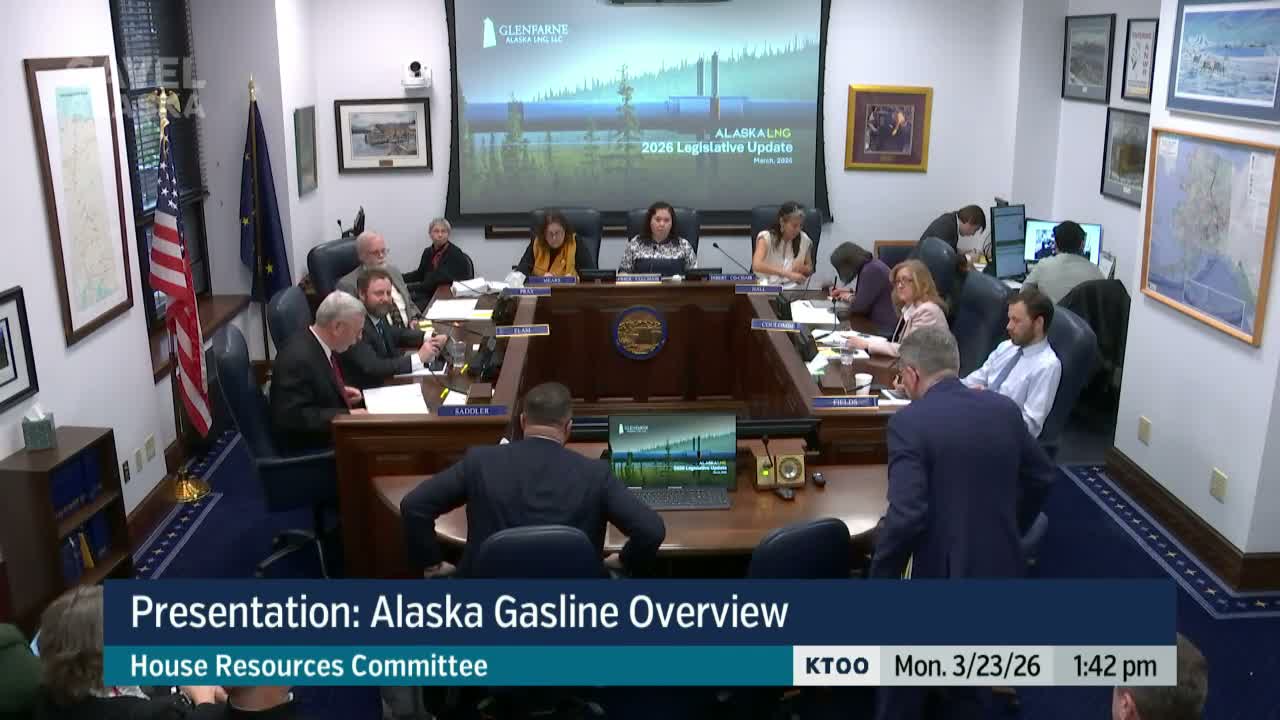
Developers and state partners gave the Alaska House Resources Committee a detailed update March 23 on the Alaska LNG project, outlining buyer commitments, phasing, schedule targets and remaining risks as legislators pressed for price transparency and assurances the project would deliver affordable in‑state energy.
Adam Presage, president of Glenfarn Alaska LNG, opened the presentation by framing the project as an opportunity for energy security and long-term economic growth. He said developer Glenfarn stepped into the project within the past year and described the project as “very ready to go forward,” noting recent geopolitical shifts that have increased global demand for LNG.
Matt Kissinger, commercial director for the Alaska Gas Line Development Corporation (AGDC), and Mark Begich (working on behalf of the administration and affiliated with Northern Compass Group/Brownstein Hyatt in a subcontractor role) joined the presentation. Kissinger said regulatory and structural changes since 2015 — including an offtake framework and phasing of the project—have made a developer-led, phased approach viable.
Key claims and milestones presented
- Buyers and capacity: Presenters said publicly announced buyers currently total about 13 million tons per annum (TPA) and the project is permitted for 20 TPA; they said financing will require long-term commitments for roughly 80% of export capacity (about 16 TPA). Adam Presage listed contracting parties including CPC (Taiwan), PTT (Thailand), JERA and Tokyo Gas, and that TotalEnergies has committed to purchase 2 TPA.
- Domestic reservation: Presenters said the joint venture guarantees at least 500 million cubic feet per day (MMcfd) for Alaska domestic use. They also stated the export-capacity figure of 20 TPA is roughly equivalent to about 2.8 billion cubic feet per day.
- Jobs and local benefits: Presenters estimated the 800-mile pipeline construction would require at least 7,000 construction jobs and generate substantial tax and royalty revenue, though precise annual state-tax figures were described in general terms rather than as a firm projection.
- Schedule targets: The team said procurement is underway and that the pipeline could reach mechanical completion by 2028 with full operations by mid-2029; the LNG export facility’s target for exports was described as around 2031, subject to contingencies and final investment decisions (FIDs).
Committee concerns and follow-ups
Lawmakers pressed presenters on timing, price, transparency and distributional impacts. Representative Fields and others asked for concrete price ranges and where contract filings would appear; Presage said negotiated contracts with utilities and other counterparties will be submitted to the Regulatory Commission of Alaska and will be public documents that can be reviewed.
Several members, including Representative Prox and Representative Colom, raised skepticism about past missed deadlines and sought clarity about the project’s final investment decision timeline and buyer commitments. Kissinger and AGDC emphasized milestones and “puzzle pieces” — upstream and downstream contracts, feed studies, pipeline builder selection and supply of pipe — as indicators for when FID is possible, and noted a recent completion of a class 2 front-end engineering design (FEED) that improves financeability.
Fairbanks and phasing: Representatives asked whether Fairbanks would see near-term relief. Kissinger and Begich said phase 1 aims to provide cheaper electricity as an early benefit while pipeline volumes ramp up, and that different rate and service structures would be considered for interior customers. Presenters also described how an LNG import terminal can be developed on an independent timeline and later converted to an export facility, noting that a large portion of import‑terminal capital is applicable if the site later serves exports.
Taxes and legislation: Committee members discussed related bills, including a House bill on a payment-in-lieu or volumetric tax alternative and forthcoming hearings on property tax proposals for the Alaska LNG project. Presenters deferred detailed tax-rate defense to the Wednesday hearing but said volumetric tax treatments align state and infrastructure incentives.
Uncertainties noted: Presenters repeatedly described FID timing as dependent on completing numerous commercial agreements, lining up construction and supply chains, and finalizing financing; they cautioned that while milestones are progressing, exact FID dates remain subject to multiple counterparties and market conditions.
The committee closed with an agreement to continue oversight and further hearings. Co-chair Representative Freer said the resources committee will convene again, and staff will circulate materials requested by members.
Adam Presage, president of Glenfarn Alaska LNG, opened the presentation by framing the project as an opportunity for energy security and long-term economic growth. He said developer Glenfarn stepped into the project within the past year and described the project as “very ready to go forward,” noting recent geopolitical shifts that have increased global demand for LNG.
Matt Kissinger, commercial director for the Alaska Gas Line Development Corporation (AGDC), and Mark Begich (working on behalf of the administration and affiliated with Northern Compass Group/Brownstein Hyatt in a subcontractor role) joined the presentation. Kissinger said regulatory and structural changes since 2015 — including an offtake framework and phasing of the project—have made a developer-led, phased approach viable.
Key claims and milestones presented
- Buyers and capacity: Presenters said publicly announced buyers currently total about 13 million tons per annum (TPA) and the project is permitted for 20 TPA; they said financing will require long-term commitments for roughly 80% of export capacity (about 16 TPA). Adam Presage listed contracting parties including CPC (Taiwan), PTT (Thailand), JERA and Tokyo Gas, and that TotalEnergies has committed to purchase 2 TPA.
- Domestic reservation: Presenters said the joint venture guarantees at least 500 million cubic feet per day (MMcfd) for Alaska domestic use. They also stated the export-capacity figure of 20 TPA is roughly equivalent to about 2.8 billion cubic feet per day.
- Jobs and local benefits: Presenters estimated the 800-mile pipeline construction would require at least 7,000 construction jobs and generate substantial tax and royalty revenue, though precise annual state-tax figures were described in general terms rather than as a firm projection.
- Schedule targets: The team said procurement is underway and that the pipeline could reach mechanical completion by 2028 with full operations by mid-2029; the LNG export facility’s target for exports was described as around 2031, subject to contingencies and final investment decisions (FIDs).
Committee concerns and follow-ups
Lawmakers pressed presenters on timing, price, transparency and distributional impacts. Representative Fields and others asked for concrete price ranges and where contract filings would appear; Presage said negotiated contracts with utilities and other counterparties will be submitted to the Regulatory Commission of Alaska and will be public documents that can be reviewed.
Several members, including Representative Prox and Representative Colom, raised skepticism about past missed deadlines and sought clarity about the project’s final investment decision timeline and buyer commitments. Kissinger and AGDC emphasized milestones and “puzzle pieces” — upstream and downstream contracts, feed studies, pipeline builder selection and supply of pipe — as indicators for when FID is possible, and noted a recent completion of a class 2 front-end engineering design (FEED) that improves financeability.
Fairbanks and phasing: Representatives asked whether Fairbanks would see near-term relief. Kissinger and Begich said phase 1 aims to provide cheaper electricity as an early benefit while pipeline volumes ramp up, and that different rate and service structures would be considered for interior customers. Presenters also described how an LNG import terminal can be developed on an independent timeline and later converted to an export facility, noting that a large portion of import‑terminal capital is applicable if the site later serves exports.
Taxes and legislation: Committee members discussed related bills, including a House bill on a payment-in-lieu or volumetric tax alternative and forthcoming hearings on property tax proposals for the Alaska LNG project. Presenters deferred detailed tax-rate defense to the Wednesday hearing but said volumetric tax treatments align state and infrastructure incentives.
Uncertainties noted: Presenters repeatedly described FID timing as dependent on completing numerous commercial agreements, lining up construction and supply chains, and finalizing financing; they cautioned that while milestones are progressing, exact FID dates remain subject to multiple counterparties and market conditions.
The committee closed with an agreement to continue oversight and further hearings. Co-chair Representative Freer said the resources committee will convene again, and staff will circulate materials requested by members.
View the Full Meeting & All Its Details
This article offers just a summary. Unlock complete video, transcripts, and insights as a Founder Member.
✓
Watch full, unedited meeting videos
✓
Search every word spoken in unlimited transcripts
✓
AI summaries & real-time alerts (all government levels)
✓
Permanent access to expanding government content
30-day money-back guarantee
