House Finance committee hears bill to require 30-day prompt payment parity for nonprofits, tribes and municipalities
March 23, 2026 | 2026 Legislature Alaska, Alaska
This article was created by AI summarizing key points discussed. AI makes mistakes, so for full details and context, please refer to the video of the full meeting. Please report any errors so we can fix them. Report an error »
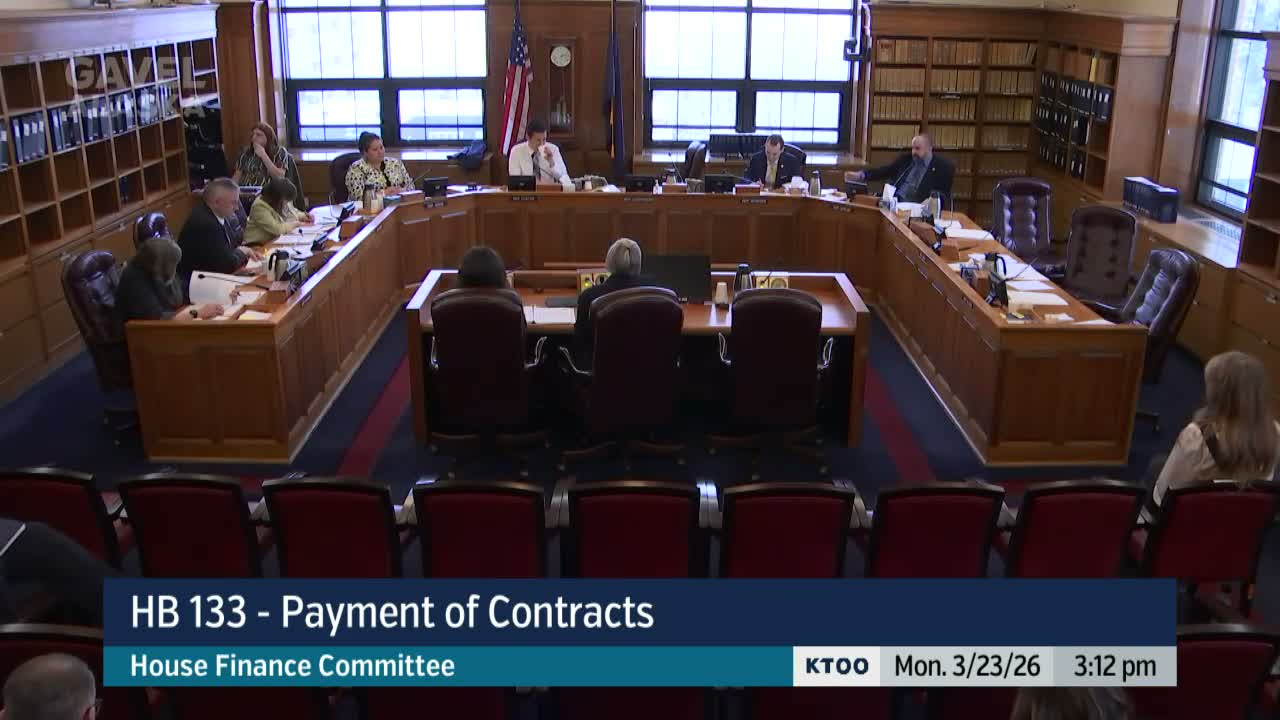
Co-chair Foster convened the House Finance Committee on March 23 to hear Representative Himshoo’s first hearing on House Bill 133, which would extend the state’s prompt-payment standard to nonprofits, municipalities and Alaska Native organizations and impose interest penalties on late payments.
The bill’s sponsor, Representative Himshoo, told the committee HB 133 aims to close a ‘‘parity’’ gap in which private contractors already have an enforceable payment timeline while other partners often wait months for state reimbursements. He said the measure ties the 30-calendar-day deadline to a compliant payment request or, for pass-through federal funds, to the agency’s receipt of federal money—whichever is later.
Laurie Wolf, president and CEO of the Foraker Group, testified in support and described widespread delays. "This is money that has already been approved by the legislature," Wolf said, adding that payments commonly lag three, six, nine months or longer and that late amounts range from about $25,000 to more than $1,000,000. She said nonprofits, tribes and municipalities often must dip into savings, take on short-term debt or delay services while waiting for state payments and urged the committee to pass the bill and allow the state to use federal rural health-care transformation funds for needed technology upgrades.
Committee members probed practical and legal questions. Representative Galvin and others asked whether HB 133 accounts for federal pass-through timing; Representative Himshoo read bill language that explicitly uses "whichever is later" (the compliant payment request or the agency’s receipt of federal funds) to avoid penalizing agencies waiting for federal reimbursements. Representative Josephson noted existing language in the private-contractor statute and asked whether the new language replicates that procedural back-and-forth for nonprofit and municipal claims.
Several lawmakers asked for evidence that nonprofits fear retaliation for speaking up; Wolf and the sponsor said many organizations declined to appear on the record out of concern, but Wolf said she had no direct evidence of threats. Committee members also pressed for more fiscal-note detail: staff reported six fiscal notes from Department of Health divisions and said work is underway to collect outstanding notes from other agencies.
Officials from the Department of Health described operational causes and corrective steps. Courtney Enright, legislative liaison, and Pam Halloran, assistant commissioner, said the department has high turnover among staff who process payments, multiple accounting systems, and training gaps. Halloran said the department expects a July 1 project to have divisions enter transactions directly into the accounting system, the addition of five positions and monthly scorecards to make timely payment performance visible and improve results.
Dale Sandreus of the Alaska Municipal League urged enforceable timelines and administrative reforms. He recommended making interest penalties automatic rather than requiring vendors to request them after the fact, allowing advanced mobilization payments where appropriate, and requiring quarterly public reporting by agency and program on days-to-pay and total interest owed to increase transparency.
Sam Turner, mayor of Tuxedo Bay, gave a local example of harm from delayed community-assistance and PELT payments: in some years the community’s payments arrived in September or October rather than in July, forcing the city to enter insurance payment plans and incur about $3,000 in extra interest last year. He said timely payments would reduce last-minute budget reallocations and the risk of service disruption.
The committee did not take votes during the hearing. Members asked staff to continue collecting fiscal notes and scheduled further consideration of the bill and associated fiscal notes at the next hearing and in follow-up committee work on the budget.
Next steps: the committee will continue to gather missing fiscal notes and address them in the bill’s next hearing; members indicated interest both in statutory enforcement and in providing agencies with resources and information-technology support to meet payment deadlines.
The bill’s sponsor, Representative Himshoo, told the committee HB 133 aims to close a ‘‘parity’’ gap in which private contractors already have an enforceable payment timeline while other partners often wait months for state reimbursements. He said the measure ties the 30-calendar-day deadline to a compliant payment request or, for pass-through federal funds, to the agency’s receipt of federal money—whichever is later.
Laurie Wolf, president and CEO of the Foraker Group, testified in support and described widespread delays. "This is money that has already been approved by the legislature," Wolf said, adding that payments commonly lag three, six, nine months or longer and that late amounts range from about $25,000 to more than $1,000,000. She said nonprofits, tribes and municipalities often must dip into savings, take on short-term debt or delay services while waiting for state payments and urged the committee to pass the bill and allow the state to use federal rural health-care transformation funds for needed technology upgrades.
Committee members probed practical and legal questions. Representative Galvin and others asked whether HB 133 accounts for federal pass-through timing; Representative Himshoo read bill language that explicitly uses "whichever is later" (the compliant payment request or the agency’s receipt of federal funds) to avoid penalizing agencies waiting for federal reimbursements. Representative Josephson noted existing language in the private-contractor statute and asked whether the new language replicates that procedural back-and-forth for nonprofit and municipal claims.
Several lawmakers asked for evidence that nonprofits fear retaliation for speaking up; Wolf and the sponsor said many organizations declined to appear on the record out of concern, but Wolf said she had no direct evidence of threats. Committee members also pressed for more fiscal-note detail: staff reported six fiscal notes from Department of Health divisions and said work is underway to collect outstanding notes from other agencies.
Officials from the Department of Health described operational causes and corrective steps. Courtney Enright, legislative liaison, and Pam Halloran, assistant commissioner, said the department has high turnover among staff who process payments, multiple accounting systems, and training gaps. Halloran said the department expects a July 1 project to have divisions enter transactions directly into the accounting system, the addition of five positions and monthly scorecards to make timely payment performance visible and improve results.
Dale Sandreus of the Alaska Municipal League urged enforceable timelines and administrative reforms. He recommended making interest penalties automatic rather than requiring vendors to request them after the fact, allowing advanced mobilization payments where appropriate, and requiring quarterly public reporting by agency and program on days-to-pay and total interest owed to increase transparency.
Sam Turner, mayor of Tuxedo Bay, gave a local example of harm from delayed community-assistance and PELT payments: in some years the community’s payments arrived in September or October rather than in July, forcing the city to enter insurance payment plans and incur about $3,000 in extra interest last year. He said timely payments would reduce last-minute budget reallocations and the risk of service disruption.
The committee did not take votes during the hearing. Members asked staff to continue collecting fiscal notes and scheduled further consideration of the bill and associated fiscal notes at the next hearing and in follow-up committee work on the budget.
Next steps: the committee will continue to gather missing fiscal notes and address them in the bill’s next hearing; members indicated interest both in statutory enforcement and in providing agencies with resources and information-technology support to meet payment deadlines.
View the Full Meeting & All Its Details
This article offers just a summary. Unlock complete video, transcripts, and insights as a Founder Member.
✓
Watch full, unedited meeting videos
✓
Search every word spoken in unlimited transcripts
✓
AI summaries & real-time alerts (all government levels)
✓
Permanent access to expanding government content
30-day money-back guarantee
