Rep. Kai Holland proposes bill to make DOT prioritize road maintenance in wildland-urban-interface areas
March 24, 2026 | 2026 Legislature Alaska, Alaska
This article was created by AI summarizing key points discussed. AI makes mistakes, so for full details and context, please refer to the video of the full meeting. Please report any errors so we can fix them. Report an error »
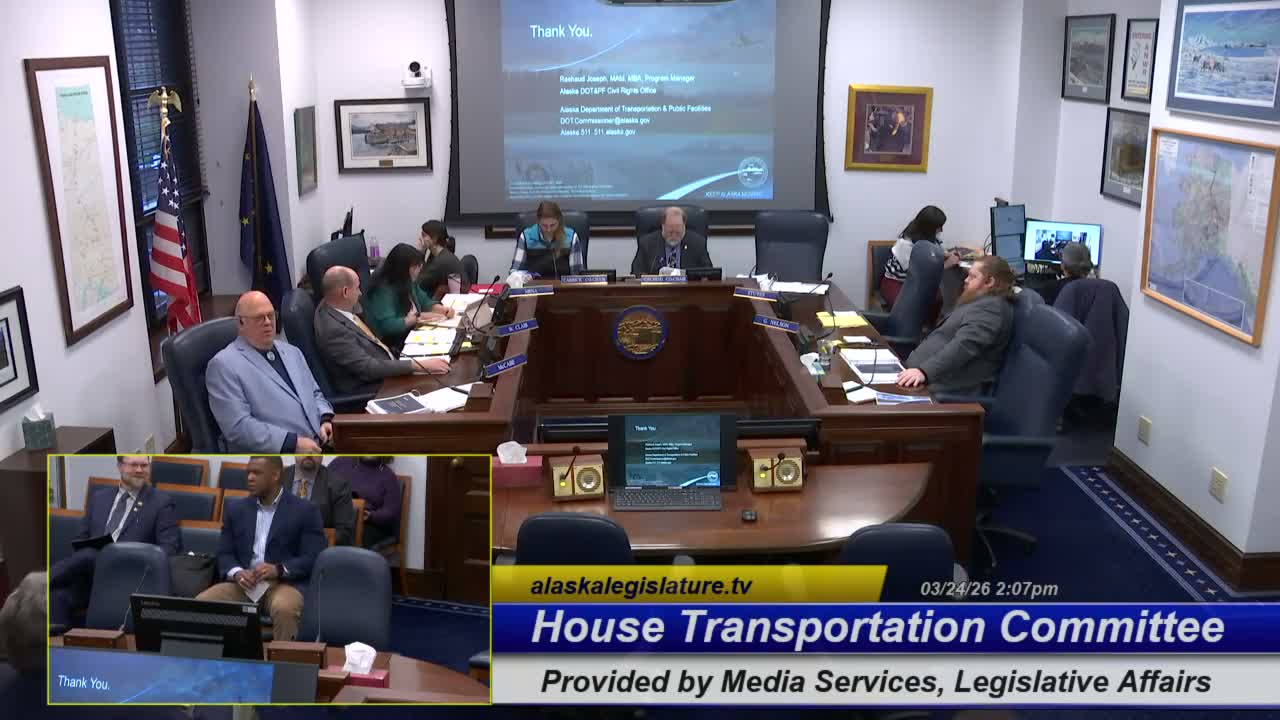
Representative Kai Holland (House District 9) told the House Transportation Committee on March 24 that House Bill 317 would add duties to the Department of Transportation and Public Facilities to identify and prioritize state roads in wildland-urban-interface areas for maintenance and mitigation.
Holland said the bill "does two things": it requires DOT to create a prioritization program for maintenance in WUI areas and it adds uncodified guidance requiring a report to the Legislature by December on how the department would develop a longer-term maintenance plan for roads that provide singular egress to isolated residential neighborhoods.
Holland framed the bill with local examples, notably Clarks Road on the Anchorage Hillside and prior shaded-fuel-break work in 2006 and later community efforts. He described complications that can arise when multiple landowners, rights-of-way and funding sources intersect, and said the proposed prioritization framework is intended to integrate mitigation work into DOT's existing maintenance rotations where feasible.
Committee members pressed for details. Representative McCabe asked what urban means in state or federal definitions; Holland deferred to the Division of Forestry and Department of Natural Resources for technical WUI definitions and said the bill is intended to create a consultative process with municipalities and local experts. Representative Mina asked why tribal governments were not explicitly listed among required consultees; Holland acknowledged he had not yet sought tribal input and said that was an omission the committee should consider.
Andy Mills of DOT told the committee the fiscal note frames the proposal as a planning and reporting effort rather than an execution program. DOT expects the work will involve staffing, GIS mapping, overlaying DNR hazard data and consultant support to assemble a prioritized list of state roads and to coordinate with municipalities.
Holland said he expects the committee to seek an official definition of WUI from the Division of Forestry and to refine consultation language; the bill's uncodified report requirement is intended to provide the Legislature information on priorities and possible funding or statutory changes.
Ending: The committee did not take final action on HB317; members requested the WUI definition and additional materials to aid deliberation.
Holland said the bill "does two things": it requires DOT to create a prioritization program for maintenance in WUI areas and it adds uncodified guidance requiring a report to the Legislature by December on how the department would develop a longer-term maintenance plan for roads that provide singular egress to isolated residential neighborhoods.
Holland framed the bill with local examples, notably Clarks Road on the Anchorage Hillside and prior shaded-fuel-break work in 2006 and later community efforts. He described complications that can arise when multiple landowners, rights-of-way and funding sources intersect, and said the proposed prioritization framework is intended to integrate mitigation work into DOT's existing maintenance rotations where feasible.
Committee members pressed for details. Representative McCabe asked what urban means in state or federal definitions; Holland deferred to the Division of Forestry and Department of Natural Resources for technical WUI definitions and said the bill is intended to create a consultative process with municipalities and local experts. Representative Mina asked why tribal governments were not explicitly listed among required consultees; Holland acknowledged he had not yet sought tribal input and said that was an omission the committee should consider.
Andy Mills of DOT told the committee the fiscal note frames the proposal as a planning and reporting effort rather than an execution program. DOT expects the work will involve staffing, GIS mapping, overlaying DNR hazard data and consultant support to assemble a prioritized list of state roads and to coordinate with municipalities.
Holland said he expects the committee to seek an official definition of WUI from the Division of Forestry and to refine consultation language; the bill's uncodified report requirement is intended to provide the Legislature information on priorities and possible funding or statutory changes.
Ending: The committee did not take final action on HB317; members requested the WUI definition and additional materials to aid deliberation.
View the Full Meeting & All Its Details
This article offers just a summary. Unlock complete video, transcripts, and insights as a Founder Member.
✓
Watch full, unedited meeting videos
✓
Search every word spoken in unlimited transcripts
✓
AI summaries & real-time alerts (all government levels)
✓
Permanent access to expanding government content
30-day money-back guarantee
