House Finance Committee advances bill tightening protections for minors in psychiatric hospitals
March 24, 2026 | 2026 Legislature Alaska, Alaska
This article was created by AI summarizing key points discussed. AI makes mistakes, so for full details and context, please refer to the video of the full meeting. Please report any errors so we can fix them. Report an error »
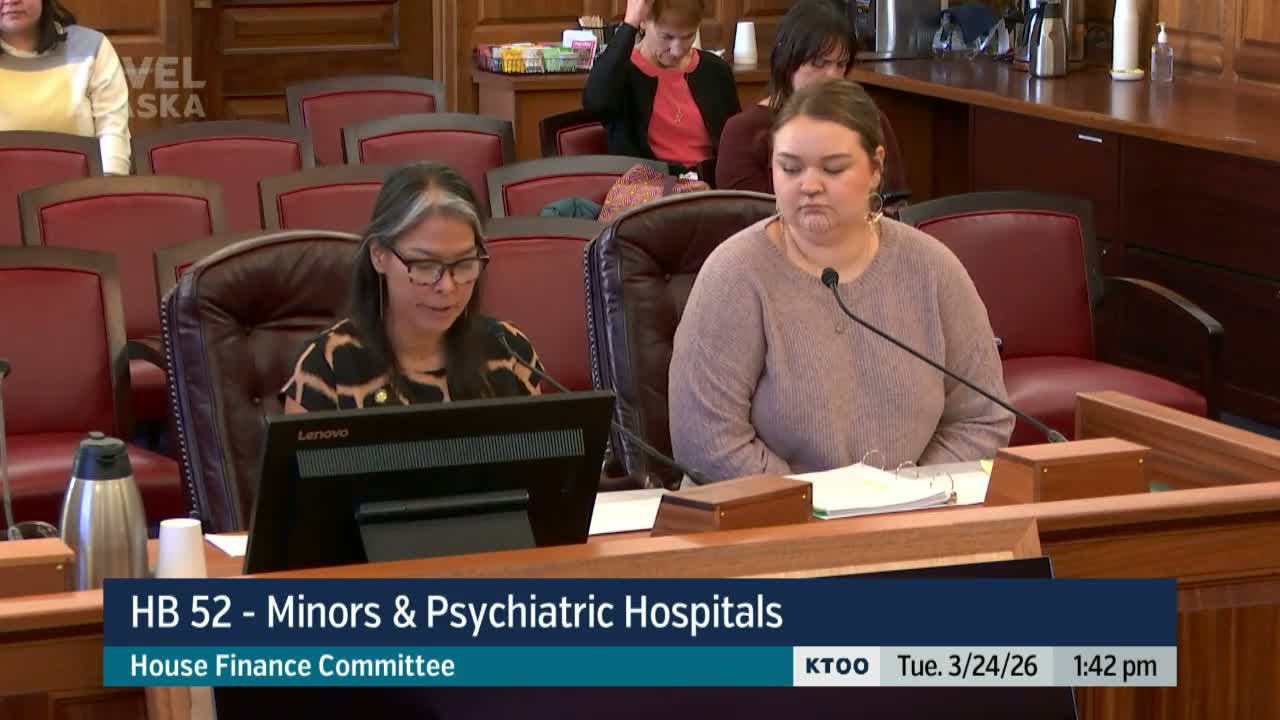
The House Finance Committee moved House Bill 52 out of committee on March 24 after a sponsor presentation and committee questioning. Representative Maxine Divert, sponsor of the bill, told the committee the measure aims "to bring more transparency to the ways our minors are treated in psychiatric hospitals in the state." The bill sets three specific requirements: at least two cumulative hours per week of confidential communication between a minor and a parent, legal guardian or approved adult; two unannounced Department of Health inspections of each psychiatric hospital that must interview at least 50% of minor patients; and written notification to the Department of Health and the minor’s legal guardian of any seclusion or restraint used on a minor within 72 hours.
Committee members questioned practical enforcement and scope. Representative Tom Shevsky asked whether the bill’s right to confidential communication could be nullified by exceptions in the text — "unless otherwise prohibited by law or court order or considered therapeutically unadvisable by the professional person in charge" — and whether that language would allow staff to routinely deny calls. Representative Divert’s staff and sponsor’s team said the language was carefully added based on a Department of Justice report and prior committee work to address documented instances in which children lacked private time to speak with guardians. Sarah Snowberger, chief of staff to Representative Divert, said the DOJ report found children “didn't have any private time without staff being there, so they could actually speak to their parent or guardian.”
The committee also asked for agency input on the standard "therapeutically unadvisable." Chrissy Voguely, senior policy advisor at the Department of Family and Community Services, said that provision is intended to protect children in state custody when contact with a parent would be harmful and that such determinations would be clinical and documented in case files. David Flatten of the Division of Juvenile Justice clarified that enforcement actions arising from the bill would fall under the Department of Health's jurisdiction, not his division.
A committee member moved to advance HB52 with individual recommendations and the attached fiscal note; the chair called for objections and, seeing none, announced the bill moves out of committee. The committee asked staff to ensure members sign the yellow sheet accompanying the motion.
Representative Divert closed by thanking the committee for their questions and support. The committee did not consider amendments at this meeting; the bill will proceed with the committee’s recommendation and the attached fiscal documentation.
Committee members questioned practical enforcement and scope. Representative Tom Shevsky asked whether the bill’s right to confidential communication could be nullified by exceptions in the text — "unless otherwise prohibited by law or court order or considered therapeutically unadvisable by the professional person in charge" — and whether that language would allow staff to routinely deny calls. Representative Divert’s staff and sponsor’s team said the language was carefully added based on a Department of Justice report and prior committee work to address documented instances in which children lacked private time to speak with guardians. Sarah Snowberger, chief of staff to Representative Divert, said the DOJ report found children “didn't have any private time without staff being there, so they could actually speak to their parent or guardian.”
The committee also asked for agency input on the standard "therapeutically unadvisable." Chrissy Voguely, senior policy advisor at the Department of Family and Community Services, said that provision is intended to protect children in state custody when contact with a parent would be harmful and that such determinations would be clinical and documented in case files. David Flatten of the Division of Juvenile Justice clarified that enforcement actions arising from the bill would fall under the Department of Health's jurisdiction, not his division.
A committee member moved to advance HB52 with individual recommendations and the attached fiscal note; the chair called for objections and, seeing none, announced the bill moves out of committee. The committee asked staff to ensure members sign the yellow sheet accompanying the motion.
Representative Divert closed by thanking the committee for their questions and support. The committee did not consider amendments at this meeting; the bill will proceed with the committee’s recommendation and the attached fiscal documentation.
View the Full Meeting & All Its Details
This article offers just a summary. Unlock complete video, transcripts, and insights as a Founder Member.
✓
Watch full, unedited meeting videos
✓
Search every word spoken in unlimited transcripts
✓
AI summaries & real-time alerts (all government levels)
✓
Permanent access to expanding government content
30-day money-back guarantee
