Court system seeks fifth Palmer superior court judge as caseloads outpace statewide average
March 24, 2026 | 2026 Legislature Alaska, Alaska
This article was created by AI summarizing key points discussed. AI makes mistakes, so for full details and context, please refer to the video of the full meeting. Please report any errors so we can fix them. Report an error »
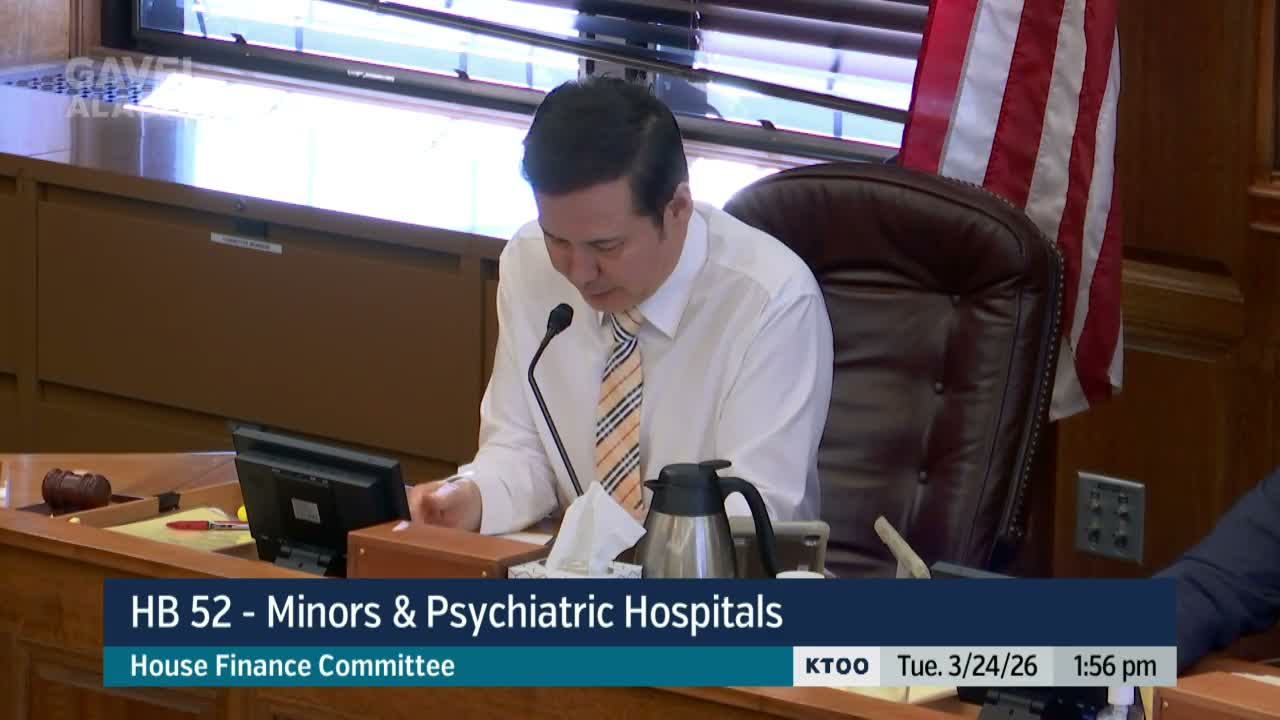
The House Finance Committee heard from Nancy Mead, General Counsel for the Alaska Court System, on March 24 about House Bill 262, which would amend the statute that sets the number of superior court judges to add one judge seated in Palmer. Mead told the committee the bill is driven by longstanding, outsized caseloads in the Mat‑Su Valley and Palmer Superior Court: recent filings range roughly between 2,650 and 2,950 per year, which currently equates to about 683 cases per judge in Palmer compared with a statewide average of about 458.
Mead described multiple drivers of heavier workload: cases have become more complex because of technology and volume of digital evidence, victims' rights processes have expanded, the 'one family, one judge' practice consolidates related family matters before a single judge, and the number of self‑represented litigants—particularly in family law—has increased, slowing case processing. The court has attempted temporary mitigations (reassigning Anchorage judges, using pro tem retired judges and temporarily assigning district court judges to superior court work) but Mead said those practices are unsustainable and reduce continuity and service.
Fiscal notes presented to the committee laid out estimated costs of adding a judge. Mead described the trial courts fiscal note (control code cited) asking $775,500 for FY27 with out‑year costs about $680,000 annually; the figure includes the judge's salary and benefits, a law clerk (range 13), an in‑court clerk (range 12A), an administrative assistant (range 12A), software and first‑year one‑time costs (about $95,000) for furniture, recording and software licensing. Renee McFarland of the Public Defender Agency said the PDA submitted a FY27 request of $268,000 to add a flexibly staffed attorney to handle the additional courtroom needs. Angie Kemp, Deputy Attorney General for the Department of Law Criminal Division, described a FY27 request of $305,500 for an attorney in Palmer and associated costs.
Committee members asked whether adding a judge necessarily creates new positions in prosecution and defense offices. Kemp and McFarland answered that adding a judge does not automatically increase caseloads, but it changes how courtroom time is allocated and can create additional demand for attorneys and staff to staff a new courtroom—hence separate fiscal notes from executive agencies. James Stinson, director of the Office of Public Advocacy, said his agency had a fiscal note submitted but not yet processed and estimated his office’s note would be roughly $94,520 less than the PDA request by replacing a long‑term non‑permanent PCN with a full flex PCN to provide stable attorney coverage.
Representatives also pressed about physical space for a new judge. Mead said the court had requested capital funding to expand the Palmer Courthouse in prior years and received $7.2 million in FY25 for a phase 1 effort; the court has used part of that allocation to remodel existing space and create a courtroom and chambers without new capital funding for this judge, though Mead said additional capital remains a priority for future needs. Bridal Anderson, staff to Cochair Foster, reminded the committee that fiscal notes move with the bill but that the committee can accept, reject, or introduce fiscal notes; conference committee ultimately packages fiscal notes for bills moving to final action.
No final vote was taken on HB262 at this hearing. Committee members indicated they want time to review attached fiscal notes, including the Office of Public Advocacy note once processed, before deciding whether to advance the bill.
Mead described multiple drivers of heavier workload: cases have become more complex because of technology and volume of digital evidence, victims' rights processes have expanded, the 'one family, one judge' practice consolidates related family matters before a single judge, and the number of self‑represented litigants—particularly in family law—has increased, slowing case processing. The court has attempted temporary mitigations (reassigning Anchorage judges, using pro tem retired judges and temporarily assigning district court judges to superior court work) but Mead said those practices are unsustainable and reduce continuity and service.
Fiscal notes presented to the committee laid out estimated costs of adding a judge. Mead described the trial courts fiscal note (control code cited) asking $775,500 for FY27 with out‑year costs about $680,000 annually; the figure includes the judge's salary and benefits, a law clerk (range 13), an in‑court clerk (range 12A), an administrative assistant (range 12A), software and first‑year one‑time costs (about $95,000) for furniture, recording and software licensing. Renee McFarland of the Public Defender Agency said the PDA submitted a FY27 request of $268,000 to add a flexibly staffed attorney to handle the additional courtroom needs. Angie Kemp, Deputy Attorney General for the Department of Law Criminal Division, described a FY27 request of $305,500 for an attorney in Palmer and associated costs.
Committee members asked whether adding a judge necessarily creates new positions in prosecution and defense offices. Kemp and McFarland answered that adding a judge does not automatically increase caseloads, but it changes how courtroom time is allocated and can create additional demand for attorneys and staff to staff a new courtroom—hence separate fiscal notes from executive agencies. James Stinson, director of the Office of Public Advocacy, said his agency had a fiscal note submitted but not yet processed and estimated his office’s note would be roughly $94,520 less than the PDA request by replacing a long‑term non‑permanent PCN with a full flex PCN to provide stable attorney coverage.
Representatives also pressed about physical space for a new judge. Mead said the court had requested capital funding to expand the Palmer Courthouse in prior years and received $7.2 million in FY25 for a phase 1 effort; the court has used part of that allocation to remodel existing space and create a courtroom and chambers without new capital funding for this judge, though Mead said additional capital remains a priority for future needs. Bridal Anderson, staff to Cochair Foster, reminded the committee that fiscal notes move with the bill but that the committee can accept, reject, or introduce fiscal notes; conference committee ultimately packages fiscal notes for bills moving to final action.
No final vote was taken on HB262 at this hearing. Committee members indicated they want time to review attached fiscal notes, including the Office of Public Advocacy note once processed, before deciding whether to advance the bill.
View the Full Meeting & All Its Details
This article offers just a summary. Unlock complete video, transcripts, and insights as a Founder Member.
✓
Watch full, unedited meeting videos
✓
Search every word spoken in unlimited transcripts
✓
AI summaries & real-time alerts (all government levels)
✓
Permanent access to expanding government content
30-day money-back guarantee
