Senate Natural Resources Committee advances bills on state land, fuel resiliency and mining; solar and wolf measures divide members
March 24, 2026 | 2026 Legislature Arizona, Arizona
This article was created by AI summarizing key points discussed. AI makes mistakes, so for full details and context, please refer to the video of the full meeting. Please report any errors so we can fix them. Report an error »
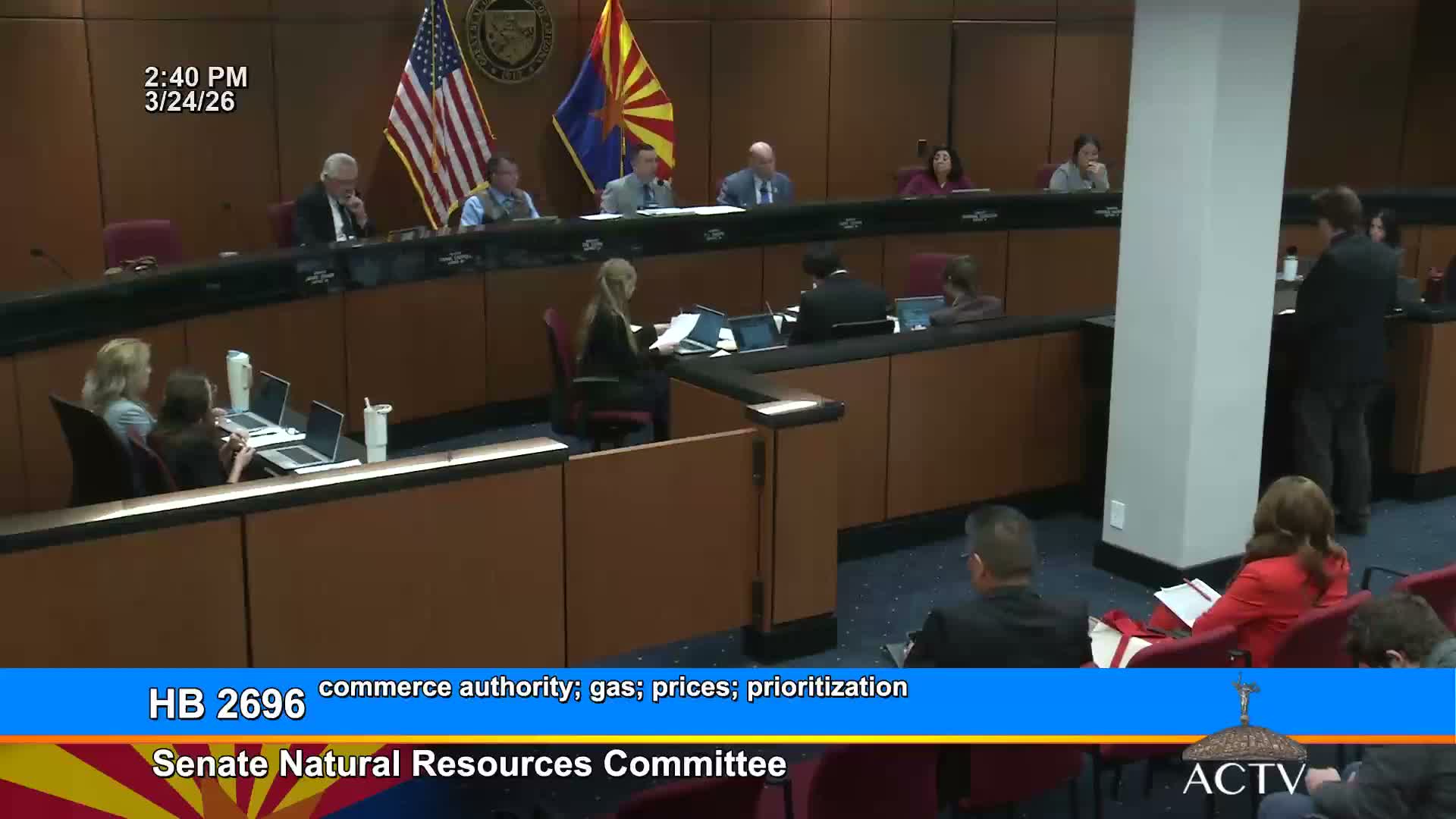
The Arizona Senate Natural Resources Committee on March 23 took up a packed agenda of bills, advancing a set of land- and energy-related measures while rejecting others after extended debate and public testimony.
The committee gave House Bill 2,787 a due-pass recommendation. The bill would bar the state, its agencies and employees from using personnel or financial resources to enforce, administer or cooperate with the federal Mexican gray wolf reintroduction program under the Endangered Species Act, while leaving intact a carve-out for the Arizona Livestock Loss Board's Livestock Loss Program. Sierra Club director Sandy Barr urged senators to oppose the measure, saying it would "hinder wolf recovery" and reduce the state wildlife agency's role. Sam Richard of Concilium Consulting, speaking for Humane World for Animals and the Animal Defense League of Arizona, challenged economic claims used by supporters, citing the Livestock Loss Board's public reports and saying reimbursement averages about 0.01% of annual cattle sales.
"Protecting wildlife and ensuring animals are treated humanely isn't a partisan issue," Sandy Barr said in testimony opposing the bill.
The committee debated several solar-related bills. Representative Neil Carter's solar decommissioning measure (transcribed as HB 2,781) drew lengthy stakeholder engagement: the Sierra Club and independent groups initially opposed the bill but signaled they could support a compromise amendment requiring financial assurance at commercial operation and clarifying that distributed, rooftop or small-scale systems are not covered. Utilities and independent power producers testified they could accept the amendment as a basis for further work.
An offered amendment to SB/ HB 2,781 failed to pass in committee and the underlying bill ultimately failed on a tie vote after senators said they wanted more time for stakeholder negotiations and raised concerns about preempting existing regulatory authority.
The panel also advanced state-land measures. HB 29-75 would suspend the Arizona State Land Department's use of solar "score" mapping tools and instead require development of resource scoring maps for mining and housing; the sponsor said the change aims to "maximize revenue for education" from trust lands. The Sierra Club and community groups opposed the bill as removing a planning tool and reducing transparency; the State Land Department told the committee the solar map layer is guidance and, if the bill passes, it would need additional funding to develop other resource maps. The committee gave HB 29-75 a due-pass recommendation.
On fuel and refinery policy, Representative Rosetta Willoughby's bill directing the Arizona Commerce Authority to make fuel resiliency one of its priorities and establishing a fuel resiliency task force drew robust debate. Willoughby said the measure responds to supply disruptions and long lead times for new pipeline or refinery projects; opponents urged a broader focus on electrification and clean energy to reduce dependence on imported fossil fuels. The committee amended the bill and gave it a due-pass recommendation as amended.
A separate proposal, HB 21-45, that would have allowed legislative leaders to grant temporary waivers from specified gasoline blend requirements failed after testimony from public-health and air-quality advocates warning the change would politicize technical standards that protect vulnerable residents from harmful emissions.
Other actions included advancing HCM 2009 urging federal changes to ease access to critical minerals and urging compensation for impaired subsurface rights; this memorial and several mining- and state-land related bills moved out of committee despite objections from conservation groups that cited recent audit findings for the State Land Department. The committee also recommended a $50,000 appropriation for ADEQ to monitor potential uranium contamination and advanced a bill that adds a legislative review step before the Game and Fish Commission may close a state shooting range, a measure proponents said would protect high-use facilities such as Ben Avery.
Votes at a glance
- HB 2,787 (Mexican gray wolf enforcement prohibition): due-pass recommendation, roll call 4 ayes, 3 nays, 1 not voting.
- HB 2,055 (Brackish Groundwater Recovery Program Fund): failed in committee, roll call recorded 2 ayes, 4 nays, 1 not voting.
- HB 2,782 (utility disclosure measure): due-pass recommendation 8-0.
- HB 2,781 (solar energy financial assurance/decommissioning): amendment failed and bill failed on tie vote (4 ayes, 4 nays).
- HB 29-75 (suspend solar score mapping/use resource scoring maps): due-pass recommendation 4 ayes, 3 nays, 1 not voting.
- HB 26-96 (Arizona Commerce Authority fuel resiliency & task force): amended and given due-pass recommendation 5 ayes, 3 nays.
- HB 20-14 (ADEQ fuel blend air emissions modeling study): amended and given due-pass recommendation.
- HB 21-45 (legislative waiver authority for gasoline standards): failed (3 ayes, 4 nays, 1 not voting).
- HCM 2009 (minerals access and federal land swaps): due-pass recommendation.
- HB 28-89 (ADEQ uranium monitoring appropriation, $50,000 FY2027): due-pass recommendation.
- HB 27-63 (Ben Avery shooting range closure oversight): due-pass recommendation.
Why it matters
The committee's actions reflect competing priorities: lawmakers seeking to protect trust-land revenue, energy and mining jobs, and fuel supply chains are frequently at odds with environmental groups and local officials concerned about planning tools, local authority and public health. Several measures were advanced subject to amendments or further floor work, meaning the bills could change before final votes.
What's next
Bills that received due-pass recommendations will move to committee of the whole or the full Senate for further consideration; sponsors indicated they expect additional stakeholder work and floor amendments on several items. Measures that failed can be revised and reintroduced or amended on the floor only if sponsors pursue that route.
Reporting notes: Quotes and attributions come from committee testimony and roll-call statements. The article does not infer outcomes beyond the committee record and limits conclusions to what speakers and staff explicitly stated at the hearing.
The committee gave House Bill 2,787 a due-pass recommendation. The bill would bar the state, its agencies and employees from using personnel or financial resources to enforce, administer or cooperate with the federal Mexican gray wolf reintroduction program under the Endangered Species Act, while leaving intact a carve-out for the Arizona Livestock Loss Board's Livestock Loss Program. Sierra Club director Sandy Barr urged senators to oppose the measure, saying it would "hinder wolf recovery" and reduce the state wildlife agency's role. Sam Richard of Concilium Consulting, speaking for Humane World for Animals and the Animal Defense League of Arizona, challenged economic claims used by supporters, citing the Livestock Loss Board's public reports and saying reimbursement averages about 0.01% of annual cattle sales.
"Protecting wildlife and ensuring animals are treated humanely isn't a partisan issue," Sandy Barr said in testimony opposing the bill.
The committee debated several solar-related bills. Representative Neil Carter's solar decommissioning measure (transcribed as HB 2,781) drew lengthy stakeholder engagement: the Sierra Club and independent groups initially opposed the bill but signaled they could support a compromise amendment requiring financial assurance at commercial operation and clarifying that distributed, rooftop or small-scale systems are not covered. Utilities and independent power producers testified they could accept the amendment as a basis for further work.
An offered amendment to SB/ HB 2,781 failed to pass in committee and the underlying bill ultimately failed on a tie vote after senators said they wanted more time for stakeholder negotiations and raised concerns about preempting existing regulatory authority.
The panel also advanced state-land measures. HB 29-75 would suspend the Arizona State Land Department's use of solar "score" mapping tools and instead require development of resource scoring maps for mining and housing; the sponsor said the change aims to "maximize revenue for education" from trust lands. The Sierra Club and community groups opposed the bill as removing a planning tool and reducing transparency; the State Land Department told the committee the solar map layer is guidance and, if the bill passes, it would need additional funding to develop other resource maps. The committee gave HB 29-75 a due-pass recommendation.
On fuel and refinery policy, Representative Rosetta Willoughby's bill directing the Arizona Commerce Authority to make fuel resiliency one of its priorities and establishing a fuel resiliency task force drew robust debate. Willoughby said the measure responds to supply disruptions and long lead times for new pipeline or refinery projects; opponents urged a broader focus on electrification and clean energy to reduce dependence on imported fossil fuels. The committee amended the bill and gave it a due-pass recommendation as amended.
A separate proposal, HB 21-45, that would have allowed legislative leaders to grant temporary waivers from specified gasoline blend requirements failed after testimony from public-health and air-quality advocates warning the change would politicize technical standards that protect vulnerable residents from harmful emissions.
Other actions included advancing HCM 2009 urging federal changes to ease access to critical minerals and urging compensation for impaired subsurface rights; this memorial and several mining- and state-land related bills moved out of committee despite objections from conservation groups that cited recent audit findings for the State Land Department. The committee also recommended a $50,000 appropriation for ADEQ to monitor potential uranium contamination and advanced a bill that adds a legislative review step before the Game and Fish Commission may close a state shooting range, a measure proponents said would protect high-use facilities such as Ben Avery.
Votes at a glance
- HB 2,787 (Mexican gray wolf enforcement prohibition): due-pass recommendation, roll call 4 ayes, 3 nays, 1 not voting.
- HB 2,055 (Brackish Groundwater Recovery Program Fund): failed in committee, roll call recorded 2 ayes, 4 nays, 1 not voting.
- HB 2,782 (utility disclosure measure): due-pass recommendation 8-0.
- HB 2,781 (solar energy financial assurance/decommissioning): amendment failed and bill failed on tie vote (4 ayes, 4 nays).
- HB 29-75 (suspend solar score mapping/use resource scoring maps): due-pass recommendation 4 ayes, 3 nays, 1 not voting.
- HB 26-96 (Arizona Commerce Authority fuel resiliency & task force): amended and given due-pass recommendation 5 ayes, 3 nays.
- HB 20-14 (ADEQ fuel blend air emissions modeling study): amended and given due-pass recommendation.
- HB 21-45 (legislative waiver authority for gasoline standards): failed (3 ayes, 4 nays, 1 not voting).
- HCM 2009 (minerals access and federal land swaps): due-pass recommendation.
- HB 28-89 (ADEQ uranium monitoring appropriation, $50,000 FY2027): due-pass recommendation.
- HB 27-63 (Ben Avery shooting range closure oversight): due-pass recommendation.
Why it matters
The committee's actions reflect competing priorities: lawmakers seeking to protect trust-land revenue, energy and mining jobs, and fuel supply chains are frequently at odds with environmental groups and local officials concerned about planning tools, local authority and public health. Several measures were advanced subject to amendments or further floor work, meaning the bills could change before final votes.
What's next
Bills that received due-pass recommendations will move to committee of the whole or the full Senate for further consideration; sponsors indicated they expect additional stakeholder work and floor amendments on several items. Measures that failed can be revised and reintroduced or amended on the floor only if sponsors pursue that route.
Reporting notes: Quotes and attributions come from committee testimony and roll-call statements. The article does not infer outcomes beyond the committee record and limits conclusions to what speakers and staff explicitly stated at the hearing.
View the Full Meeting & All Its Details
This article offers just a summary. Unlock complete video, transcripts, and insights as a Founder Member.
✓
Watch full, unedited meeting videos
✓
Search every word spoken in unlimited transcripts
✓
AI summaries & real-time alerts (all government levels)
✓
Permanent access to expanding government content
30-day money-back guarantee
