Committee hears wide support and agency concerns for optional anonymous school reporting bill
March 25, 2026 | 2026 Legislature MN, Minnesota
This article was created by AI summarizing key points discussed. AI makes mistakes, so for full details and context, please refer to the video of the full meeting. Please report any errors so we can fix them. Report an error »
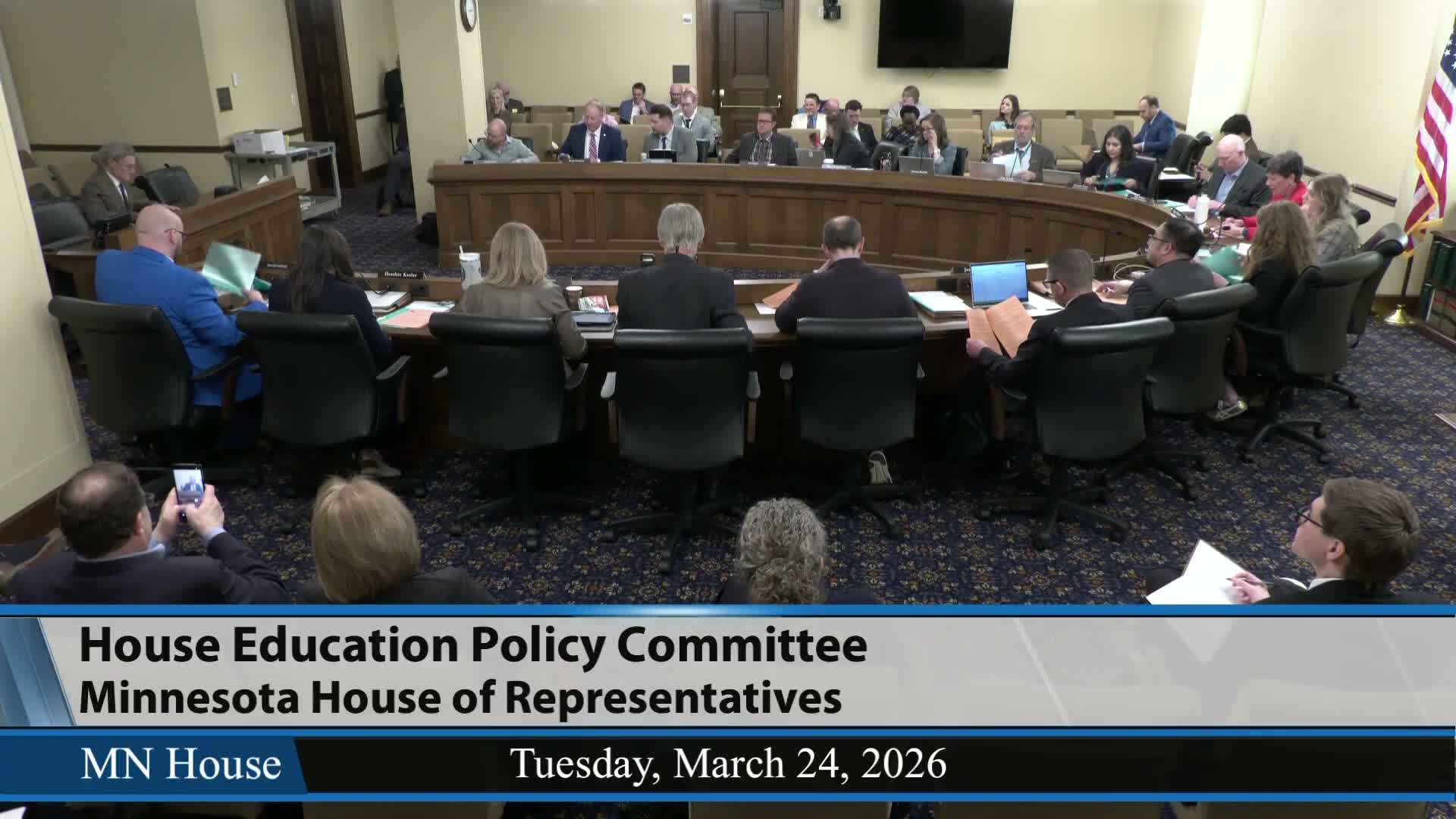
Representative Adrienne Nadeau presented House File 3764 as an optional framework allowing school districts and charter schools to adopt local anonymous threat‑reporting systems that funnel tips 24/7 to trained crisis counselors and school‑based teams.
“Every school with a system will have to have at least 3 employees that are trained to receive and respond to these reports,” Nadeau said, describing vendor approval timelines and required reporting to the Minnesota Department of Education (MDE) on provider contact information and report counts.
School and advocacy testimony emphasized the systems’ role in early intervention. Chris Lindquist, director of community education for Saint Francis area schools, said his district’s use of the Sandy Hook Promise system produced life‑saving interventions and encouraged the committee to support HF3764.
“Since the 02/2024 school year, we have partnered with the Sandy Hook Promise to provide the Say Something anonymous reporting system,” Lindquist said. “In just 3 years, I personally witnessed this program save lives in our district.”
Alexandra Fitzsimmons of Children’s Defense Fund Minnesota said anonymous reporting systems paired with trained response teams can identify warning signs before violence occurs and urged lawmakers to back the bill.
District associations and emergency‑management staff voiced conditional support but urged clearer operational standards and funding. Rick Kaufman, testifying for multiple associations, said an anonymous tip line alone is not enough.
“If that information does not reach those trained to assess that behavior and activate threat assessment teams, we lose the ability and the opportunity to intervene at a critical time,” Kaufman said.
MDE’s Joe Schueney told the committee that while the department supports the policy goal, the DE’s reporting and aggregation duties would require technical infrastructure, privacy safeguards under FERPA and staff time to validate multiple vendor data formats. He warned that a low‑cost reporting option would produce limited, low‑utility data without dedicated resources.
“We agree that an anonymous reporting system would be an important resource for the state,” Schueney said. “But ensuring consistency across multiple systems will require staff time to align data, flag discrepancies, and check for potential issues such as accidental inclusion of personally identifiable information.”
Chair Jordan moved to refer HF3764 to the Education Finance Committee to resolve the fiscal and data‑reporting questions; the roll‑call motion failed on a 7–7 tie. After additional debate, the chair laid HF3764 as amended over for further committee work.
What’s next: The bill was laid over; committee members recommended additional stakeholder work on funding, vendor standards, and how school‑level tip triage will be coordinated with the BCA and local threat assessment teams.
“Every school with a system will have to have at least 3 employees that are trained to receive and respond to these reports,” Nadeau said, describing vendor approval timelines and required reporting to the Minnesota Department of Education (MDE) on provider contact information and report counts.
School and advocacy testimony emphasized the systems’ role in early intervention. Chris Lindquist, director of community education for Saint Francis area schools, said his district’s use of the Sandy Hook Promise system produced life‑saving interventions and encouraged the committee to support HF3764.
“Since the 02/2024 school year, we have partnered with the Sandy Hook Promise to provide the Say Something anonymous reporting system,” Lindquist said. “In just 3 years, I personally witnessed this program save lives in our district.”
Alexandra Fitzsimmons of Children’s Defense Fund Minnesota said anonymous reporting systems paired with trained response teams can identify warning signs before violence occurs and urged lawmakers to back the bill.
District associations and emergency‑management staff voiced conditional support but urged clearer operational standards and funding. Rick Kaufman, testifying for multiple associations, said an anonymous tip line alone is not enough.
“If that information does not reach those trained to assess that behavior and activate threat assessment teams, we lose the ability and the opportunity to intervene at a critical time,” Kaufman said.
MDE’s Joe Schueney told the committee that while the department supports the policy goal, the DE’s reporting and aggregation duties would require technical infrastructure, privacy safeguards under FERPA and staff time to validate multiple vendor data formats. He warned that a low‑cost reporting option would produce limited, low‑utility data without dedicated resources.
“We agree that an anonymous reporting system would be an important resource for the state,” Schueney said. “But ensuring consistency across multiple systems will require staff time to align data, flag discrepancies, and check for potential issues such as accidental inclusion of personally identifiable information.”
Chair Jordan moved to refer HF3764 to the Education Finance Committee to resolve the fiscal and data‑reporting questions; the roll‑call motion failed on a 7–7 tie. After additional debate, the chair laid HF3764 as amended over for further committee work.
What’s next: The bill was laid over; committee members recommended additional stakeholder work on funding, vendor standards, and how school‑level tip triage will be coordinated with the BCA and local threat assessment teams.
View the Full Meeting & All Its Details
This article offers just a summary. Unlock complete video, transcripts, and insights as a Founder Member.
✓
Watch full, unedited meeting videos
✓
Search every word spoken in unlimited transcripts
✓
AI summaries & real-time alerts (all government levels)
✓
Permanent access to expanding government content
30-day money-back guarantee
