Arizona Water Banking Authority outlines stored Colorado River credits and recovery limits
March 24, 2026 | 2026 Legislature Arizona, Arizona
This article was created by AI summarizing key points discussed. AI makes mistakes, so for full details and context, please refer to the video of the full meeting. Please report any errors so we can fix them. Report an error »
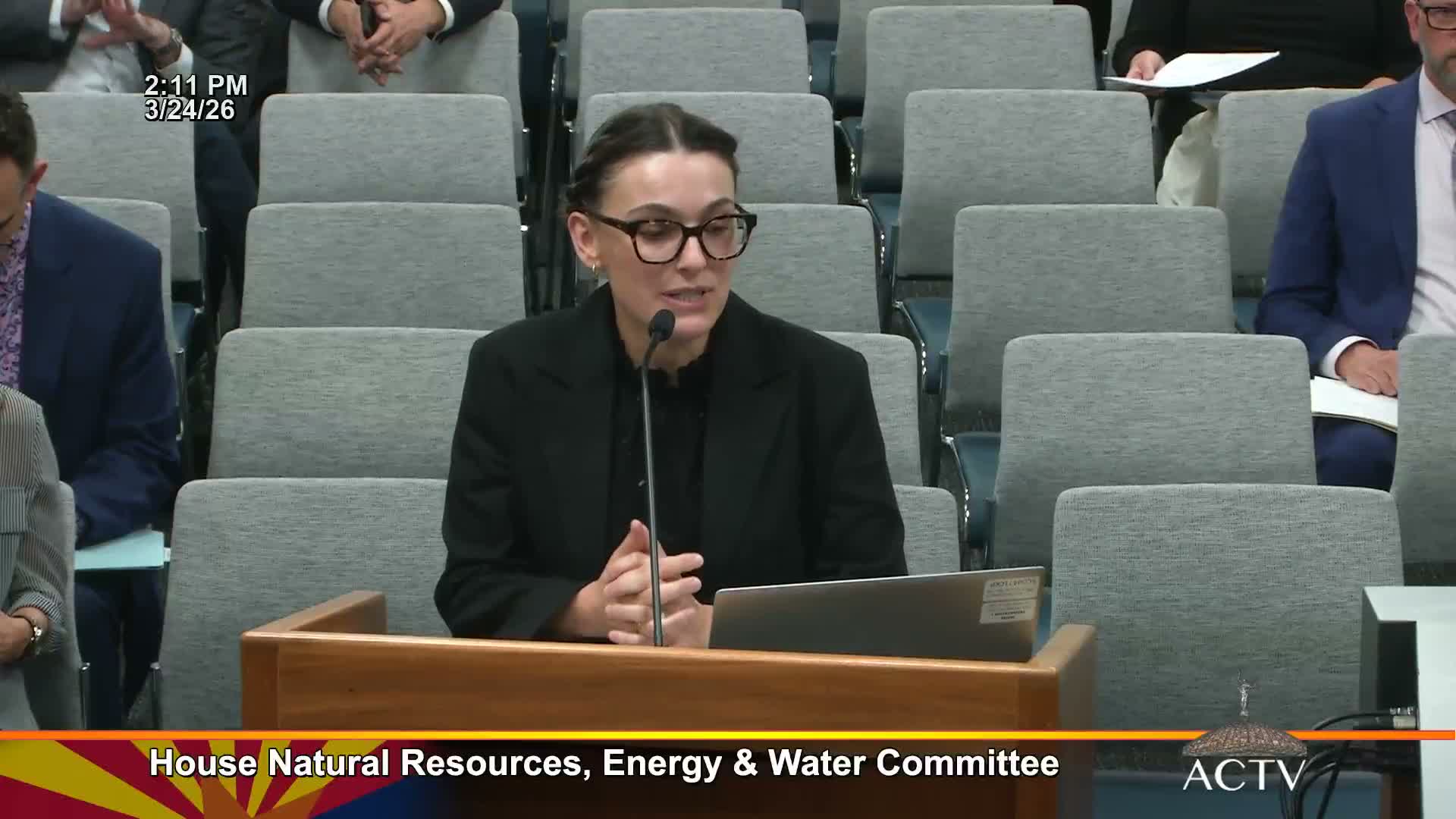
An Arizona Water Banking Authority representative told the House Natural Resources, Energy and Water Committee that the agency has accrued more than 3.8 million acre‑feet of long‑term storage credits from past underground recharge but has not been able to store additional Colorado River water since 2020.
The presenter explained the AWBA is housed within the Department of Water Resources but operates as a separate commission whose chair is the ADWR director. The authority partners with the Central Arizona Water Conservation District (CAWCD) to recharge and recover stored water at facilities across the Phoenix, Pinal and Tucson active management areas. AWBA staff said those partners and CAWCD ad valorem funds financed much of the long‑term storage credited to CAP (Central Arizona Project) municipal and industrial subcontractors.
Committee members pressed AWBA staff on how the agency will "firm" municipal and industrial CAP subcontractors in the event of future Colorado River shortages. AWBA said it currently has no formal firming policy for post‑2026 distribution to CAP M&I subcontractors and is awaiting more guidance from Colorado River operating guidelines. Staff said recovery methods vary: some subcontractors already have recovery wells and permits through ADWR, CAWCD operates canal exchanges that can deliver wet water, and in other cases AWBA must coordinate with CAWCD and subcontractors to plan recoveries.
The AWBA also clarified obligations for tribal firming. Staff said the Authority has reserved credits for tribal communities under the Arizona Water Settlements Act of 2004 and that the state has a long‑term obligation (described in testimony as a 100‑year obligation beginning in 2008) to provide Indian firming supplies. AWBA noted it holds roughly 2,000,000 acre‑feet for CAP M&I subcontractors acquired with CAWCD funds, about 250,000 acre‑feet reserved with general funds for Mohave County Water Authority, and additional credits reserved for Nevada and other entities.
On funding, AWBA said its primary revenue sources are groundwater withdrawal fees and CAWCD ad valorem taxes; purchases of LTSCs funded by CAWCD require board approval.
The committee did not adopt policy at the hearing; members asked AWBA and CAWCD to provide further detail, especially on recovery operations, the status of recovery wells, and how firming decisions would be made once Colorado River shortage determinations and guidelines are finalized.
The presenter explained the AWBA is housed within the Department of Water Resources but operates as a separate commission whose chair is the ADWR director. The authority partners with the Central Arizona Water Conservation District (CAWCD) to recharge and recover stored water at facilities across the Phoenix, Pinal and Tucson active management areas. AWBA staff said those partners and CAWCD ad valorem funds financed much of the long‑term storage credited to CAP (Central Arizona Project) municipal and industrial subcontractors.
Committee members pressed AWBA staff on how the agency will "firm" municipal and industrial CAP subcontractors in the event of future Colorado River shortages. AWBA said it currently has no formal firming policy for post‑2026 distribution to CAP M&I subcontractors and is awaiting more guidance from Colorado River operating guidelines. Staff said recovery methods vary: some subcontractors already have recovery wells and permits through ADWR, CAWCD operates canal exchanges that can deliver wet water, and in other cases AWBA must coordinate with CAWCD and subcontractors to plan recoveries.
The AWBA also clarified obligations for tribal firming. Staff said the Authority has reserved credits for tribal communities under the Arizona Water Settlements Act of 2004 and that the state has a long‑term obligation (described in testimony as a 100‑year obligation beginning in 2008) to provide Indian firming supplies. AWBA noted it holds roughly 2,000,000 acre‑feet for CAP M&I subcontractors acquired with CAWCD funds, about 250,000 acre‑feet reserved with general funds for Mohave County Water Authority, and additional credits reserved for Nevada and other entities.
On funding, AWBA said its primary revenue sources are groundwater withdrawal fees and CAWCD ad valorem taxes; purchases of LTSCs funded by CAWCD require board approval.
The committee did not adopt policy at the hearing; members asked AWBA and CAWCD to provide further detail, especially on recovery operations, the status of recovery wells, and how firming decisions would be made once Colorado River shortage determinations and guidelines are finalized.
View the Full Meeting & All Its Details
This article offers just a summary. Unlock complete video, transcripts, and insights as a Founder Member.
✓
Watch full, unedited meeting videos
✓
Search every word spoken in unlimited transcripts
✓
AI summaries & real-time alerts (all government levels)
✓
Permanent access to expanding government content
30-day money-back guarantee
