Committee backs bill to let small towns run EPA‑approved on‑site bacteriological tests
March 24, 2026 | 2026 Legislature Arizona, Arizona
This article was created by AI summarizing key points discussed. AI makes mistakes, so for full details and context, please refer to the video of the full meeting. Please report any errors so we can fix them. Report an error »
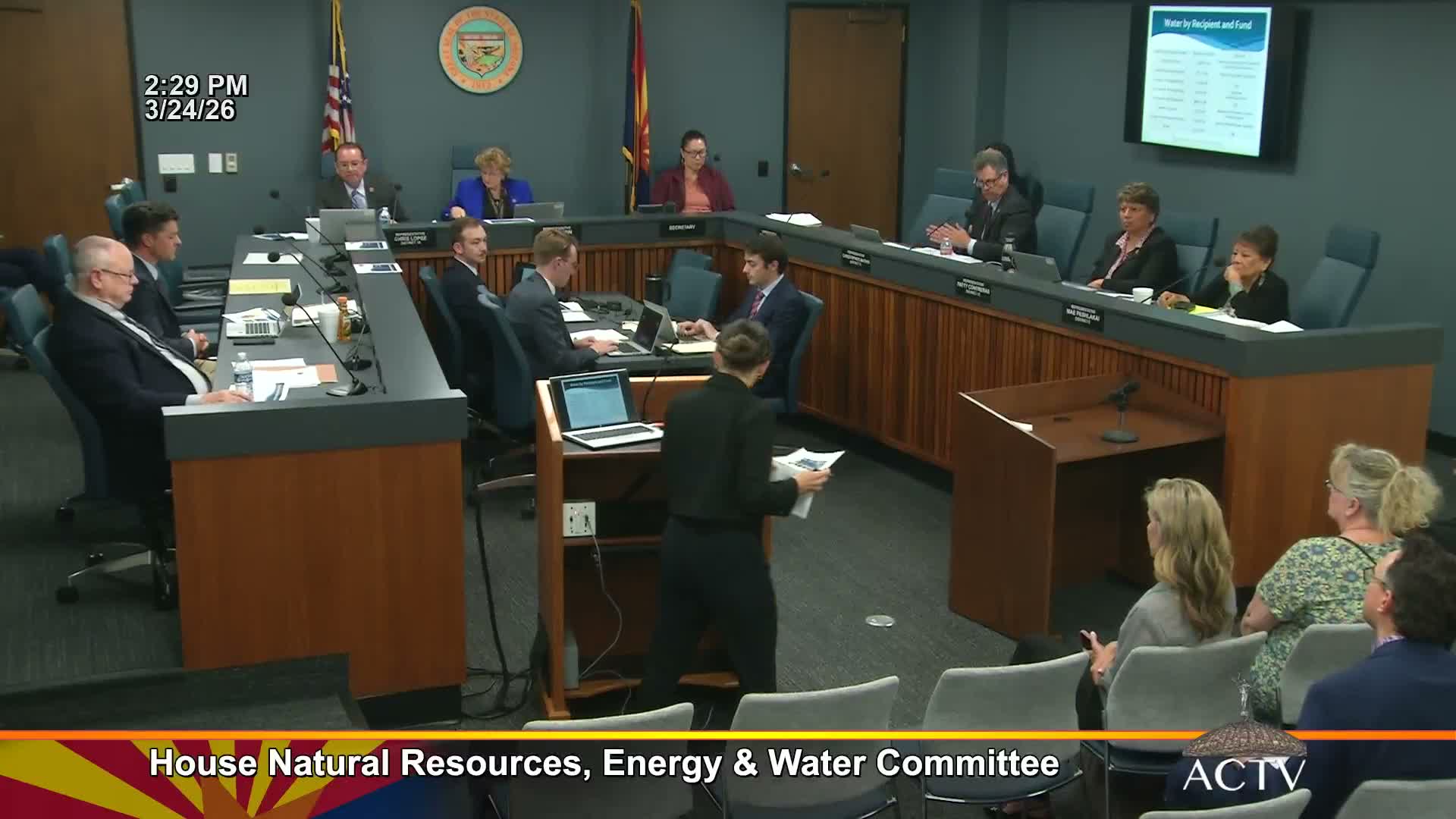
The House Natural Resources, Energy and Water Committee adopted an amendment and returned Senate Bill 14‑45 with a due‑pass recommendation after hearing testimony that small towns could save thousands annually by using EPA‑approved on‑site bacteriological testing equipment.
Senate Bill 14‑45, as presented by staff, would allow municipalities meeting the bill’s population threshold to test bacteriological samples on‑site with equipment approved by the U.S. Environmental Protection Agency and originally included language limiting ADEQ from requiring more than four samplings per month for certain small municipalities. The Griffin amendment (read into the record) removed the provision limiting testing frequency.
Curtis Stacy, mayor of Kearny, testified that his town currently must collect samples, transport them up to two‑and‑a‑half hours to the nearest certified lab, and pay $30–$150 per sample; he said an IDEXX machine costs roughly $35,000 and that in‑house testing would reduce vehicle, labor and lab costs substantially. Stacy told the committee other rural towns in Representative Rogers' district—Superior, Sierra Vista, Safford, Thatcher and Pima—face similar challenges.
Members asked whether ADEQ or ADHS already allow on‑site testing through lab certification. ADEQ staff (cited in committee correspondence) noted facilities can be certified by ADHS to perform on‑site analysis; proponents said the bill would create an option that reduces the upfront regulatory burden of setting up a full certified lab and would allow a single test to be conducted on site with proper calibration and oversight. The sponsor argued codifying the option in statute removes uncertainty for rural communities and facilitates coordination with ADEQ on training, calibration reporting and certification.
After questions and the adoption of the Griffin amendment (which struck the frequency limit), the committee voted to return SB14‑45 as amended with a due‑pass recommendation.
Senate Bill 14‑45, as presented by staff, would allow municipalities meeting the bill’s population threshold to test bacteriological samples on‑site with equipment approved by the U.S. Environmental Protection Agency and originally included language limiting ADEQ from requiring more than four samplings per month for certain small municipalities. The Griffin amendment (read into the record) removed the provision limiting testing frequency.
Curtis Stacy, mayor of Kearny, testified that his town currently must collect samples, transport them up to two‑and‑a‑half hours to the nearest certified lab, and pay $30–$150 per sample; he said an IDEXX machine costs roughly $35,000 and that in‑house testing would reduce vehicle, labor and lab costs substantially. Stacy told the committee other rural towns in Representative Rogers' district—Superior, Sierra Vista, Safford, Thatcher and Pima—face similar challenges.
Members asked whether ADEQ or ADHS already allow on‑site testing through lab certification. ADEQ staff (cited in committee correspondence) noted facilities can be certified by ADHS to perform on‑site analysis; proponents said the bill would create an option that reduces the upfront regulatory burden of setting up a full certified lab and would allow a single test to be conducted on site with proper calibration and oversight. The sponsor argued codifying the option in statute removes uncertainty for rural communities and facilitates coordination with ADEQ on training, calibration reporting and certification.
After questions and the adoption of the Griffin amendment (which struck the frequency limit), the committee voted to return SB14‑45 as amended with a due‑pass recommendation.
View the Full Meeting & All Its Details
This article offers just a summary. Unlock complete video, transcripts, and insights as a Founder Member.
✓
Watch full, unedited meeting videos
✓
Search every word spoken in unlimited transcripts
✓
AI summaries & real-time alerts (all government levels)
✓
Permanent access to expanding government content
30-day money-back guarantee
