Austin Resource Recovery reports ISO certification, highlights KPIs and enforcement push on Universal Recycling Ordinance
March 25, 2026 | Austin, Travis County, Texas
This article was created by AI summarizing key points discussed. AI makes mistakes, so for full details and context, please refer to the video of the full meeting. Please report any errors so we can fix them. Report an error »
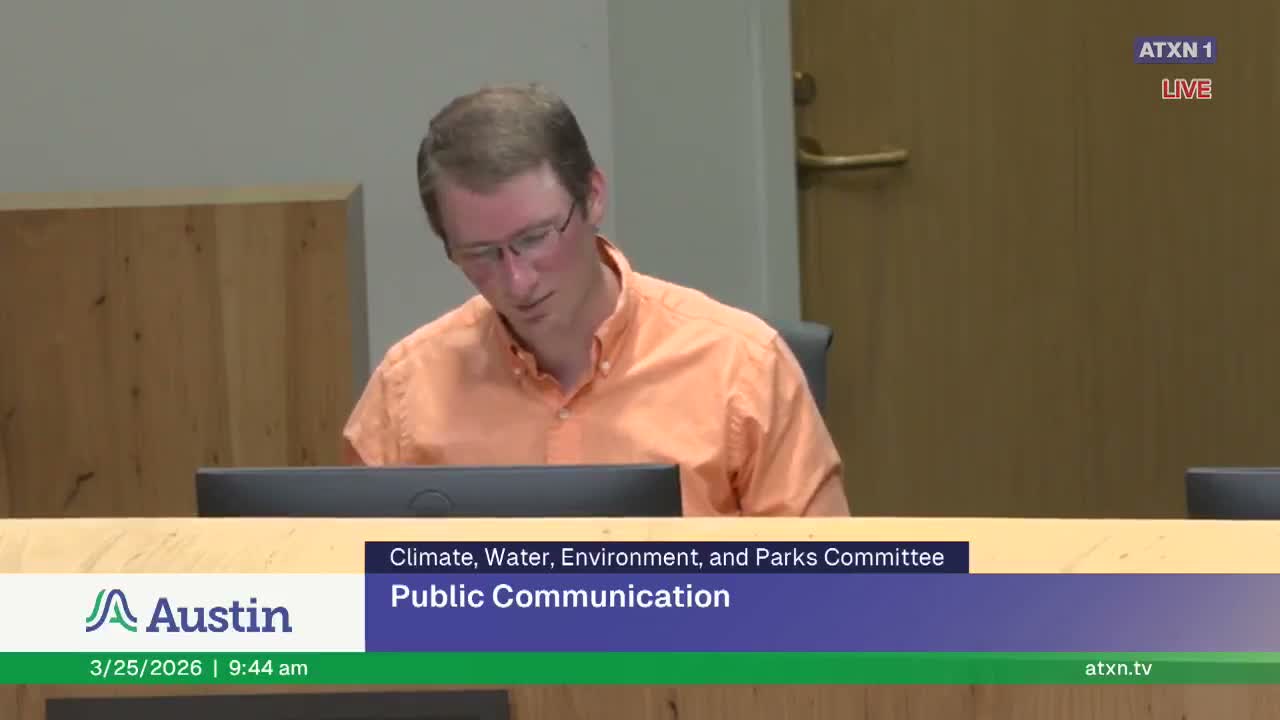
Austin Resource Recovery (ARR) briefed the Climate, Water, Environment, Parks Committee on March 25 about department performance measures, strategic goals and program milestones. Deputy Director Gina McKinley said ARR recently completed ISO 9001:2015 certification and has been refining process measures to improve service delivery.
"We were able to get that complete at the beginning of the year," McKinley said of the ISO certification, and she described the certification as a tool that produced supplemental performance measures and better process mapping.
McKinley walked the committee through ARR's primary published KPIs: average customer satisfaction with curbside and household hazardous‑waste services (71.7% in FY23), lost‑time injury rates (a spike in FY25 driven mostly by sprains and strains during peak organics and summer collection), on‑time collection performance, percent of curbside material diverted from landfill, and reporting by Universal Recycling Ordinance (URO)‑affected properties. On the latter, McKinley noted that reporting depends on individual property submissions and that some properties may be compliant but not have submitted forms.
On enforcement, McKinley told the committee the department "can" issue fines and that a criminal penalty exists for URO noncompliance. She said the city recently shifted staff into Development Services to support dedicated code enforcement for URO compliance and expects increased enforcement activity in the coming reporting period.
ARR also highlighted programs supporting diversion and circular economy objectives: MoveOutATX (a reuse partnership with the University of Texas), an internal reuse marketplace (Rheaply) that ARR said has processed more than 12,000 transactions and produced roughly $400,000 in avoided city costs, pilot on‑demand household hazardous waste pickups (383 tons collected), compost expansion for multifamily properties and capture‑rate studies to refine diversion estimates. McKinley said FY25 curbside recycling diverted just over 40,000 tons and curbside composting just under 39,000 tons.
Committee members asked for more detail on internal KPIs and the data that supports the published metrics; McKinley said the department maintains a broader internal dashboard and will follow up with comparative data and capture‑rate results. Council members also pressed ARR on how to boost multifamily composting adoption and asked for improved public communication tools.
The committee did not take any formal action on ARR items at this meeting; staff agreed to return with additional data and to provide requested written materials.
"We were able to get that complete at the beginning of the year," McKinley said of the ISO certification, and she described the certification as a tool that produced supplemental performance measures and better process mapping.
McKinley walked the committee through ARR's primary published KPIs: average customer satisfaction with curbside and household hazardous‑waste services (71.7% in FY23), lost‑time injury rates (a spike in FY25 driven mostly by sprains and strains during peak organics and summer collection), on‑time collection performance, percent of curbside material diverted from landfill, and reporting by Universal Recycling Ordinance (URO)‑affected properties. On the latter, McKinley noted that reporting depends on individual property submissions and that some properties may be compliant but not have submitted forms.
On enforcement, McKinley told the committee the department "can" issue fines and that a criminal penalty exists for URO noncompliance. She said the city recently shifted staff into Development Services to support dedicated code enforcement for URO compliance and expects increased enforcement activity in the coming reporting period.
ARR also highlighted programs supporting diversion and circular economy objectives: MoveOutATX (a reuse partnership with the University of Texas), an internal reuse marketplace (Rheaply) that ARR said has processed more than 12,000 transactions and produced roughly $400,000 in avoided city costs, pilot on‑demand household hazardous waste pickups (383 tons collected), compost expansion for multifamily properties and capture‑rate studies to refine diversion estimates. McKinley said FY25 curbside recycling diverted just over 40,000 tons and curbside composting just under 39,000 tons.
Committee members asked for more detail on internal KPIs and the data that supports the published metrics; McKinley said the department maintains a broader internal dashboard and will follow up with comparative data and capture‑rate results. Council members also pressed ARR on how to boost multifamily composting adoption and asked for improved public communication tools.
The committee did not take any formal action on ARR items at this meeting; staff agreed to return with additional data and to provide requested written materials.
View the Full Meeting & All Its Details
This article offers just a summary. Unlock complete video, transcripts, and insights as a Founder Member.
✓
Watch full, unedited meeting videos
✓
Search every word spoken in unlimited transcripts
✓
AI summaries & real-time alerts (all government levels)
✓
Permanent access to expanding government content
30-day money-back guarantee
