Arizona Senate caucus advances broad consent calendar including space‑plate fees, election safeguards and property‑title ID changes
March 24, 2026 | 2026 Legislature Arizona, Arizona
This article was created by AI summarizing key points discussed. AI makes mistakes, so for full details and context, please refer to the video of the full meeting. Please report any errors so we can fix them. Report an error »
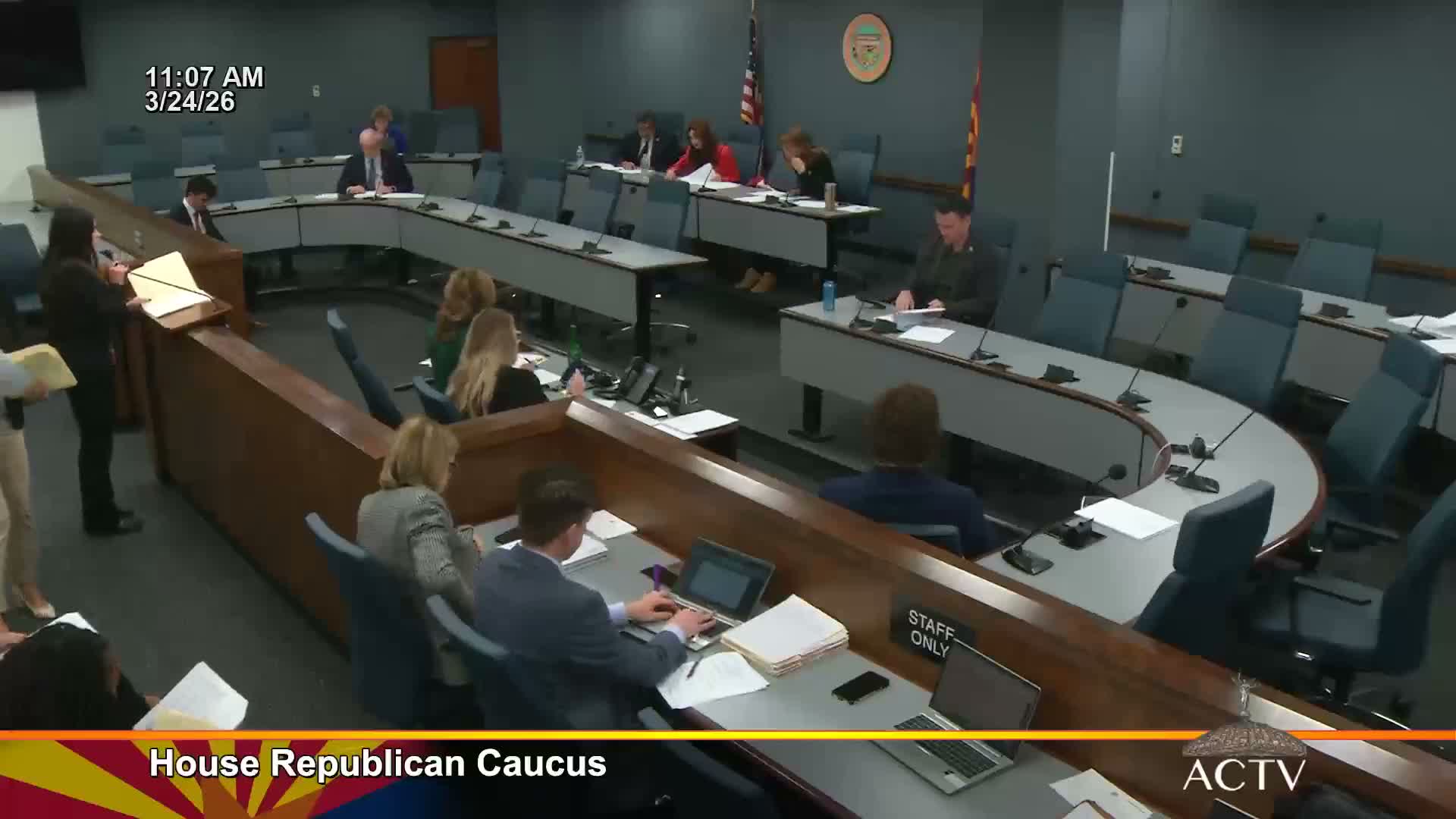
The Arizona Senate Republican caucus moved through a broad third‑reading consent calendar that included bills to create a new space‑themed specialty license plate, tighten rules for election equipment, and add photo‑ID verification for county recorder documents.
Staff summarized Senate Bill 10 20 as establishing an Arizona Space Commission specialty plate with a $25 fee; staff said $8 would cover administrative costs deposited to the Arizona highways fund and $17 would go to a space exploration and aeronautics research fund. Staff offered to take questions but none were raised on the floor.
On election security, staff described SB 10 37 (as amended) as prohibiting voting and tabulation equipment used in elections from having Internet access and adding other data‑security requirements. During brief discussion a committee member asked whether the measure bans any Internet access and whether there are penalties; staff replied the bill bars Internet access for both polling‑place and tabulation machinery and includes penalties for violations, including a class 1 misdemeanor.
Separately, staff outlined SB 14 79, which would add a photo‑identification requirement for documents presented at county recorder offices, tighten notarization measures for deeds and property documents, and reclassify knowingly submitting a false deed or forgery from a class 1 misdemeanor to a class 5 felony. A committee member highlighted bipartisan stakeholder work on the bill and urged support to deter deed and title fraud.
Other items placed on the consent calendar included bills affecting behavioral‑health technician definitions and oversight, timing and administration of primary elections, continuity of Medicaid billing during nursing‑home ownership changes, expansion of traumatic‑event counseling programs for public‑safety employees, and an array of criminal‑justice and regulatory updates. Multiple sponsors noted some bills had been amended to address technical or federal‑compliance concerns and several petitioned for committee‑level or floor technical amendments.
No formal roll‑call votes were recorded during the caucus discussion; most bills were presented on the consent calendar and committee staff indicated availability for follow‑up questions. The caucus concluded after the list of consent items was completed.
Staff summarized Senate Bill 10 20 as establishing an Arizona Space Commission specialty plate with a $25 fee; staff said $8 would cover administrative costs deposited to the Arizona highways fund and $17 would go to a space exploration and aeronautics research fund. Staff offered to take questions but none were raised on the floor.
On election security, staff described SB 10 37 (as amended) as prohibiting voting and tabulation equipment used in elections from having Internet access and adding other data‑security requirements. During brief discussion a committee member asked whether the measure bans any Internet access and whether there are penalties; staff replied the bill bars Internet access for both polling‑place and tabulation machinery and includes penalties for violations, including a class 1 misdemeanor.
Separately, staff outlined SB 14 79, which would add a photo‑identification requirement for documents presented at county recorder offices, tighten notarization measures for deeds and property documents, and reclassify knowingly submitting a false deed or forgery from a class 1 misdemeanor to a class 5 felony. A committee member highlighted bipartisan stakeholder work on the bill and urged support to deter deed and title fraud.
Other items placed on the consent calendar included bills affecting behavioral‑health technician definitions and oversight, timing and administration of primary elections, continuity of Medicaid billing during nursing‑home ownership changes, expansion of traumatic‑event counseling programs for public‑safety employees, and an array of criminal‑justice and regulatory updates. Multiple sponsors noted some bills had been amended to address technical or federal‑compliance concerns and several petitioned for committee‑level or floor technical amendments.
No formal roll‑call votes were recorded during the caucus discussion; most bills were presented on the consent calendar and committee staff indicated availability for follow‑up questions. The caucus concluded after the list of consent items was completed.
View the Full Meeting & All Its Details
This article offers just a summary. Unlock complete video, transcripts, and insights as a Founder Member.
✓
Watch full, unedited meeting videos
✓
Search every word spoken in unlimited transcripts
✓
AI summaries & real-time alerts (all government levels)
✓
Permanent access to expanding government content
30-day money-back guarantee
