Crash survivors and researchers urge stricter AV data rules and limits on risky deployments
March 24, 2026 | California State Senate, Senate, Legislative, California
This article was created by AI summarizing key points discussed. AI makes mistakes, so for full details and context, please refer to the video of the full meeting. Please report any errors so we can fix them. Report an error »
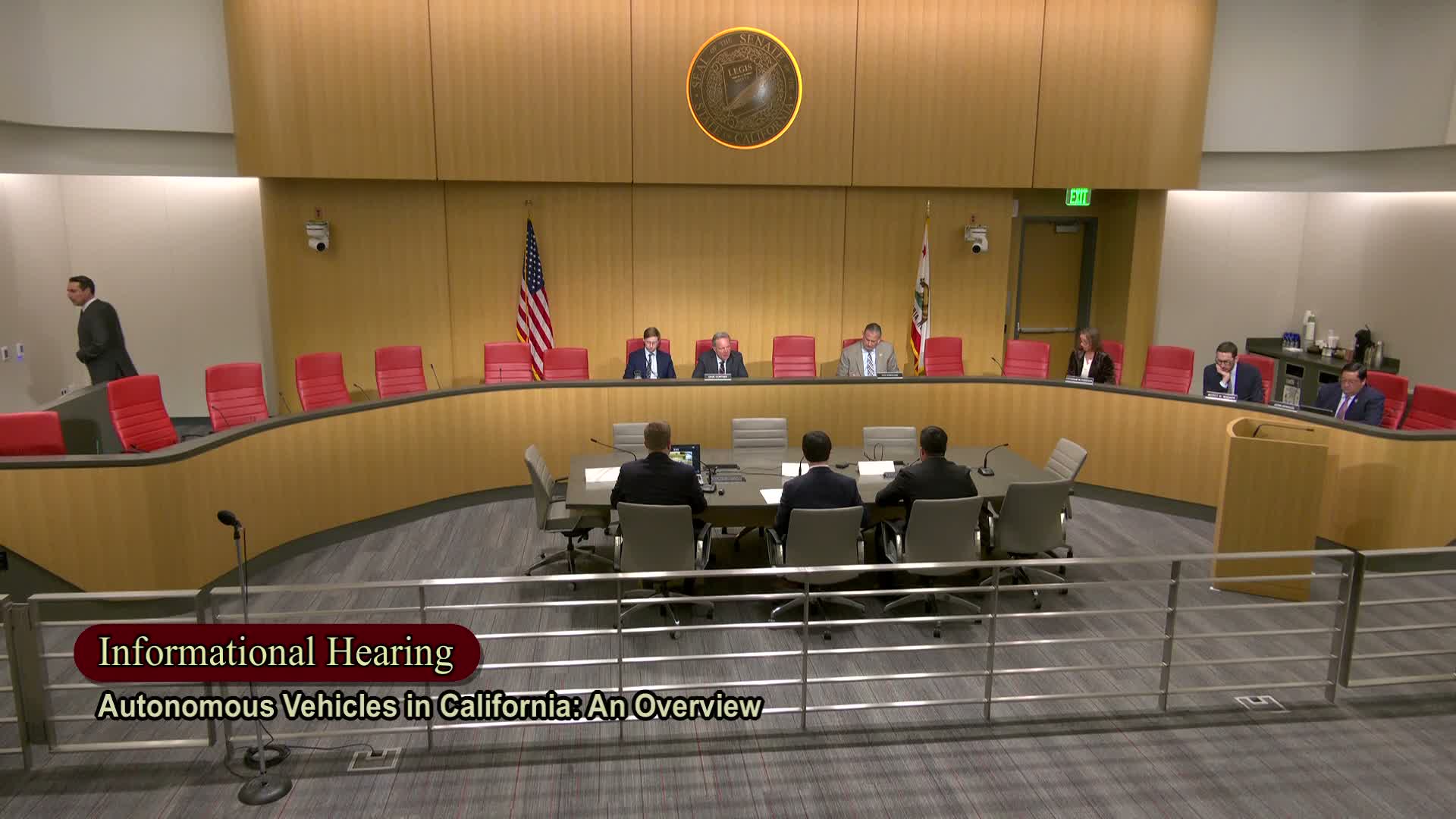
Survivors, safety researchers and public‑interest advocates urged the California State Senate Transportation Committee on Wednesday to require stronger transparency and operational limits for autonomous vehicles (AVs).
Dylan Angulo, who said his partner Nybelle Benavides Leon died in a 2019 crash involving a Tesla operating with Autopilot engaged, told senators: "Please require preservation and disclosure of vehicle data after serious collisions." Angulo described months of litigation and difficulty obtaining the car’s augmented video and crash data and said that access to those recordings was decisive in proving the vehicle’s role in the crash.
Robert O'Dowd of the Dawn Project urged the committee to close legal gaps he said allow companies to deploy AI driving systems "with little to no oversight." He asked lawmakers to require manufacturers to comply with level‑4 disclosure standards, to stop allowing redaction of critical data, and to mandate prompt fixes or disabling of software where defects are found. "We cannot allow known defective systems to remain active on our roads any longer," O'Dowd said.
Dr. Missy Cummings, a professor at George Mason University testifying virtually, highlighted technical risks tied to computer‑vision systems, including ‘‘phantom braking’’ and other perception failures that can produce abrupt, dangerous maneuvers. She also raised concerns about remote operations, saying latency from overseas remote‑operator centers "incurs at least an additional 2‑second latency delay, on average," and warned that those delays have caused crashes in California.
Industry counsel Ariel Wolf, general counsel to the Autonomous Vehicle Industry Association (AVIA), acknowledged distinctions between driver‑assist systems and fully autonomous vehicles and said the industry supports uniform, federally aligned design and performance standards. Wolf disputed characterizations that all deployment is unregulated, pointing to California’s permitting structure and DMV oversight; he also asked regulators and researchers to let independent verification settle disputed safety claims.
Committee members pressed witnesses on empirical claims cited in testimony, including the frequently cited "92 percent" reduction in serious injuries in areas where AVs operate. Witnesses and senators agreed independent third‑party verification of manufacturer data would improve confidence in headline safety figures.
Why it matters: witnesses argued that lack of automatic access to sensor and recorded video after serious collisions hampers investigations, slows litigation and undercuts public trust. Several witnesses urged either federal electronic data‑recorder rules or state law that would require automatic preservation and third‑party access to AV sensor/video data after serious incidents.
The hearing closed with senators asking the DMV and CPUC about next steps; state regulators said they are strengthening reporting, incident review and enforcement tools under forthcoming rulemakings but called for continued dialogue with first responders, researchers and legislators.
The committee did not vote on legislation at the hearing; members signaled they may pursue statutory changes tied to data access and enforcement in future sessions.
Dylan Angulo, who said his partner Nybelle Benavides Leon died in a 2019 crash involving a Tesla operating with Autopilot engaged, told senators: "Please require preservation and disclosure of vehicle data after serious collisions." Angulo described months of litigation and difficulty obtaining the car’s augmented video and crash data and said that access to those recordings was decisive in proving the vehicle’s role in the crash.
Robert O'Dowd of the Dawn Project urged the committee to close legal gaps he said allow companies to deploy AI driving systems "with little to no oversight." He asked lawmakers to require manufacturers to comply with level‑4 disclosure standards, to stop allowing redaction of critical data, and to mandate prompt fixes or disabling of software where defects are found. "We cannot allow known defective systems to remain active on our roads any longer," O'Dowd said.
Dr. Missy Cummings, a professor at George Mason University testifying virtually, highlighted technical risks tied to computer‑vision systems, including ‘‘phantom braking’’ and other perception failures that can produce abrupt, dangerous maneuvers. She also raised concerns about remote operations, saying latency from overseas remote‑operator centers "incurs at least an additional 2‑second latency delay, on average," and warned that those delays have caused crashes in California.
Industry counsel Ariel Wolf, general counsel to the Autonomous Vehicle Industry Association (AVIA), acknowledged distinctions between driver‑assist systems and fully autonomous vehicles and said the industry supports uniform, federally aligned design and performance standards. Wolf disputed characterizations that all deployment is unregulated, pointing to California’s permitting structure and DMV oversight; he also asked regulators and researchers to let independent verification settle disputed safety claims.
Committee members pressed witnesses on empirical claims cited in testimony, including the frequently cited "92 percent" reduction in serious injuries in areas where AVs operate. Witnesses and senators agreed independent third‑party verification of manufacturer data would improve confidence in headline safety figures.
Why it matters: witnesses argued that lack of automatic access to sensor and recorded video after serious collisions hampers investigations, slows litigation and undercuts public trust. Several witnesses urged either federal electronic data‑recorder rules or state law that would require automatic preservation and third‑party access to AV sensor/video data after serious incidents.
The hearing closed with senators asking the DMV and CPUC about next steps; state regulators said they are strengthening reporting, incident review and enforcement tools under forthcoming rulemakings but called for continued dialogue with first responders, researchers and legislators.
The committee did not vote on legislation at the hearing; members signaled they may pursue statutory changes tied to data access and enforcement in future sessions.
View the Full Meeting & All Its Details
This article offers just a summary. Unlock complete video, transcripts, and insights as a Founder Member.
✓
Watch full, unedited meeting videos
✓
Search every word spoken in unlimited transcripts
✓
AI summaries & real-time alerts (all government levels)
✓
Permanent access to expanding government content
30-day money-back guarantee
