First responders say robotaxis can block emergency access; urge override and staffing rules
March 24, 2026 | California State Senate, Senate, Legislative, California
This article was created by AI summarizing key points discussed. AI makes mistakes, so for full details and context, please refer to the video of the full meeting. Please report any errors so we can fix them. Report an error »
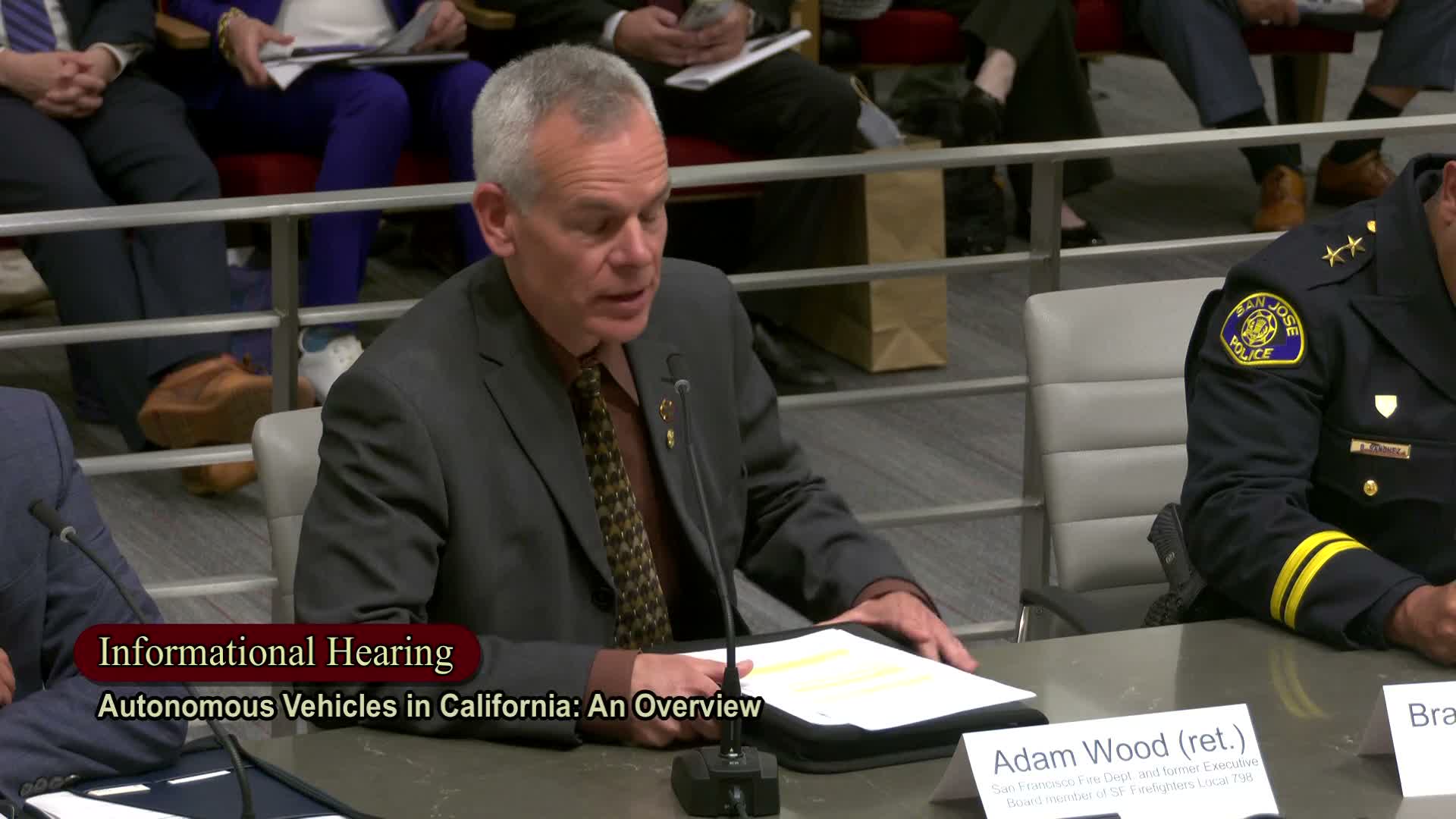
First responders and municipal safety officials told the California State Senate Transportation Committee that autonomous passenger vehicles and robotaxis are producing operational problems that can impede emergency response.
Adam Wood, retired from the San Francisco Fire Department, said AVs have "pulled to the middle of an active shooter scene and shut down," blocked fire hoses, and in a December power outage dozens of AVs were immobilized at intersections for between 20 minutes and almost an hour. Wood urged a "public safety manual override option" that would let police officers, firefighters or paramedics move a vehicle without contacting a remote operator.
Deputy Chief Brandon Sanchez of the San Jose Police Department, speaking for the California Police Chiefs Association, said clarity around responsibility is essential. "When there is no driver, it is unclear who is responsible for a traffic violation," he said, and described incidents in which AVs failed to navigate around emergency vehicles or stopped in traffic lanes.
Multiple gig drivers and union representatives echoed those concerns, describing near collisions, aggressive AV maneuvers, and episodes where first responders had to physically move disabled vehicles. Witnesses urged clearer operational staffing standards for remote‑operation centers, requirements that companies adequately staff support lines during emergencies, and local tools to suspend permits where safety cannot be demonstrated.
Why it matters: witnesses said delayed or failed AV responses to emergencies can slow patient access, hamper firefighting, and—during major outages or disasters—create systemic traffic blockages. Fire and police testimony included examples of long hotline hold times and failures to resolve immobilized vehicles promptly, which officials said added to response delays.
Regulators and some industry representatives said the DMV and CPUC are building incident reporting, enforcement and law‑enforcement interaction plans into forthcoming rulemakings; first responders asked the committee to consider statutory guardrails to ensure rapid access and clearly defined authority on scene.
The committee did not take formal action at the hearing.
Adam Wood, retired from the San Francisco Fire Department, said AVs have "pulled to the middle of an active shooter scene and shut down," blocked fire hoses, and in a December power outage dozens of AVs were immobilized at intersections for between 20 minutes and almost an hour. Wood urged a "public safety manual override option" that would let police officers, firefighters or paramedics move a vehicle without contacting a remote operator.
Deputy Chief Brandon Sanchez of the San Jose Police Department, speaking for the California Police Chiefs Association, said clarity around responsibility is essential. "When there is no driver, it is unclear who is responsible for a traffic violation," he said, and described incidents in which AVs failed to navigate around emergency vehicles or stopped in traffic lanes.
Multiple gig drivers and union representatives echoed those concerns, describing near collisions, aggressive AV maneuvers, and episodes where first responders had to physically move disabled vehicles. Witnesses urged clearer operational staffing standards for remote‑operation centers, requirements that companies adequately staff support lines during emergencies, and local tools to suspend permits where safety cannot be demonstrated.
Why it matters: witnesses said delayed or failed AV responses to emergencies can slow patient access, hamper firefighting, and—during major outages or disasters—create systemic traffic blockages. Fire and police testimony included examples of long hotline hold times and failures to resolve immobilized vehicles promptly, which officials said added to response delays.
Regulators and some industry representatives said the DMV and CPUC are building incident reporting, enforcement and law‑enforcement interaction plans into forthcoming rulemakings; first responders asked the committee to consider statutory guardrails to ensure rapid access and clearly defined authority on scene.
The committee did not take formal action at the hearing.
View the Full Meeting & All Its Details
This article offers just a summary. Unlock complete video, transcripts, and insights as a Founder Member.
✓
Watch full, unedited meeting videos
✓
Search every word spoken in unlimited transcripts
✓
AI summaries & real-time alerts (all government levels)
✓
Permanent access to expanding government content
30-day money-back guarantee
