Assembly committee advances multiple natural-resources and public-safety bills, splits on water-board emergency authority
March 24, 2026 | California State Assembly, House, Legislative, California
This article was created by AI summarizing key points discussed. AI makes mistakes, so for full details and context, please refer to the video of the full meeting. Please report any errors so we can fix them. Report an error »
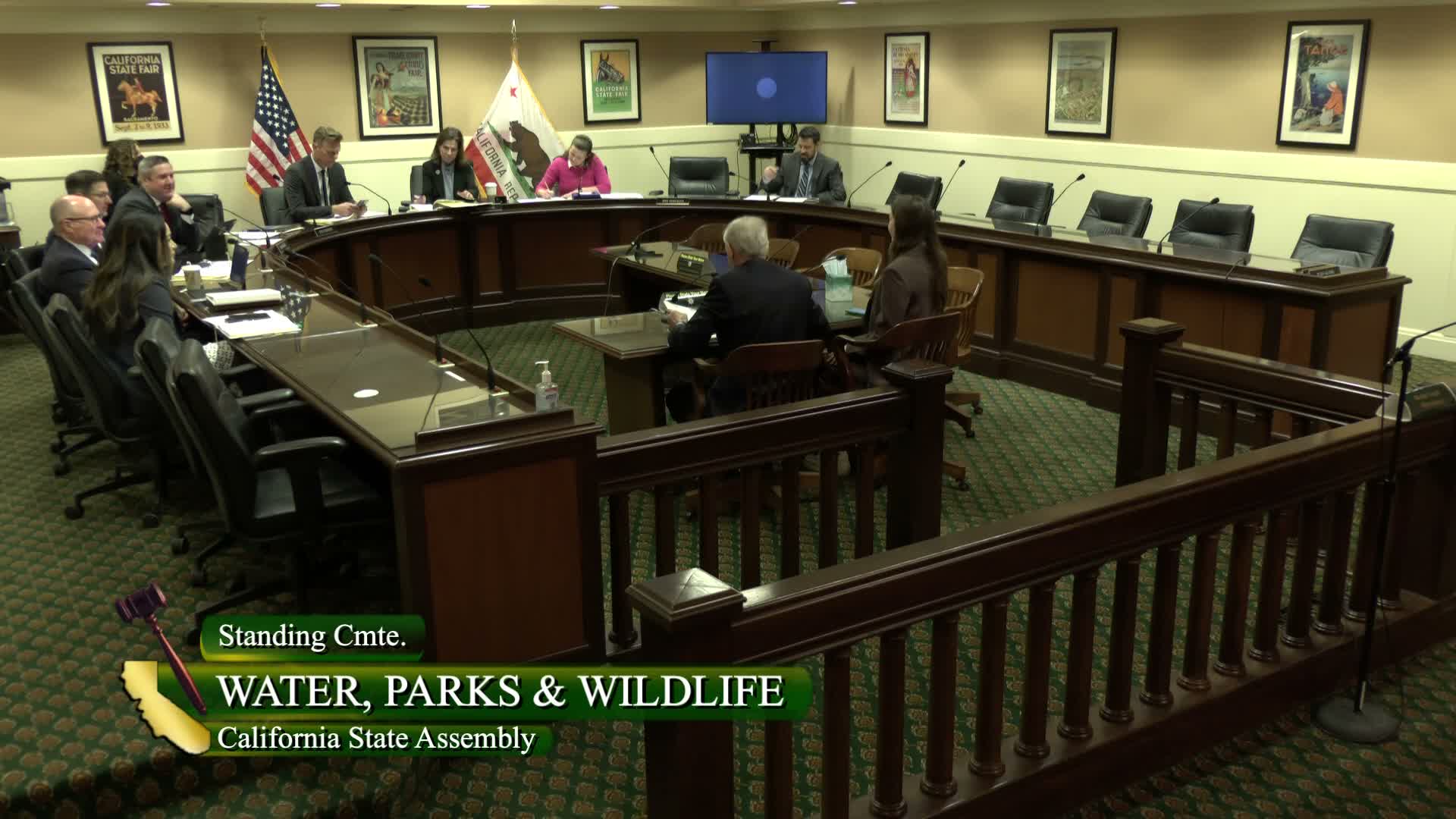
A California State Assembly committee on March 25 advanced a bundle of bills on conservation, public safety and water regulation while debating how to balance regulatory agility and public accountability.
Assemblymember Ramos opened the hearing on AB 15 92, which would authorize the Department of Parks and Recreation to enter into a governance agreement with a California Indian Heritage Center support organization. Tribal chairwoman Erica Pinto testified in strong support, saying the center "represents a commitment by the state to honor the truth of our history and to celebrate the living cultures of more than 100 native nations" and called the center "long overdue." Pinto and the bill's supporters noted the state previously appropriated $100,000,000 for the project (2018) and that a 43‑acre land transfer has been pledged by the city of West Sacramento; she said AB 15 92 would not appropriate new state funds but would create a partnership and governance framework to unlock private fundraising.
The committee next advanced AB 22 16 to expand the Sacramento–San Joaquin Delta Conservancy’s service area and fundable project types. Michael Jayer of the Nature Conservancy told members the change would allow larger watershed‑scale projects, support wildfire‑resilience work and permit advance payments and indirect‑cost coverage for tribal and underserved grantees. The measure moved out of committee on an 11–1 vote.
Members also approved AB 17 02, which would expand eligibility for the distinguished veterans pass and create a discounted State Parks pass for veterans, reservists and active‑duty service members. Assemblymember Johnson said the change would remove service‑period restrictions that now exclude some disabled veterans from existing passes.
The committee spent the most time on AB 26 30, a proposal to grant the State Water Resources Control Board limited emergency regulatory authority over measurement and reporting rules for water diversions to enable quick, technical fixes to the CalWaters platform. Proponents, including Catherine Van Dyke of the Community Alliance with Family Farmers, said the board needs agility to address software and technical issues and to improve timeliness and accuracy of data used for drought and groundwater decisions. Van Dyke testified the change would "support the ability to gather accurate and timely data which is greatly needed to deal with drought conditions and make informed groundwater recharge decisions."
Opponents — including Julia Hall of the Association of California Water Agencies, Alex Bering of the California Farm Bureau and representatives of the Chamber of Commerce and municipal utilities groups — warned the measure would let the board make midseason changes that could force farmers to install new meters or change measurement methods without sufficient stakeholder input. "We do have significant concerns with this bill's lack of public input and state level oversight," Hall said, arguing that the emergency authority granted in 2015 produced regulations that were later found to have clarity problems and that relying on recurring emergency readoptions could produce poor compliance outcomes.
In committee debate lawmakers pressed for safeguards. The author accepted a five‑year sunset amendment intended to limit the authority's duration and said the committee process would remain open for further changes. Assemblymember Bennett summarized the tradeoff: the bill is intended to "streamline some things so we can get some things done" while remaining open to stakeholder refinements.
After discussion, the committee moved AB 26 30 as amended (five‑year sunset) to the next committee on an 8–4 vote.
Other bills advanced on largely bipartisan margins. AB 16 73, which allows counties to use certain Fish and Game Code violation revenues to reimburse county sheriffs or fund wildlife‑conflict prevention, was supported by Sierra County Sheriff Mike Fisher and moved out of committee. AB 19 12, which would allow concealed firearms for archery deer hunters (aligning statute with regulations already in place for other big‑game seasons), drew testimony from retired game warden David Bass and hunting‑conservation groups and was advanced. AB 19 87 would dedicate hunting fee and certain ag lease revenues to state wildlife areas that generate them; conservation groups urged support, and it was approved to move forward.
Votes at a glance (committee recommendation and committee roll‑call totals announced at adjournment): AB 15 92 — do pass as amended to appropriations (12–0); AB 16 73 — do pass as amended to appropriations (12–0); AB 17 02 — do pass to Military and Veterans Affairs (12–0); AB 18 04 — consent calendar (12–0); AB 19 12 — do pass as amended to Public Safety (12–0); AB 19 87 — do pass as amended to Appropriations (12–0); AB 22 16 — do pass to Natural Resources (11–1); AB 22 60 — consent (12–0); AB 26 30 — do pass as amended to Natural Resources (8–4).
The committee adjourned after handling the consent calendar; several members said they expect continued stakeholder conversations on AB 26 30 as the bill proceeds.
Assemblymember Ramos opened the hearing on AB 15 92, which would authorize the Department of Parks and Recreation to enter into a governance agreement with a California Indian Heritage Center support organization. Tribal chairwoman Erica Pinto testified in strong support, saying the center "represents a commitment by the state to honor the truth of our history and to celebrate the living cultures of more than 100 native nations" and called the center "long overdue." Pinto and the bill's supporters noted the state previously appropriated $100,000,000 for the project (2018) and that a 43‑acre land transfer has been pledged by the city of West Sacramento; she said AB 15 92 would not appropriate new state funds but would create a partnership and governance framework to unlock private fundraising.
The committee next advanced AB 22 16 to expand the Sacramento–San Joaquin Delta Conservancy’s service area and fundable project types. Michael Jayer of the Nature Conservancy told members the change would allow larger watershed‑scale projects, support wildfire‑resilience work and permit advance payments and indirect‑cost coverage for tribal and underserved grantees. The measure moved out of committee on an 11–1 vote.
Members also approved AB 17 02, which would expand eligibility for the distinguished veterans pass and create a discounted State Parks pass for veterans, reservists and active‑duty service members. Assemblymember Johnson said the change would remove service‑period restrictions that now exclude some disabled veterans from existing passes.
The committee spent the most time on AB 26 30, a proposal to grant the State Water Resources Control Board limited emergency regulatory authority over measurement and reporting rules for water diversions to enable quick, technical fixes to the CalWaters platform. Proponents, including Catherine Van Dyke of the Community Alliance with Family Farmers, said the board needs agility to address software and technical issues and to improve timeliness and accuracy of data used for drought and groundwater decisions. Van Dyke testified the change would "support the ability to gather accurate and timely data which is greatly needed to deal with drought conditions and make informed groundwater recharge decisions."
Opponents — including Julia Hall of the Association of California Water Agencies, Alex Bering of the California Farm Bureau and representatives of the Chamber of Commerce and municipal utilities groups — warned the measure would let the board make midseason changes that could force farmers to install new meters or change measurement methods without sufficient stakeholder input. "We do have significant concerns with this bill's lack of public input and state level oversight," Hall said, arguing that the emergency authority granted in 2015 produced regulations that were later found to have clarity problems and that relying on recurring emergency readoptions could produce poor compliance outcomes.
In committee debate lawmakers pressed for safeguards. The author accepted a five‑year sunset amendment intended to limit the authority's duration and said the committee process would remain open for further changes. Assemblymember Bennett summarized the tradeoff: the bill is intended to "streamline some things so we can get some things done" while remaining open to stakeholder refinements.
After discussion, the committee moved AB 26 30 as amended (five‑year sunset) to the next committee on an 8–4 vote.
Other bills advanced on largely bipartisan margins. AB 16 73, which allows counties to use certain Fish and Game Code violation revenues to reimburse county sheriffs or fund wildlife‑conflict prevention, was supported by Sierra County Sheriff Mike Fisher and moved out of committee. AB 19 12, which would allow concealed firearms for archery deer hunters (aligning statute with regulations already in place for other big‑game seasons), drew testimony from retired game warden David Bass and hunting‑conservation groups and was advanced. AB 19 87 would dedicate hunting fee and certain ag lease revenues to state wildlife areas that generate them; conservation groups urged support, and it was approved to move forward.
Votes at a glance (committee recommendation and committee roll‑call totals announced at adjournment): AB 15 92 — do pass as amended to appropriations (12–0); AB 16 73 — do pass as amended to appropriations (12–0); AB 17 02 — do pass to Military and Veterans Affairs (12–0); AB 18 04 — consent calendar (12–0); AB 19 12 — do pass as amended to Public Safety (12–0); AB 19 87 — do pass as amended to Appropriations (12–0); AB 22 16 — do pass to Natural Resources (11–1); AB 22 60 — consent (12–0); AB 26 30 — do pass as amended to Natural Resources (8–4).
The committee adjourned after handling the consent calendar; several members said they expect continued stakeholder conversations on AB 26 30 as the bill proceeds.
View the Full Meeting & All Its Details
This article offers just a summary. Unlock complete video, transcripts, and insights as a Founder Member.
✓
Watch full, unedited meeting videos
✓
Search every word spoken in unlimited transcripts
✓
AI summaries & real-time alerts (all government levels)
✓
Permanent access to expanding government content
30-day money-back guarantee
