Assembly committee advances bill to change management objectives for demonstration state forests
March 23, 2026 | California State Assembly, House, Legislative, California
This article was created by AI summarizing key points discussed. AI makes mistakes, so for full details and context, please refer to the video of the full meeting. Please report any errors so we can fix them. Report an error »
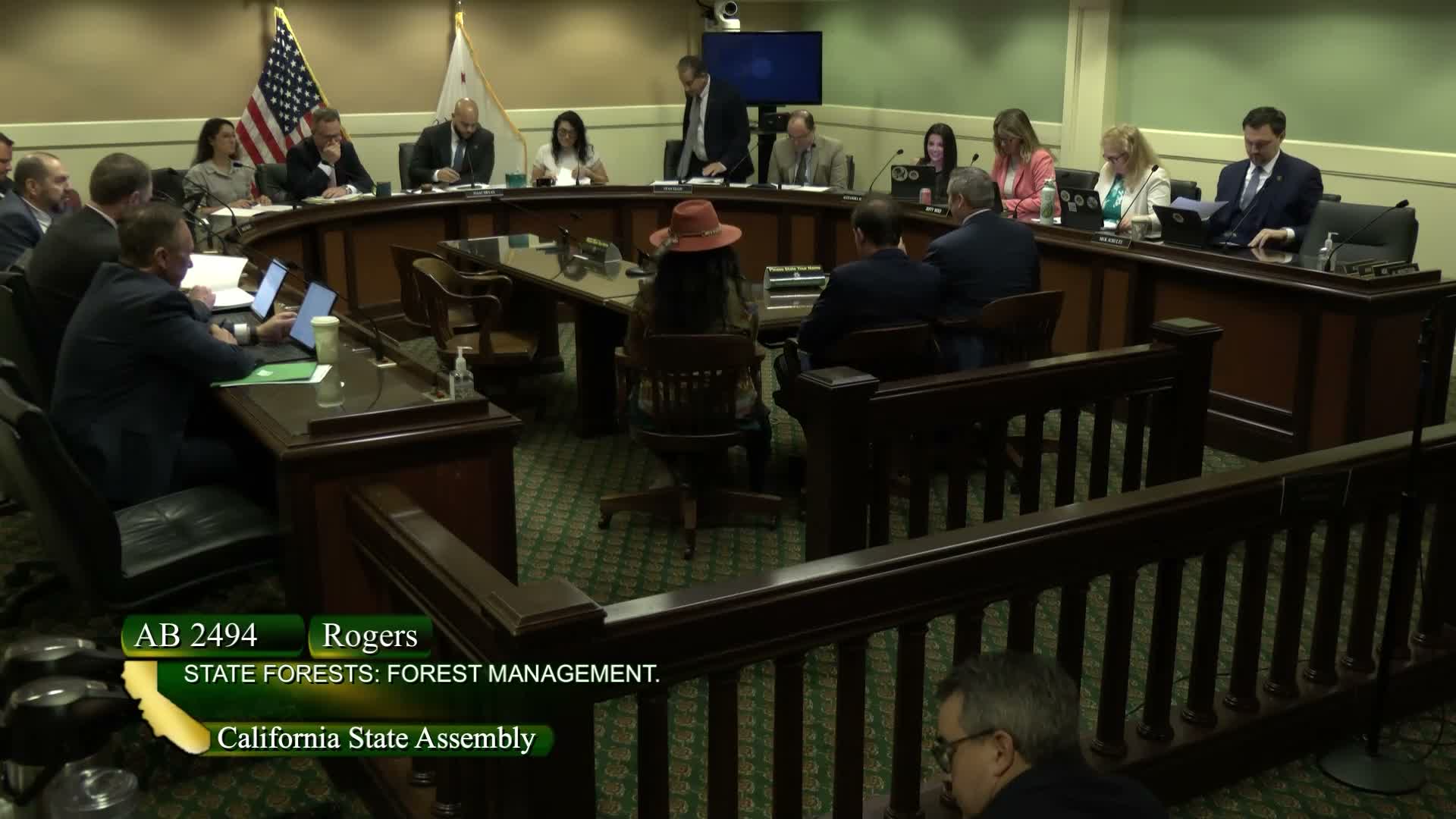
Assemblymember Rogers presented AB 24 94 to the Assembly Natural Resources Committee, saying the bill would replace the long-standing mandate that California's demonstration state forests prioritize maximum sustained timber production with a broader management framework emphasizing biodiversity conservation, carbon sequestration, wildfire resiliency, recreation and research. "We're not saying don't cut trees," the author said; "we are saying the projects need to better reflect the science of what we're trying to achieve globally as a state." (Assemblymember Rogers)
Supporters described local and tribal reasons for the change. Buffy Campbell, executive director of the Intertribal Sinkingo Wilderness Council, told the panel that the Jackson Demonstration State Forest (JDSF) is ancestral Pomo land and urged statutory recognition of tribal co-governance and stronger protection for cultural resources. "By providing meaningful, committed tribal co-governance and stewardship and integrating indigenous tribal ecological knowledge, sustained forest health and ecosystems will be realized once again," Campbell said. Ted Williams, Mendocino County supervisor, said the county's economy needs diversified opportunities and argued the bill could support ecotourism and research jobs in his district.
Industry witnesses urged caution. Peter Ansell of the California Farm Bureau and Matt Diaz of the California Forestry Association said the bill narrows the forests' mission away from sustained timber production, risks long-term funding instability, and could reduce tools used to lower wildfire risk. Ansell warned that "this bill fundamentally shifts that mission" and that treating carbon only as standing trees may overlook the carbon life cycle of wood products. Diaz said shifting dedicated funding streams could jeopardize the demonstration forest system's fiscal sustainability.
Committee members pressed the author and witnesses on key technical issues: whether old-growth remnants are protected (witnesses said management plans prohibit harvesting old growth), how existing research projects would be affected (witnesses said research remains allowed), and whether funding should be piloted at Jackson before a statewide change. The author emphasized that the proposal would not eliminate timber harvest but would change priorities and funding mechanisms to decouple harvest revenue from management decisions.
After extended questioning and public testimony, the committee moved the bill and recorded a roll call. The motion to refer AB 24 94 as amended to the appropriations committee passed on a recorded vote. Next steps: the bill proceeds to the Assembly Appropriations Committee for fiscal review and further amendment.
Ending: The committee's action advances a bill that seeks to reframe how publicly managed demonstration forests are used and funded in California; proponents say it will codify tribal co-management and prioritize restoration and research, while opponents warn of unintended funding and wildfire-management consequences. The measure will face more detailed fiscal and policy review in appropriations.
Supporters described local and tribal reasons for the change. Buffy Campbell, executive director of the Intertribal Sinkingo Wilderness Council, told the panel that the Jackson Demonstration State Forest (JDSF) is ancestral Pomo land and urged statutory recognition of tribal co-governance and stronger protection for cultural resources. "By providing meaningful, committed tribal co-governance and stewardship and integrating indigenous tribal ecological knowledge, sustained forest health and ecosystems will be realized once again," Campbell said. Ted Williams, Mendocino County supervisor, said the county's economy needs diversified opportunities and argued the bill could support ecotourism and research jobs in his district.
Industry witnesses urged caution. Peter Ansell of the California Farm Bureau and Matt Diaz of the California Forestry Association said the bill narrows the forests' mission away from sustained timber production, risks long-term funding instability, and could reduce tools used to lower wildfire risk. Ansell warned that "this bill fundamentally shifts that mission" and that treating carbon only as standing trees may overlook the carbon life cycle of wood products. Diaz said shifting dedicated funding streams could jeopardize the demonstration forest system's fiscal sustainability.
Committee members pressed the author and witnesses on key technical issues: whether old-growth remnants are protected (witnesses said management plans prohibit harvesting old growth), how existing research projects would be affected (witnesses said research remains allowed), and whether funding should be piloted at Jackson before a statewide change. The author emphasized that the proposal would not eliminate timber harvest but would change priorities and funding mechanisms to decouple harvest revenue from management decisions.
After extended questioning and public testimony, the committee moved the bill and recorded a roll call. The motion to refer AB 24 94 as amended to the appropriations committee passed on a recorded vote. Next steps: the bill proceeds to the Assembly Appropriations Committee for fiscal review and further amendment.
Ending: The committee's action advances a bill that seeks to reframe how publicly managed demonstration forests are used and funded in California; proponents say it will codify tribal co-management and prioritize restoration and research, while opponents warn of unintended funding and wildfire-management consequences. The measure will face more detailed fiscal and policy review in appropriations.
Don't Miss a Word: See the Full Meeting!
Go beyond summaries. Unlock every video, transcript, and key insight with a Founder Membership.
✓
Get instant access to full meeting videos
✓
Search and clip any phrase from complete transcripts
✓
Receive AI-powered summaries & custom alerts
✓
Enjoy lifetime, unrestricted access to government data
30-day money-back guarantee
